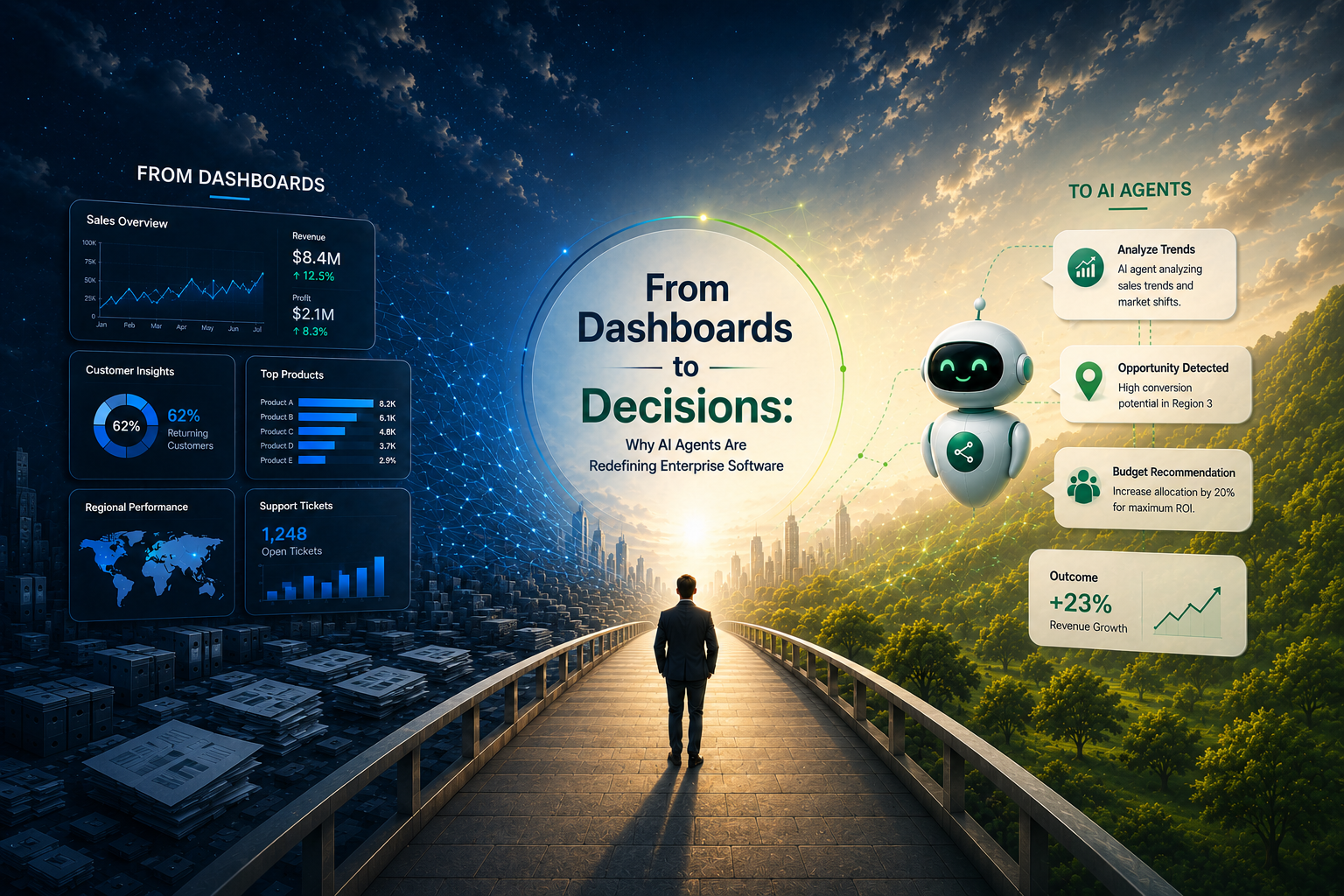
Dashboards to Decisions: Why AI Agents Are Redefining Enterprise Software
 Purva Wankhade,
3 months ago
5 min read
Purva Wankhade,
3 months ago
5 min read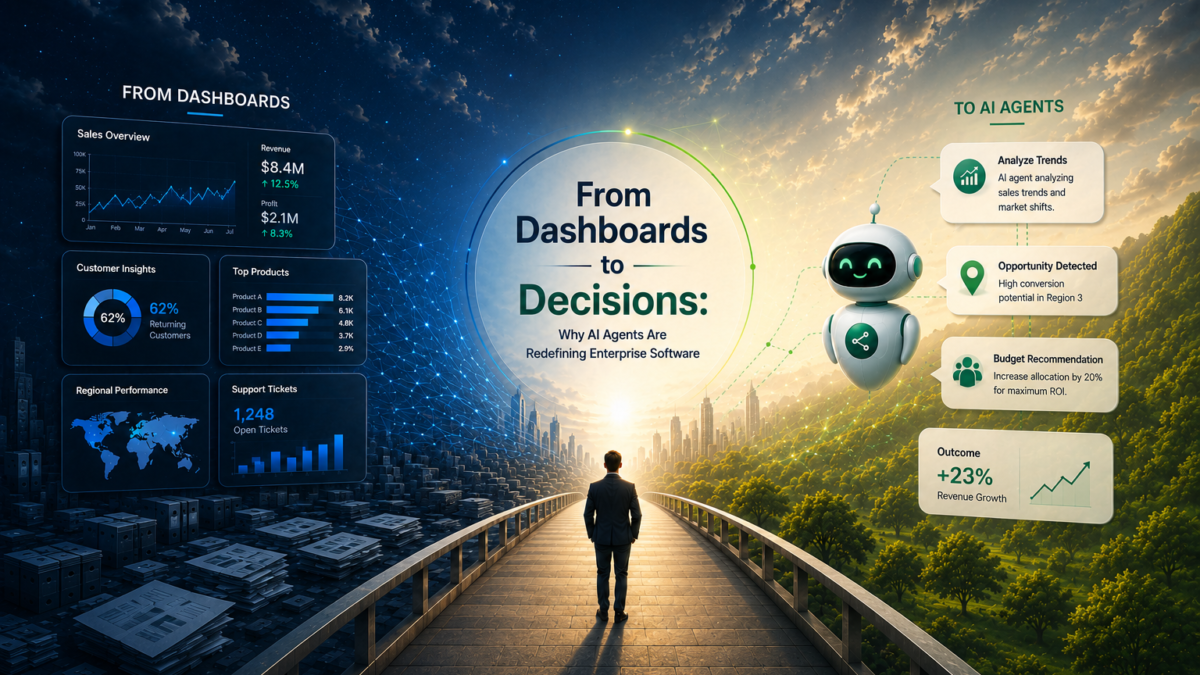
Enterprise software has spent decades perfecting one thing: presenting data. Dashboards became more sophisticated, reports became more interactive, and analytics grew increasingly detailed. Yet despite these advances, many business leaders still face the same challenge every morning, deciding what to do with all that information.
In 2026, that paradigm is changing. Businesses no longer want software that simply displays metrics; they want platforms that interpret information, recommend actions, and automate execution. This shift is fueling the rapid rise of the AI Agent, transforming enterprise software from passive systems of record into active systems of intelligence.
Recent developments across the technology industry reinforce this direction. Leading enterprise software vendors including Microsoft, Salesforce, SAP, Oracle, ServiceNow, and Google Cloud continue expanding agentic AI capabilities within their platforms. Instead of functioning as standalone assistants, AI-powered agents are becoming embedded across customer service, finance, HR, procurement, cybersecurity, and operations, helping organizations make faster and more informed decisions.
For B2B decision makers, this evolution is not simply another software upgrade. It represents a fundamental change in how enterprise technology creates business value.
Enterprise Software Is Moving Beyond Static Dashboards
Traditional dashboards have long been the foundation of enterprise decision-making. They collect data from multiple sources, organize key performance indicators, and provide executives with visibility into business operations. While dashboards remain valuable, they depend heavily on human interpretation. Teams still spend valuable time reviewing reports, identifying anomalies, discussing possible actions, and assigning responsibilities before any meaningful progress occurs.
Modern AI Agent technology is reducing this delay by continuously analyzing business data and transforming insights into recommendations or automated workflows. Rather than waiting for employees to identify declining sales performance, delayed supplier deliveries, rising operational costs, or customer churn risks, intelligent agents proactively detect patterns and surface the next best action.
This shift is particularly important as organizations generate more data than ever before. Cloud platforms, ERP systems, CRM platforms, collaboration tools, IoT devices, and digital commerce applications continuously produce massive volumes of information. Human teams cannot realistically monitor every metric in real time, but an AI Agent can evaluate thousands of signals simultaneously while highlighting the insights that matter most.
The result is faster decision-making, improved operational efficiency, and reduced dependence on manual analysis.
AI Agents Are Becoming Enterprise Decision Partners
One of the biggest misconceptions surrounding artificial intelligence is that it exists solely to automate repetitive tasks. The latest generation of enterprise AI demonstrates something far more valuable.
An AI Agent can monitor procurement activity, identify supply chain disruptions, recommend inventory adjustments, summarize executive reports, prioritize customer opportunities, detect financial anomalies, and coordinate workflows across multiple business systems. Rather than replacing employees, these intelligent agents augment decision-making by providing context, predictive insights, and actionable recommendations.
Recent investments across enterprise software reflect this transition. Agentic AI has become a central focus for major technology providers as businesses seek software capable of reasoning, planning, and executing tasks with minimal human intervention. Organizations are increasingly experimenting with networks of specialized AI agents that collaborate across departments instead of relying on isolated automation tools.
For B2B enterprises managing complex operations, this capability delivers measurable advantages. Sales teams receive opportunity recommendations based on buyer intent. Finance departments gain proactive cash-flow forecasting. HR leaders identify workforce trends before they become retention issues. Customer service organizations resolve cases faster by combining historical interactions with real-time business data.
The value no longer lies in generating more reports. It lies in helping people make better decisions at the moment they matter most.
The Future Belongs to Software That Acts, Not Just Reports
Enterprise software is entering an entirely new phase where intelligence becomes an active participant in daily business operations. Instead of serving as repositories for historical information, platforms are becoming collaborative environments where AI continuously supports business outcomes.
As organizations continue investing in digital transformation, several trends are accelerating this evolution. The growing adoption of large language models, enterprise knowledge graphs, retrieval-augmented generation, API-first architectures, and multi-agent orchestration is enabling software platforms to connect previously isolated business functions. At the same time, businesses are placing greater emphasis on governance, security, and responsible AI deployment to ensure intelligent systems operate transparently and reliably.
The modern AI Agent thrives within this environment. It can interpret enterprise policies, access approved business knowledge, interact with multiple applications, and coordinate complex workflows while maintaining compliance requirements. This creates opportunities for organizations to simplify operations without sacrificing visibility or control.
Looking ahead, enterprise applications will increasingly shift from answering questions to completing work. Executives may no longer need to ask why revenue declined or which supplier caused production delays. Instead, intelligent agents will identify the issue, explain the underlying cause, recommend corrective actions, and initiate approved workflows automatically.
For B2B decision makers, this represents a significant competitive advantage. Faster decisions lead to quicker execution, more efficient operations, and stronger customer experiences. Organizations that adopt intelligent enterprise software today will be better positioned to respond to market changes tomorrow.
The future of enterprise technology is no longer defined by the quality of its dashboards alone. It will be defined by how effectively software helps businesses think, decide, and act. As AI Agent capabilities continue evolving across enterprise platforms, the most valuable software will not simply report what has happened. It will help shape what happens next.