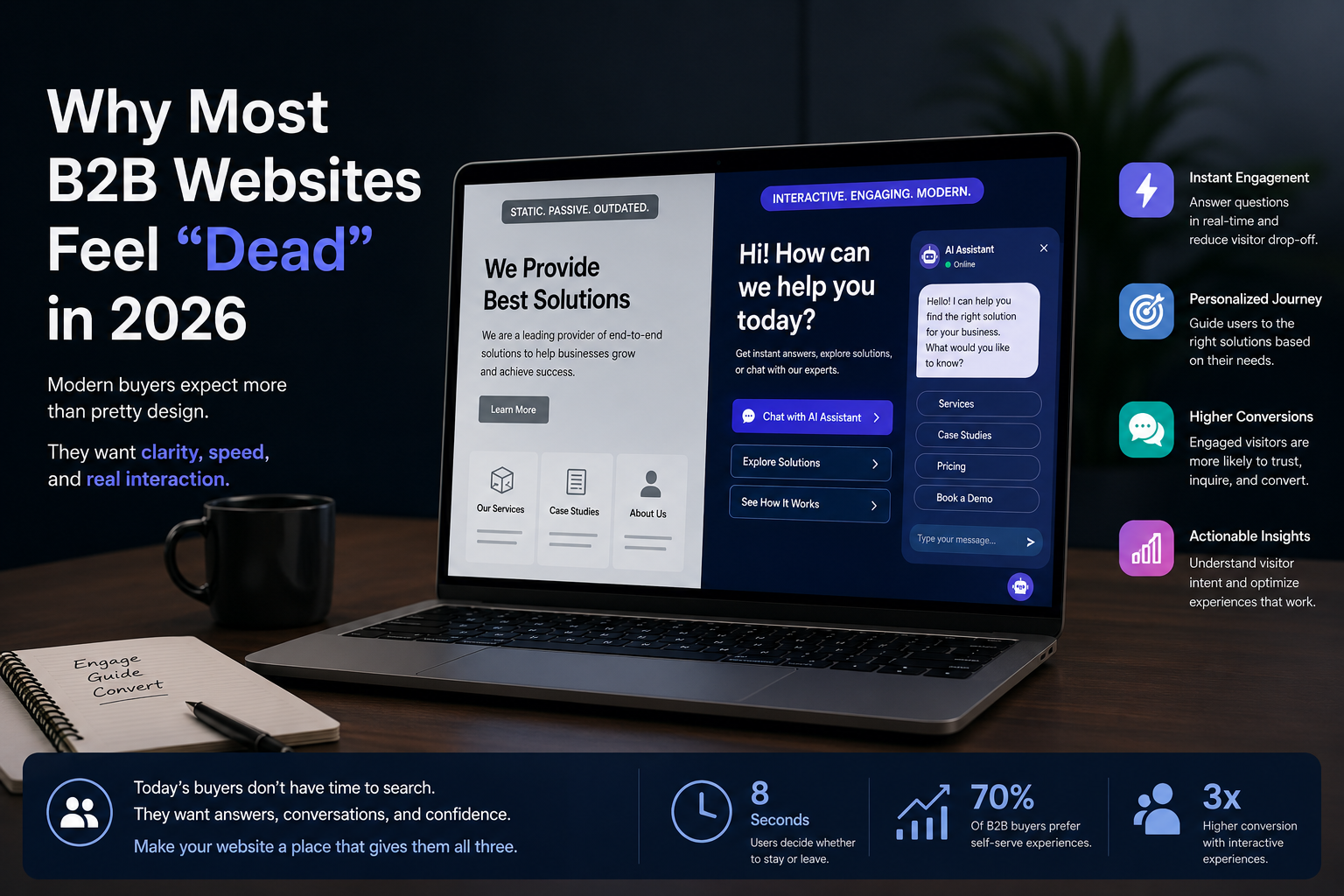
The Problem Most Businesses Don’t Notice
You visit a B2B websites.
It looks polished.
Professional branding.
Smooth animations.
Modern UI.
But within seconds, you leave.
Not because the company looked bad.
Not because the service was irrelevant.
The website just felt… empty.
This is becoming one of the biggest hidden problems in modern B2B marketing. Most websites still behave like digital brochures in an internet built entirely around interaction.
And buyers are noticing it faster than ever.
The Internet Changed Faster Than Most Websites
A few years ago, businesses could get away with static websites packed with corporate messaging, long paragraphs, and generic “Book a Demo” buttons. Buyers were willing to spend time exploring websites slowly.
That behavior is disappearing rapidly.
Today’s internet has completely changed user expectations. Platforms like TikTok, Netflix, Instagram, Amazon, and Spotify have trained people to expect instant engagement everywhere online. Every app responds immediately. Every platform adapts dynamically. Every experience feels interactive.
Then users land on most B2B websites and suddenly everything feels frozen in time.
The experience becomes passive.
Why Attention Disappears So Quickly
Modern buyers no longer “study” websites carefully. They scan aggressively for relevance within seconds. They subconsciously ask themselves:
Does this company understand what I need?
Can I get clarity quickly?
Does this feel modern or outdated?
And most importantly:
Should I continue paying attention?
That last question is becoming the biggest challenge in digital marketing today.
Attention spans are shrinking, but it’s not because people suddenly became incapable of focusing. It’s because the internet has become extremely efficient at filtering irrelevant experiences.
Buyers are overwhelmed with information, ads, outreach, notifications, and AI-generated content every single day. Their brains are constantly deciding what deserves attention and what does not.
Why Most B2B Websites Feel Identical
The problem gets worse because almost every B2B websites sounds identical now.
Every homepage promises:
- “Innovation”
- “Digital transformation”
- “End-to-end solutions”
- “Scalable growth”
The language feels polished but emotionally empty.
AI-generated copy has amplified this problem dramatically. Businesses are publishing more content than ever before, but much of it feels interchangeable.
As a result, buyers are becoming harder to impress.
Ironically, this is making simplicity more powerful again.
The Rise of Conversational Website Experiences
The websites performing best in 2026 are often not the loudest or the most visually complex. They simply feel easier to engage with.
They create clarity quickly.
They guide users naturally.
They reduce friction instead of overwhelming visitors with information.
This is why conversational website experiences are growing rapidly.
Businesses are beginning to realize that users do not always want another form or another static landing page. They want responsiveness. They want answers instantly. They want guidance without digging through endless menus.
The shift toward AI chat interfaces, interactive onboarding, and conversational engagement reflects a much deeper behavioral change happening online.
People now expect websites to respond.
The Hidden Cost of “Silent” Websites
One of the most overlooked realities in B2B marketing today is that many companies are losing potential customers long before any sales conversation even begins.
A visitor may arrive with genuine interest, but confusion, friction, slow navigation, or passive experiences quietly kill momentum before trust can build.
That’s why modern websites are increasingly becoming active sales environments instead of static information hubs.
Because in many cases, conversion is not about traffic.
It is about engagement.
What the Future of B2B Websites Looks Like
In many ways, the future of B2B websites is not about adding more information.
It is about creating better interaction.
The businesses winning online today are usually the ones making experiences:
- Faster
- Clearer
- More responsive
- More conversational
- Easier to navigate
Because in 2026, attention is expensive.
And the companies that know how to hold it will always have the advantage.