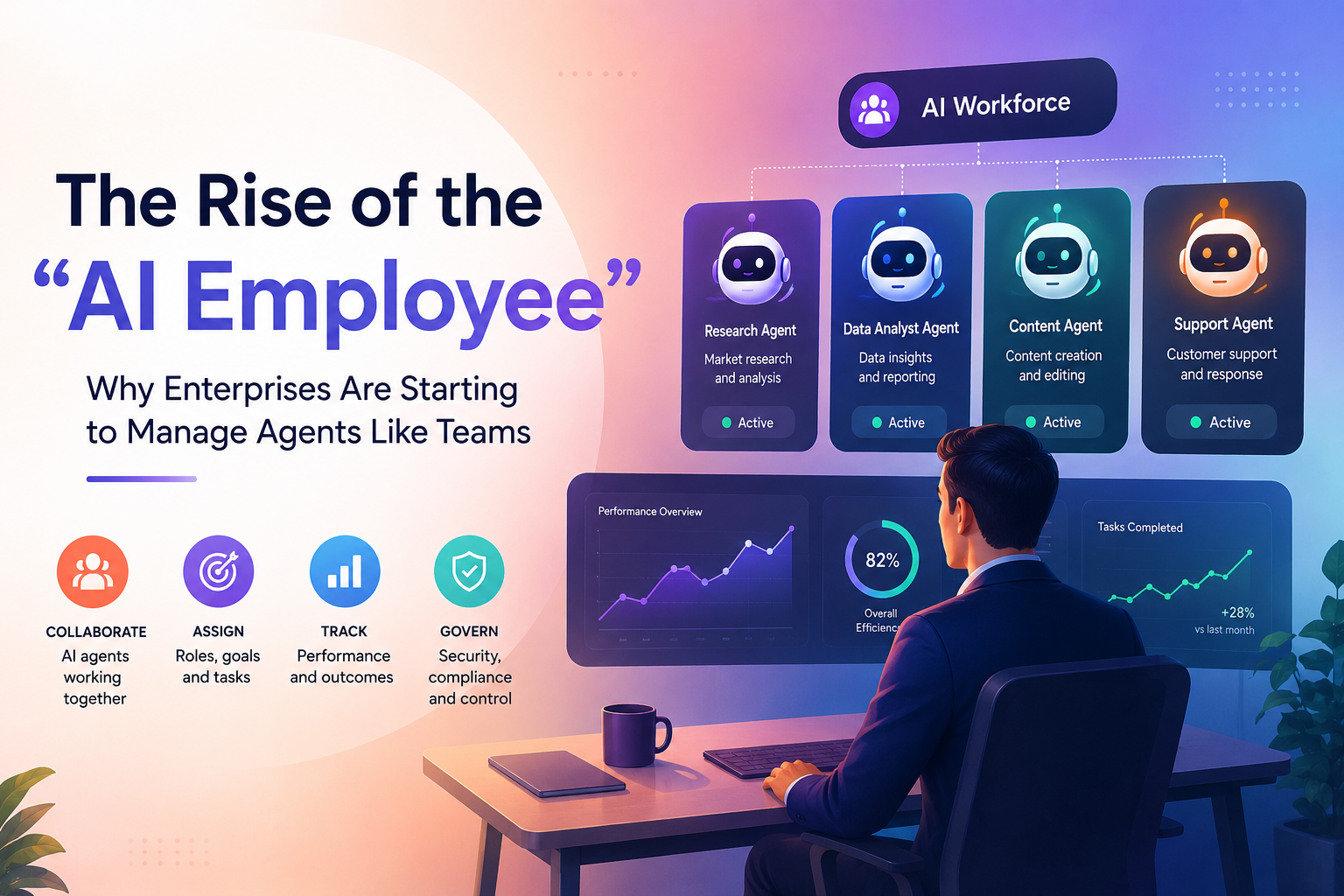
The Rise of the “AI Employee”: Why Enterprises Are Starting to Manage Agents Like Teams
 Purva Wankhade,
3 months ago
5 min read
Purva Wankhade,
3 months ago
5 min read
The conversation around artificial intelligence has changed dramatically over the past year. Not long ago, organizations were focused on how AI could help employees work faster by generating emails, summarizing meetings, or creating content. Today, the discussion has shifted toward something much bigger: what happens when an AI Agent doesn’t just assist people—but starts completing work independently.
Across industries, enterprises are experimenting with AI systems that can analyze information, make decisions within predefined boundaries, collaborate with other software, and execute multi-step business processes with minimal human intervention. Instead of being treated as another productivity tool, these systems are increasingly being viewed as digital teammates.
This shift is giving rise to an entirely new management challenge. If organizations are going to deploy hundreds—or even thousands—of AI-powered agents across departments, they’ll need to think less like software administrators and more like team managers.
From AI Assistant to AI Employee
The evolution is happening faster than many expected.
The first generation of enterprise AI focused on helping humans complete individual tasks. The new generation of AI Agent technology is designed around objectives rather than prompts. Instead of asking an AI to write an email, businesses can assign it a broader responsibility such as qualifying leads, monitoring cybersecurity events, processing invoices, managing procurement requests, or coordinating customer support workflows.
This distinction is subtle but transformative.
An assistant waits for instructions. An agent pursues outcomes.
Major technology companies have accelerated this transition by introducing agentic AI capabilities into enterprise platforms. From productivity suites and CRM systems to developer tools and cloud infrastructure, vendors are racing to build AI that can reason across multiple applications instead of operating within a single interface. Rather than simply responding to user requests, these systems can retrieve data, trigger workflows, consult internal knowledge bases, and collaborate with other agents to accomplish complex business goals.
For enterprise leaders, this represents more than another software upgrade. It signals a fundamental change in how work itself is organized.
Why Businesses Are Starting to Think Like AI Managers
Every enterprise eventually develops management systems for people. Teams have job descriptions, performance metrics, reporting structures, security permissions, onboarding processes, and compliance guidelines.
As organizations deploy larger numbers of AI agents, those same concepts are beginning to apply to digital workers.
Forward-looking enterprises are asking questions that would have sounded unusual only a year ago. Which AI Agent should own customer onboarding? Which agent has permission to access financial records? How should one agent communicate with another? Who approves an agent’s decisions before they reach customers? When should an employee intervene?
These aren’t technical questions alone—they’re operational ones.
This is why governance has become one of the defining themes of enterprise AI adoption in 2026. Businesses are recognizing that the value of AI isn’t determined solely by model quality. It depends on whether organizations can deploy intelligent systems responsibly, securely, and at scale. As organizations evaluate these capabilities, educational resources such as fintech whitepapers are playing an increasingly important role in helping decision-makers understand AI governance frameworks, compliance requirements, and best practices before making technology investments.
Instead of measuring success by the number of AI tools purchased, executives are beginning to evaluate how effectively AI agents fit into existing business processes, accountability structures, and compliance requirements.
The organizations seeing the strongest outcomes aren’t replacing entire departments with AI. They’re redesigning workflows where people and AI each contribute what they do best.
The New Enterprise Org Chart Includes Digital Workers
One of the most fascinating developments is that enterprises are beginning to map AI into organizational structures.
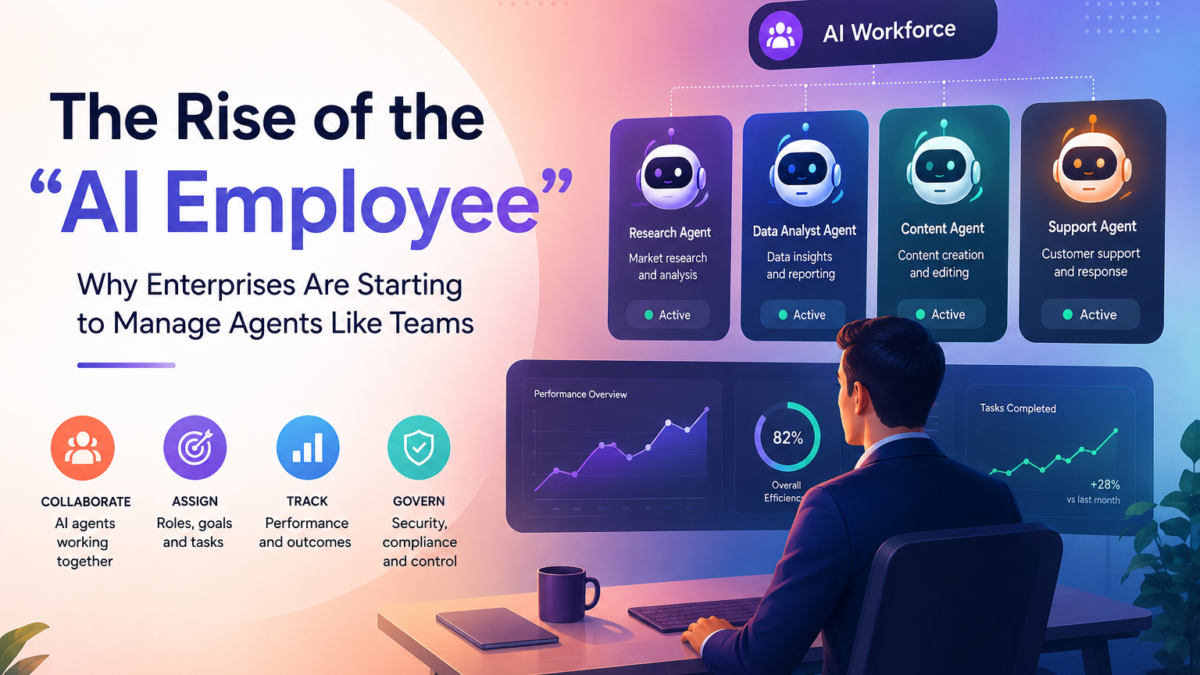
Imagine a customer support operation where one AI Agent handles ticket classification, another retrieves policy information, a third drafts personalized responses, while a human supervisor reviews only high-risk conversations. Or consider finance teams where agents reconcile invoices, identify anomalies, prepare reports, and notify analysts only when exceptions require judgment.
In these scenarios, AI isn’t replacing employees—it becomes part of the operating model.
This also changes leadership responsibilities.
Managers may soon oversee hybrid teams consisting of people, software applications, and autonomous AI agents working together toward shared business objectives. Performance reviews could evolve beyond employee KPIs to include agent accuracy, execution speed, cost savings, and governance compliance.
In many ways, enterprises are discovering that scaling AI requires the same disciplines that have always been essential for scaling people: clear responsibilities, measurable outcomes, continuous monitoring, and thoughtful oversight.
The difference is that digital workers never sleep, can be replicated instantly, and continuously improve through updated models and business rules.
That introduces tremendous opportunity—but also new operational complexity.
Organizations will increasingly need visibility into how AI agents make decisions, interact with enterprise systems, and collaborate with one another. Transparency, auditability, and explainability are becoming strategic requirements rather than technical nice-to-haves, particularly in highly regulated industries where accountability cannot be delegated entirely to automation.
Success Will Depend Less on AI Models—and More on AI Management
The enterprise AI conversation is entering its next phase.
Competitive advantage is no longer determined simply by who has access to the most advanced language model. Those capabilities are becoming increasingly accessible across the market. The differentiator is shifting toward how effectively organizations orchestrate multiple AI agents across business functions while maintaining governance, security, and human oversight.
In many ways, we’re witnessing the emergence of a new management discipline.
Just as cloud computing created the need for cloud architecture and cybersecurity created dedicated security operations, agentic AI is creating demand for organizations that know how to supervise, coordinate, and continuously optimize intelligent digital workers.
For B2B decision makers, this changes the strategic question. Instead of asking, “Where can we use AI?” the more valuable question becomes, “How should AI become part of our workforce?”
That mindset moves the conversation beyond experimentation toward long-term operational transformation.
The enterprises that succeed won’t necessarily deploy the highest number of AI agents. They’ll be the ones that build environments where human expertise and autonomous intelligence complement each other, creating systems that are more adaptive, more efficient, and better equipped to handle the growing complexity of modern business.
The rise of the AI Agent is not simply another technology trend. It’s the beginning of a new chapter in enterprise operations—one where managing digital teammates may become just as important as managing human ones