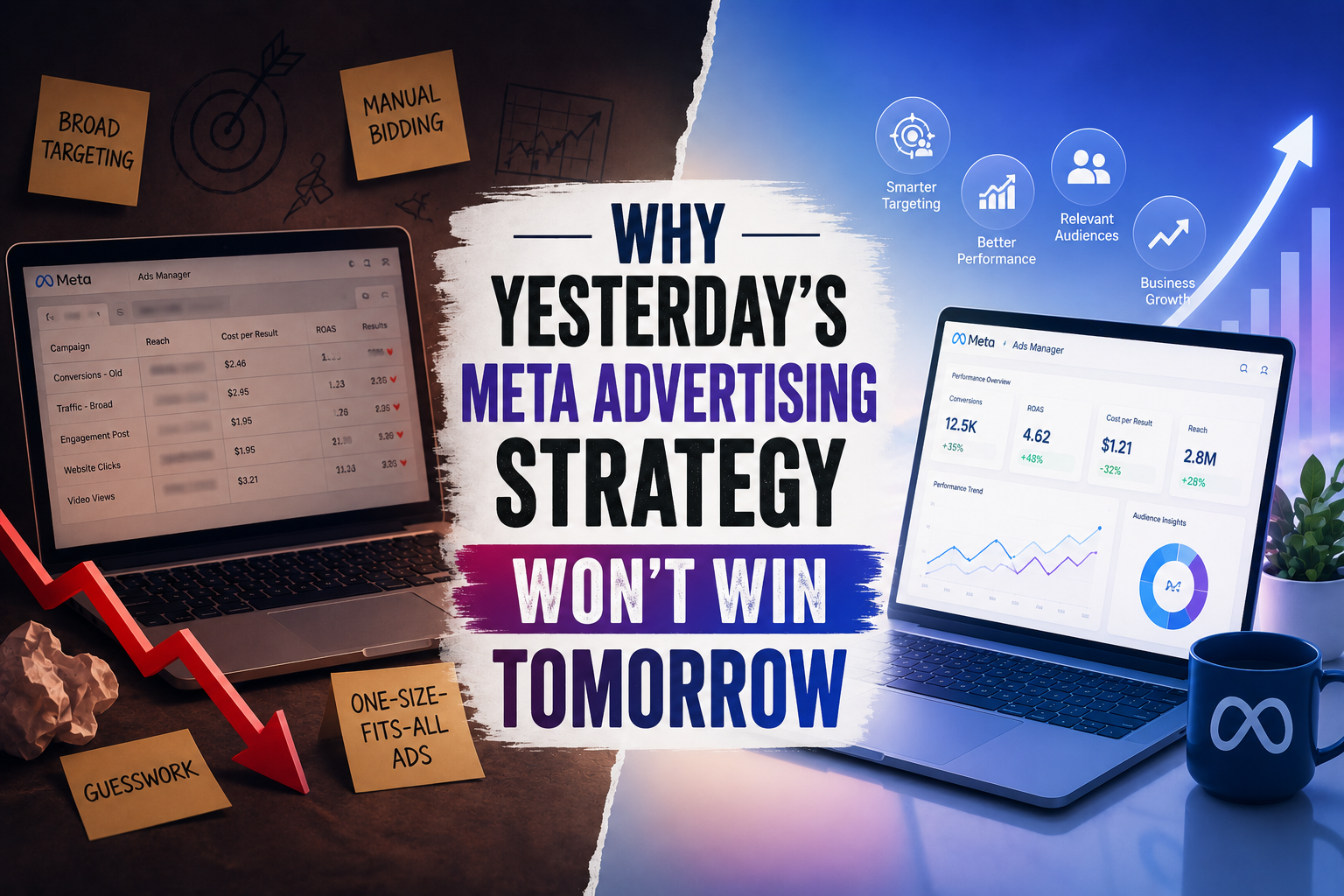
Why Yesterday’s Meta Advertising Strategy Won’t Win Tomorrow
 Purva Wankhade,
2 months ago
5 min read
Purva Wankhade,
2 months ago
5 min read
For more than a decade, success in digital advertising often depended on how precisely marketers could define their audiences. Campaigns were built around carefully selected interests, demographic filters, lookalike audiences, and countless manual adjustments designed to improve performance over time. The more control advertisers had, the better they believed the outcomes would be.
That philosophy is rapidly evolving.
Today, Meta Advertising is entering an era where artificial intelligence is becoming the primary decision-maker behind campaign optimization. Rather than asking marketers to manually determine every audience segment or creative variation, Meta’s AI-powered advertising ecosystem increasingly automates these decisions by analyzing millions of real-time signals that no human team could realistically process.
For enterprise leaders, this represents more than a technological upgrade. It marks a fundamental shift in how advertising strategies are planned, measured, and scaled. The competitive advantage is no longer determined solely by campaign management expertise it increasingly depends on how effectively organizations collaborate with AI.
AI Is Becoming the New Campaign Manager
One of the biggest transformations within Meta Advertising is the growing role of automation across every stage of campaign execution.
Meta has continued expanding AI-driven capabilities that optimize audience discovery, budget allocation, ad delivery, creative testing, and conversion prediction. Solutions such as Advantage+ campaign features, AI-powered audience expansion, automated placements, and machine learning-based optimization have significantly reduced the need for manual campaign adjustments while improving the system’s ability to identify high-value customers.
This reflects a broader trend across enterprise marketing.
Artificial intelligence no longer simply supports advertising decisions it actively participates in making them.
Instead of defining dozens of audience combinations manually, marketers are increasingly providing AI with business objectives, high-quality creative assets, conversion data, and measurement frameworks. The platform then determines which users are most likely to respond, when they should see an advertisement, and which creative variation is most likely to drive results.
The implications are substantial.
Traditional optimization techniques that once consumed hours of campaign management are becoming increasingly automated. This allows marketing teams to redirect their attention toward strategic decisions such as customer positioning, messaging, creative direction, and long-term business objectives.
For B2B organizations with complex buying journeys, this evolution is particularly important. Enterprise purchasing decisions rarely occur after a single advertisement. AI can help identify decision-makers across lengthy buying cycles while continuously adapting campaign delivery based on behavioral signals, engagement patterns, and changing audience intent.
The campaign itself becomes more intelligent with every interaction.
Creative Quality Is Becoming More Important Than Audience Targeting
As AI assumes greater responsibility for campaign optimization, another shift is taking place.
Creative quality is emerging as one of the most significant competitive differentiators.
For years, advertisers focused heavily on audience segmentation because targeting capabilities were considered the primary driver of campaign success. Today, AI systems can often identify the right audience more effectively than manual targeting methods, shifting greater importance toward the quality of the message itself. This evolution is particularly relevant in industries like legal tech, where delivering highly relevant, compliant, and personalized messaging is becoming a key differentiator in enterprise marketing.
This changes how enterprises should think about Meta Advertising.
Instead of investing disproportionate effort into building increasingly complex audience structures, organizations are finding greater value in producing diverse, high-quality creative assets that AI can test and optimize dynamically.
Images, videos, messaging variations, customer testimonials, product demonstrations, thought leadership content, and industry-specific narratives all become valuable inputs for machine learning systems.
The richer the creative ecosystem, the more opportunities AI has to identify winning combinations.
This also aligns with broader changes in customer expectations.
Business buyers increasingly expect advertising to feel relevant, educational, and personalized rather than purely promotional. They want content that addresses business challenges, demonstrates expertise, and offers meaningful insights before asking for a commitment.
AI can determine who should see a message.
Human creativity determines whether that message resonates.
This partnership between automation and storytelling is becoming one of the defining characteristics of successful enterprise advertising.
Enterprise Success Will Depend on Human Strategy and AI Intelligence
Perhaps the biggest misconception surrounding AI-powered advertising is that it reduces the importance of marketing expertise.
The opposite is happening.
As artificial intelligence automates campaign execution, strategic thinking becomes even more valuable.
Enterprise marketing leaders must now focus on questions that technology alone cannot answer.
Which customer problems deserve the greatest attention?
How should the brand differentiate itself in increasingly competitive markets?
What stories build long-term trust rather than short-term clicks?
How should advertising align with broader customer experience initiatives?
These are strategic decisions that continue to require human judgment.
Meanwhile, AI excels at processing enormous datasets, identifying optimization opportunities, predicting customer behavior, and continuously improving campaign efficiency.
Together, they create a far more powerful marketing model than either could achieve independently.
Recent developments across the advertising industry also reinforce this direction. AI-generated creative assistance, predictive audience modeling, conversational shopping experiences, privacy-conscious measurement, and automation-first campaign management are becoming standard capabilities rather than experimental features. At the same time, enterprises are adapting to a future with fewer third-party cookies and a greater reliance on first-party data, making AI-driven optimization even more valuable.
For B2B decision-makers, this requires a shift in perspective.
Success in Meta Advertising will no longer be defined by who builds the most complex campaigns or manages the greatest number of audience segments. Instead, it will belong to organizations that combine trusted customer data, compelling creative, clear business objectives, and AI-powered optimization into a unified marketing strategy.
The future of enterprise advertising isn’t about replacing marketers with algorithms.
It’s about allowing algorithms to manage complexity while marketers focus on strategy, innovation, and customer relationships.
As AI continues reshaping digital advertising, enterprises have an opportunity to move beyond campaign management and toward intelligent marketing systems that continuously learn, adapt, and improve.
In that future, Meta Advertising becomes more than a platform for running ads. It becomes a strategic engine for understanding audiences, delivering meaningful experiences, and building stronger business relationships at scale.
The organizations that embrace this evolution won’t simply advertise more efficiently they’ll communicate more intelligently.