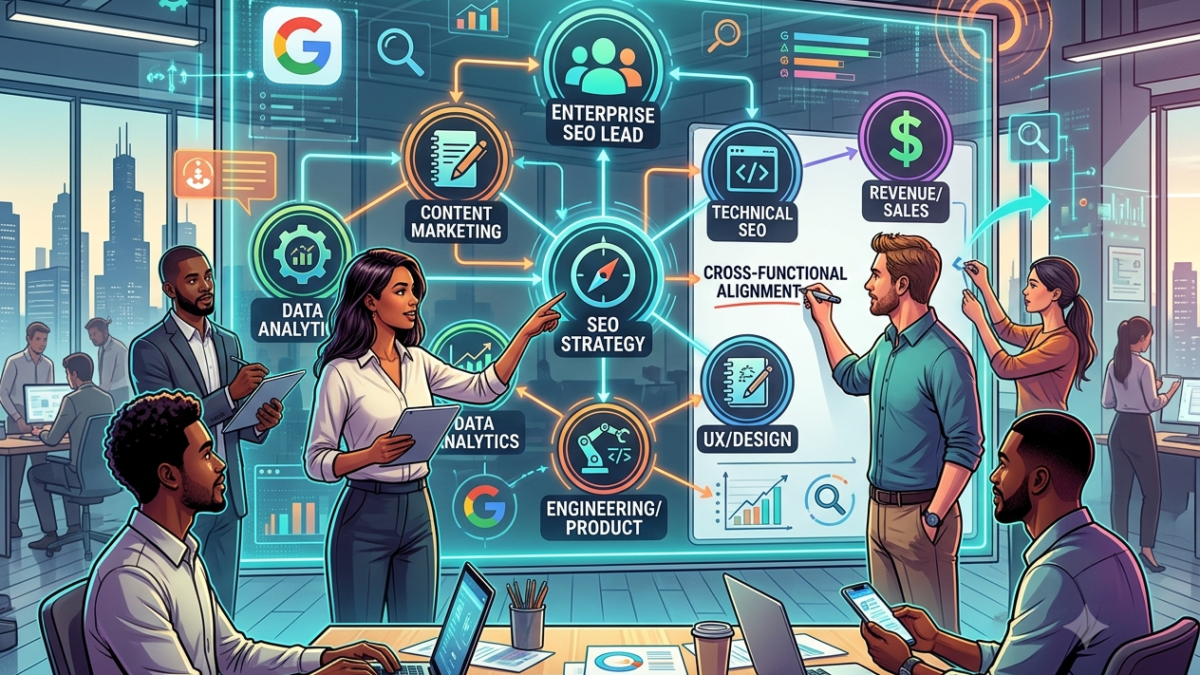
For years, Enterprise SEO was often viewed as the responsibility of a specialized marketing team. SEO professionals focused on keyword research, technical audits, content optimization, and reporting while collaborating with developers whenever website changes were required. It was a functional model that worked well when search engines primarily evaluated pages based on keywords, links, and technical performance.
That model is becoming increasingly outdated.
The modern search landscape is being reshaped by artificial intelligence, evolving search experiences, stricter content quality expectations, and the growing influence of structured data and brand authority. Search visibility is no longer determined by one department’s efforts alone. Instead, it reflects how effectively an entire organization creates, manages, and distributes knowledge.
For B2B enterprises, this signals an important organizational shift. The question is no longer whether a company has an SEO team. The real question is whether the organization itself is structured to compete in AI-driven search.
In many ways, Enterprise SEO has evolved beyond a marketing discipline. It is becoming an enterprise-wide operational capability.
Search Success Now Depends on Cross-Functional Collaboration
One of the biggest changes in enterprise search is that ranking performance increasingly depends on decisions made outside the SEO department.
Engineering teams influence website performance, Core Web Vitals, structured data implementation, and crawl efficiency. Product teams create documentation that can become valuable search assets. Sales departments uncover customer questions that reveal high-intent search opportunities. Customer success teams generate insights that inspire authoritative content, while legal and compliance teams shape how information is published in regulated industries.
Every department now contributes to search visibility, whether intentionally or not.
This reality has become even more significant as AI-powered search experiences continue to evolve. Search engines increasingly evaluate topical authority, content depth, expertise, and user satisfaction rather than simply matching keywords to queries. Large language models powering AI search also rely on well-structured, trustworthy information that often originates across multiple business functions.
As a result, successful Enterprise SEO initiatives require far more collaboration than traditional SEO programs ever demanded.
Instead of operating as a standalone function, SEO is increasingly becoming a coordinator that connects marketing, engineering, product, analytics, communications, and executive leadership around shared business goals.
Organizations that recognize this shift are moving faster because knowledge no longer remains trapped within departmental silos. Every customer interaction, product update, research report, and technical improvement has the potential to strengthen search performance when teams work together.
The Enterprise SEO Team Is Becoming an Enterprise Intelligence Team
The role of SEO professionals is changing just as rapidly as search itself.
Traditionally, SEO specialists spent much of their time optimizing pages after content had already been created. Today, they are becoming strategic advisors who influence decisions long before content reaches publication.
They help identify emerging customer questions using search data, evaluate market demand before product launches, advise engineering teams on technical architecture, collaborate with content strategists on topical authority, and work alongside analysts to measure business outcomes beyond rankings.
In many organizations, Enterprise SEO is evolving into an intelligence function that helps leaders understand changing customer behavior.
Search data often reveals market trends before they appear in sales reports. It uncovers shifts in buyer language, emerging industry challenges, competitive positioning, and new areas of customer interest.
This makes SEO valuable far beyond organic traffic.
Executives can use search insights to guide product development, shape messaging, prioritize content investments, and identify opportunities in emerging markets. Instead of simply reporting keyword movements, SEO teams are increasingly contributing to strategic business planning.
Artificial intelligence is accelerating this evolution rather than replacing it.
AI tools can automate repetitive optimization tasks, generate content drafts, identify technical issues, and analyze large datasets within minutes. That automation allows SEO professionals to spend more time interpreting data, building cross-functional relationships, and aligning search strategy with broader business objectives.
The competitive advantage shifts from executing SEO tasks to orchestrating organizational knowledge.
Tomorrow’s Enterprise SEO Org Chart Will Look Very Different
The future of Enterprise SEO is unlikely to revolve around larger SEO departments.
Instead, enterprises will build interconnected teams where SEO expertise is embedded across multiple functions.
Marketing will continue creating demand, but engineering will optimize discoverability. Product teams will contribute subject matter expertise. Customer success will identify recurring questions worth answering. Data teams will provide behavioral insights, while AI systems will help analyze performance and uncover optimization opportunities at scale.
Rather than operating independently, these functions will work together within a unified search strategy.
This organizational evolution reflects a broader business trend.
Modern enterprises are increasingly recognizing that search visibility isn’t simply a marketing KPI. It influences brand perception, customer acquisition, digital trust, and long-term revenue growth.
At the same time, AI-generated search experiences are rewarding organizations that demonstrate genuine expertise, consistent authority, and comprehensive knowledge rather than isolated pieces of optimized content. Businesses that treat SEO as an organization-wide capability will be better positioned to adapt to these changes than those relying solely on traditional workflows.
For B2B decision-makers, this creates an important leadership opportunity.
Instead of asking whether the SEO team is producing enough content or improving rankings, leaders should consider whether their organizational structure enables knowledge to flow efficiently across departments.
Because in today’s search environment, every team contributes to discoverability.
The companies that thrive won’t necessarily have the largest SEO budgets or publish the greatest number of webpages. They’ll be the organizations that break down internal silos, align expertise across departments, and transform enterprise knowledge into trusted digital experiences.
That’s why the next evolution of Enterprise SEO isn’t about hiring more SEO specialists. It’s about building an organization where search success becomes everyone’s responsibility.
In the AI era, the strongest search strategy may not begin with a keyword. It may begin with a better org chart.