AI Infrastructure Wars: Why Tech Giants Are Spending Billions in 2026
 Vansh Banthia,
5 months ago
5 min read
Vansh Banthia,
5 months ago
5 min read
Introduction
The global technology industry is witnessing one of the largest infrastructure races in modern history.
From artificial intelligence startups to cloud computing giants, companies across the world are investing billions of dollars into AI infrastructure, data centers, cloud expansion, and advanced computing systems. What began as an AI innovation wave has now evolved into a full-scale technological arms race.
In 2026, artificial intelligence is no longer just a software trend — it is becoming the foundation of global business operations, cybersecurity systems, enterprise automation, financial services, healthcare innovation, and digital communication.
As demand for generative AI tools, autonomous agents, and enterprise AI platforms skyrockets, tech companies are rushing to secure the computing power necessary to stay competitive.
The result?
Massive investments, global cloud expansion, rising energy consumption, cybersecurity concerns, and an entirely new digital economy centered around AI infrastructure.
The AI Infrastructure Boom is Accelerating
Some of the world’s largest technology companies are significantly increasing their AI spending in 2026.
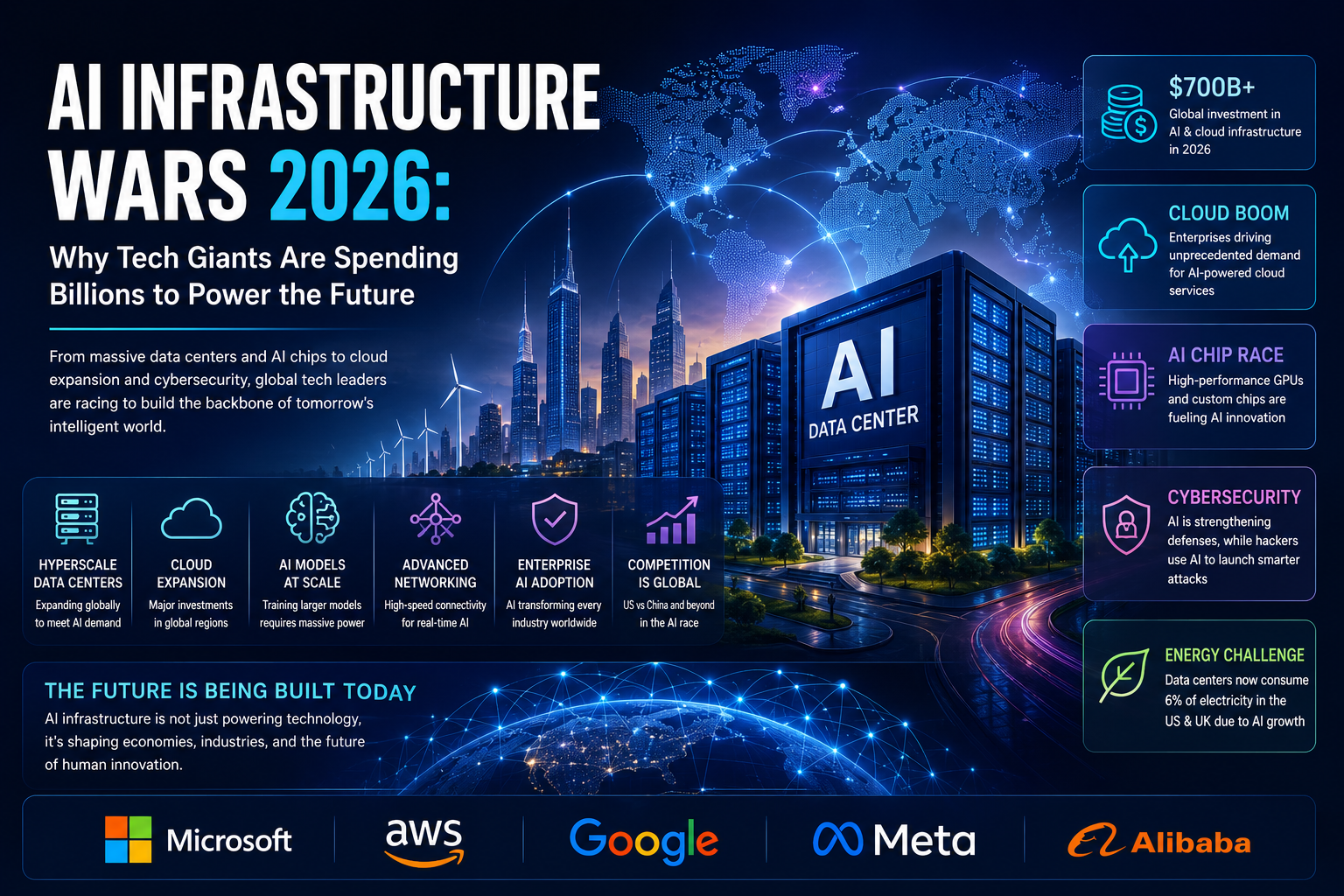
Companies like Microsoft, Amazon, Google, Meta, and Alibaba are collectively pouring hundreds of billions into AI-focused infrastructure expansion. Reuters reports that global AI investment is accelerating rapidly as companies race to build stronger cloud ecosystems and support increasing enterprise AI demand.
According to recent reports, tech giants are expected to collectively spend more than $700 billion on AI and cloud infrastructure in 2026 alone.
This includes investments in:
- AI supercomputers
- Hyperscale data centers
- AI chips and GPUs
- Cloud computing platforms
- AI networking systems
- Advanced cybersecurity frameworks
- High-bandwidth memory systems
The goal is simple: dominate the next generation of artificial intelligence.
Why AI Infrastructure Matters So Much
Artificial intelligence models are becoming dramatically more complex.
Modern large language models and autonomous AI systems require enormous computing resources to:
- Train AI models
- Process real-time requests
- Analyze massive datasets
- Generate responses instantly
- Power enterprise AI tools globally
This demand has created unprecedented pressure on cloud providers and infrastructure companies.
For example, Reuters recently reported that AI startup Anthropic signed a massive $1.8 billion cloud deal with Akamai Technologies to support growing AI demand.
Similarly, cloud companies are expanding rapidly to meet enterprise adoption needs.
Cloud Computing is Becoming the Core of AI Growth
Cloud computing has become the backbone of the AI revolution.
Major cloud providers are seeing massive demand from businesses integrating AI into:
- Customer support
- Marketing automation
- Cybersecurity
- Data analytics
- Software development
- Financial operations
- Healthcare systems
Reuters reported that Amazon Web Services exceeded market expectations due to strong AI-driven cloud demand from enterprises worldwide.
At the same time, Microsoft announced an $18 billion investment in Australia to strengthen its AI and cloud computing capabilities.
These investments show how cloud infrastructure is now directly tied to AI competitiveness.
Cybersecurity Risks Are Rising Alongside AI Growth
While AI is unlocking enormous opportunities, it is also creating major cybersecurity concerns.
Advanced AI systems are now capable of identifying software vulnerabilities, automating cyberattacks, and accelerating malicious hacking operations.
Reuters recently reported that cybersecurity experts and global regulators are increasingly warning banks and enterprises about AI-assisted cyber threats.
Google researchers also noted that hackers are using AI to innovate faster and scale sophisticated cyberattacks more efficiently.
This has created a new global priority:
AI security infrastructure.
As organizations adopt AI tools faster, investments in:
- AI threat detection
- Zero-trust security models
- Cloud security platforms
- AI monitoring systems
- Automated cybersecurity solutions
are becoming critical for enterprise survival.
The Hidden Cost: Energy Consumption
One of the biggest challenges of AI infrastructure growth is energy usage.
Data centers powering AI systems consume enormous amounts of electricity.
Research published this week revealed that data centers now account for approximately 6% of electricity usage in both the UK and the US, largely driven by AI expansion.
As AI adoption accelerates, governments and environmental organizations are becoming increasingly concerned about:
- Carbon emissions
- Water usage
- Power grid pressure
- Sustainability risks
- Long-term environmental impact
This is pushing technology companies to invest heavily in renewable energy partnerships and sustainable data center technologies.
The Global AI Competition is Intensifying
AI is no longer just a business competition — it has become a geopolitical race.
The United States and China are aggressively competing for dominance in:
- AI research
- Semiconductor manufacturing
- Cloud computing
- Cybersecurity
- AI regulation
- Advanced computing infrastructure
Reuters recently highlighted growing tensions between the US and China over AI leadership, chip restrictions, and access to advanced AI systems.
This rivalry is shaping global technology policy and influencing international trade relationships.
What This Means for Businesses
For businesses worldwide, the AI infrastructure boom creates both opportunities and challenges.
Organizations that adopt AI early can:
- Improve efficiency
- Automate operations
- Enhance customer experiences
- Reduce costs
- Increase scalability
However, companies also face growing pressure to:
- Secure AI systems
- Manage rising cloud costs
- Handle compliance risks
- Protect sensitive data
- Adapt to rapid technological change
The businesses that invest strategically in AI readiness today will likely dominate tomorrow’s digital economy.
Conclusion
The AI infrastructure race is redefining the global technology industry.
What we are witnessing in 2026 is not just another technology trend — it is the construction of the digital backbone for the next decade of innovation.
From cloud computing and cybersecurity to data centers and AI chips, billions of dollars are flowing into infrastructure that will power future economies, businesses, and societies.
As AI adoption accelerates worldwide, one thing is becoming increasingly clear:
The companies that control AI infrastructure may ultimately control the future of technology itself.