For years, the internet worked in a very predictable way.
Someone searched on Google.
They saw a list of links.
They clicked a website.
Businesses earned traffic.
With the rise of AI search, businesses must adapt their strategies to maintain visibility.
That system shaped modern digital marketing for nearly two decades.
But in 2026, something major is changing quietly beneath the surface:
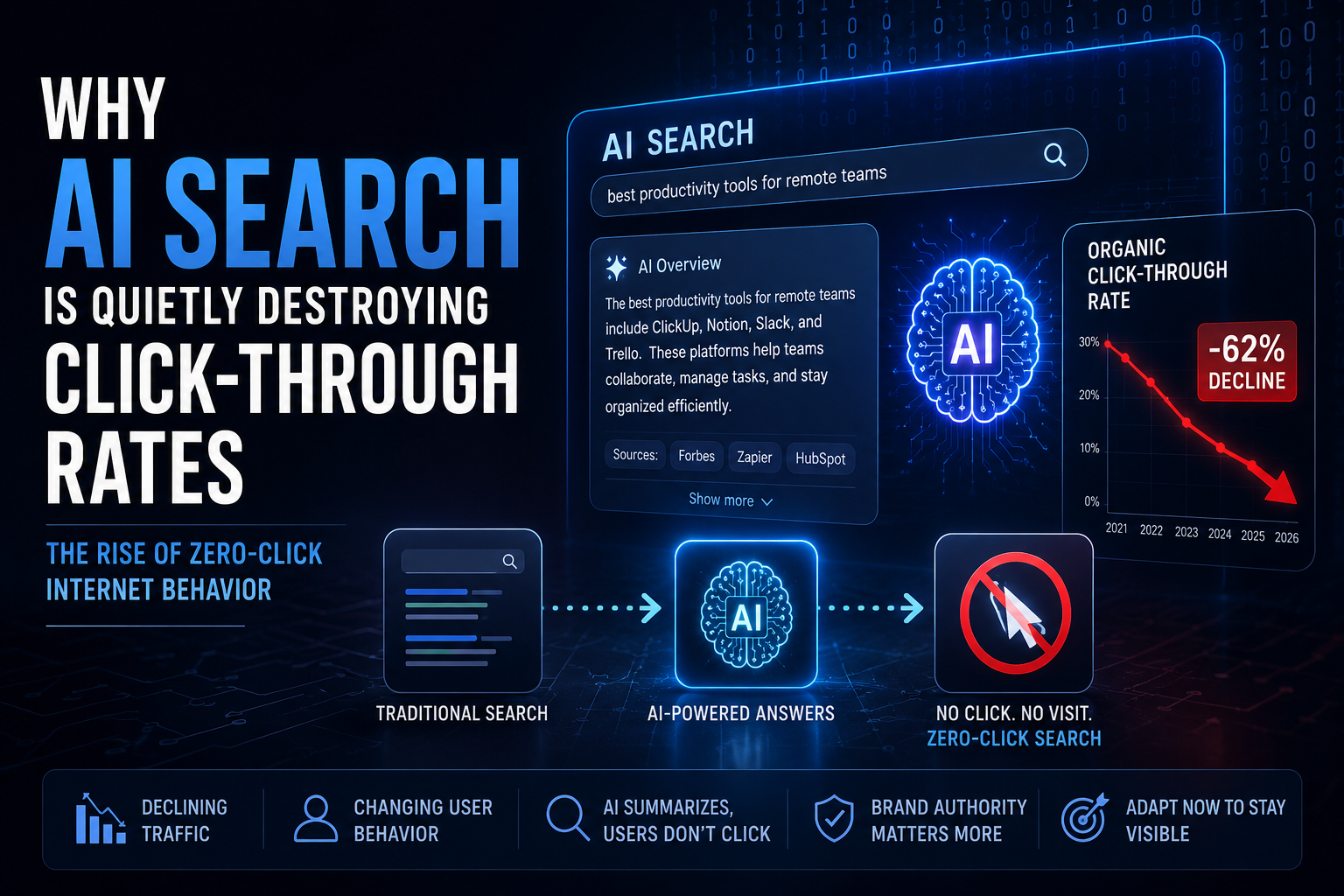
people are increasingly getting answers without clicking anything at all.
And that shift is beginning to create one of the biggest visibility problems businesses have faced in years.
The Rise of “Zero-Click” Behavior
Modern users are becoming less interested in browsing multiple websites.
They want faster answers.
This new landscape dominated by AI search is forcing companies to rethink their approach to digital marketing.
AI-powered search experiences are accelerating this behavior rapidly. Platforms like ChatGPT, Perplexity, Gemini, and Google AI Overviews now summarize information directly inside search experiences instead of simply showing users a list of websites.
This creates what marketers increasingly call:
“zero-click behavior.”
The user gets the answer immediately.
No website visit required.
For businesses that depend heavily on organic traffic, this changes everything.
Why Traditional Search Traffic Is Becoming Harder
For years, SEO strategies focused heavily on rankings and clicks.
The assumption was simple:
higher rankings generated more traffic.
But AI search systems are reshaping how visibility works.
Instead of encouraging exploration, many AI systems compress information into conversational summaries. Users now often receive:
- Product recommendations
- Comparisons
- Explanations
- Research summaries
- Buying guidance
Without ever leaving the search environment itself.
This means businesses may remain visible online while still losing actual website traffic.
That distinction is becoming extremely important.
AI Is Changing User Expectations
One reason AI search is growing so quickly is because it reduces friction dramatically.
Traditional search behavior often required users to:
- Open multiple tabs
- Compare websites manually
- Scan long articles
- Filter repetitive content
- Navigate overloaded pages
AI systems simplify this process into direct conversation.
That convenience changes user behavior very quickly.
Once users become accustomed to faster answers, returning to slower browsing experiences feels inefficient.
And behavioral shifts at internet scale usually reshape entire marketing industries.
The Internet Created Its Own Problem
Ironically, AI search became popular partly because traditional SEO content became overwhelming.
Over the years, the internet became flooded with:
- Generic blogs
- Repetitive listicles
- Keyword-heavy articles
- Low-value content written mainly to rank
Users became exhausted by content designed more for algorithms than for actual usefulness.
AI systems emerged as a cleaner alternative:
faster summaries, simpler answers, less friction.
In many ways, the SEO industry unintentionally trained users to prefer AI-generated discovery experiences.
Visibility No Longer Guarantees Traffic
One of the biggest mindset shifts businesses now face is understanding that visibility and traffic are no longer the same thing.
A brand may:
- Appear inside AI-generated answers
- Be referenced conversationally
- Influence purchase decisions indirectly
While receiving fewer actual website visits.
This creates a difficult challenge for marketers because traditional success metrics were heavily tied to clicks, sessions, and traffic growth.
The future may become much harder to measure using older analytics models.
Why Brand Authority Matters More Than Ever
As AI systems increasingly summarize information for users, brands need stronger authority signals to remain visible.
AI engines tend to prioritize:
- Trusted sources
- Recognizable expertise
- Clear topical authority
- Consistent digital presence
- Contextually useful information
This means businesses relying only on keyword optimization may struggle over time.
The internet is slowly shifting from:
“Who ranks highest?”
to:
“Who feels trustworthy enough to reference?”
That is a very different competitive environment.
The Future of Content Is Changing
The rise of AI search may also change how businesses create content entirely.
Instead of producing massive amounts of SEO-focused articles, companies may increasingly prioritize:
- Original insights
- Research-backed thinking
- Unique expertise
- Strong positioning
- Conversational relevance
Because AI systems can summarize generic information easily.
What becomes harder to replace is perspective.
This may eventually reward brands that create genuinely valuable thinking instead of simply producing more content volume.
Why Businesses Should Adapt Early
The shift toward AI-powered discovery is still evolving, but the direction is becoming increasingly clear.
Search behavior is changing.
Traffic patterns are changing.
Discovery systems are changing.
Businesses that adapt early will likely have stronger long-term visibility advantages as AI search becomes more integrated across browsers, operating systems, and digital ecosystems.
The future of digital marketing may no longer belong only to businesses that rank highest.
It may belong to the businesses AI systems trust enough to mention first.