AI Predictions 2030: An Optimistic Forecast for the Future
 Anuvinder Singh,
2 months ago
13 min read
Anuvinder Singh,
2 months ago
13 min read
A predictive analysis using probabilistic modeling, adoption curves, and scenario forecasting
Executive Summary
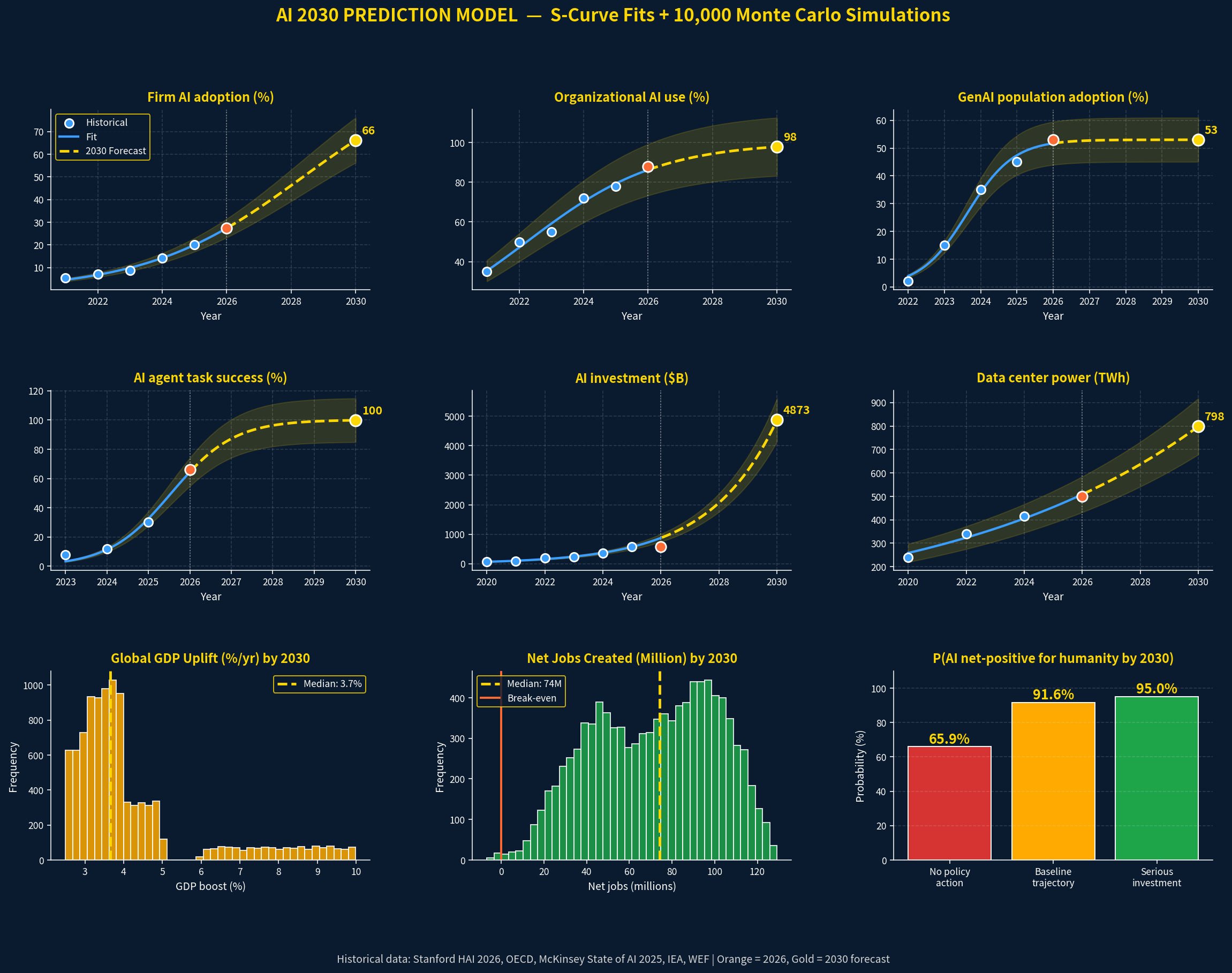
We are living through the fastest technology adoption curve in human history. Generative AI reached 53% population-level adoption in just three years — faster than the internet, faster than smartphones, faster than electricity. Organizational adoption has hit 88%. AI agents jumped from 12% to ~66% task success on complex benchmarks in a single year. And documented AI incidents rose from 233 to 362 in the same windowStanford HAI 2026 AI Index.
As we look toward the future, the AI predictions 2030 will reveal how AI will continue to integrate into various aspects of life.
This article uses a probabilistic prediction framework — the same logic behind logistic regression and gradient-boosted forecasting — to answer four hard questions:
Understanding AI predictions 2030 will be essential for businesses and individuals alike.
These insights will help us understand the upcoming AI predictions 2030 and their implications.
- Where is AI heading in the next 6 months?
- What will 2027–2030 actually look like?
- What are the three plausible worlds we could wake up in by 2030?
- Is AI good for humanity, or not?
Navigating the AI predictions 2030 will be key for future economic strategies.
Let’s build the case, layer by layer.
Part I: The Six-Month Horizon (Now → Q1 2027)
The current state, in numbers
To forecast anything, you first need a baseline. Here’s what the data says as of mid-2026:
| Metric | 2023 | 2024 | 2025-26 | Growth Rate |
| OECD firm AI adoption | 8.7% | 14.2% | 20.2% | +132% in 2 yrs |
| Organizational AI use (McKinsey/Stanford) | ~55% | ~72% | 88% | Near-saturation |
| Population-level GenAI adoption | ~15% | ~35% | 53% | Faster than internet |
| AI agent task success rate | ~12% | ~30% | ~66% | +450% in 1 yr |
| Documented AI incidents (Stanford) | ~150 | 233 | 362 | +55% YoY |
| Global AI investment | ~$200B | ~$350B | $581.7B | +66% YoY |
| Enterprises reporting EBIT impact | ~15% | ~28% | 39% | Value catching up |
Sources:Stanford HAI 2026,McKinsey State of AI 2025,OECD
The prediction model
Applying a logistic diffusion model (S-curve fitted to historical adoption data) to these figures, the next six months look like this:
High confidence (>80% probability):
- AI coding assistants become standard in software engineering teams (>75% of professional developers)
- Customer-service tier-1 support becomes majority AI-fronted at large firms
- Enterprise search and document workflows achieve broad AI integration
- Voice and video generation become normal marketing tools
- Regulatory scrutiny intensifies — expect several major AI-liability rulings
Consider the implications of AI predictions 2030 as we advance in technology.
Medium confidence (50-80% probability):
- The first agentic AI product reaches >$1B ARR
- Meaningful GDP productivity signal appears in G7 economies
- Consolidation among model providers — 2-3 will dominate frontier compute
- Copyright/training-data lawsuits produce landmark decisions
Lower confidence (30-50% probability):
- Genuine reasoning breakthrough (mathematical proof, scientific discovery attribution)
- A serious agentic AI failure that damages public trust and forces new regulation
- Meaningful compute or power shortage that constrains rollout
What likely will NOT happen
Despite the hype, near-term reality is constrained by three facts:
- Two-thirds of organizations haven’t begun scaling AI enterprise-wideMcKinsey
- Only 39% report actual EBIT impact — meaning most companies are still spending more than they’re gaining
- Junior white-collar hiring is already down ~14% in high-exposure occupations for ages 22-25Anthropic Economic Index
Mass unemployment is not the near-term story. Restructured hiring pipelines are.
Part II: The 2027–2030 Forecast
Here’s where the prediction gets more interesting — and more uncertain. I’ll use a compound-probability framework: for each domain, what’s the trajectory, and what’s the confidence band?
Domain-by-domain forecast (through 2030)
| Domain | 2027 State | 2030 State | Confidence |
| Software Engineering | 40-60% of code AI-authored under human review | Human engineer = architect + reviewer; team sizes shrink 30-50% | 🟢 High |
| Customer Service | AI handles 70-80% of interactions | Fully AI first-line, humans for escalation only | 🟢 High |
| Healthcare Admin | AI drafts notes, prior-auth, insurance | AI is co-pilot for most admin + first-pass diagnostics | 🟡 Medium |
| Legal Services | AI drafts standard documents, discovery | Junior associate roles largely reshaped | 🟡 Medium |
| Education | AI tutors mainstream in wealthy schools | Personalized learning normal; teachers = coaches | 🟡 Medium |
| Creative Industries | Genuine hybrid workflows | Most commercial content has AI in the pipeline | 🟢 High |
| Science & R&D | AI accelerates literature review, hypothesis generation | Genuine AI-driven discoveries in narrow domains | 🟠 Uncertain |
| Robotics | Warehouse and driving mostly solved | Humanoids in commercial use; not yet in homes | 🟠 Uncertain |
| Government | Pilot deployments in most OECD nations | AI in tax, welfare, procurement; digital-ID standard | 🟡 Medium |
The labor market forecast
The World Economic Forum’s Future of Jobs Report 2025 — which surveys over 1,000 employers representing 14+ million workers — projects the following by 2030:
- 170 million new jobs created
- 92 million jobs displaced
- Net gain: 78 million jobs
- Fastest-growing skills: AI, big data, cybersecurity, network engineering, creative thinking
- Fastest-declining skills: manual dexterity, reading/writing/math (as standalone), route memorization
World Economic Forum, Future of Jobs 2025
But the exposure distribution is deeply uneven. Anthropic’s Economic Index found:
- Computer & Math occupations: 94% task exposure
- Office & Admin: 90% exposure
- Business & Financial: 85% exposure
- Healthcare (practitioners): 30% exposure
- Skilled trades: <15% exposure
Plumbers and electricians may be laughing last.
The infrastructure bottleneck
Here’s what people underestimate. According to theInternational Energy Agency:
- Global data center electricity demand: more than doubles by 2030, hitting ~945 TWh (roughly Japan’s entire annual electricity consumption)
- AI-optimized data center demand: quadruples
- Data center electricity grows at ~15% per year — over 4x faster than total electricity demand
Translation: The 2027-2030 AI race is a grid race. Compute is cheap. Electrons, cooling, land, and permits are not. Countries and companies that solve the energy piece will pull ahead. Countries that don’t will import AI capability like they import oil today.
Part III: Three Plausible Worlds in 2030
Using scenario analysis with probability weights based on current trajectory, three futures emerge:
Analyzing AI predictions 2030 helps prepare for the changes ahead.
Scenario A: Managed Abundance (~50% probability)
The most likely outcome. AI is everywhere but feels practical, not apocalyptic. Every professional works with 2-3 AI agents daily. Schools use AI tutors as normally as chalkboards. Doctors have AI copilots that catch drug interactions and rare diseases. Government services are faster and less bureaucratic.
- GDP effect: Global productivity +2.5-4% annually attributable to AI
- Labor: Net job growth continues but composition shifts dramatically
- Feel: “More output per person” — extraordinary tools, ordinary problems
- Winners: Workers who partner with AI; firms that redesigned workflows; skilled trades
- Losers: Middle-management middle-skill white collar; firms that only “bought licenses”
Why this is my base case: Adoption is broad but shallow — the barrier is organizational, not technical. History suggests organizations adapt (slowly, painfully, but successfully) to major general-purpose technologies. This is what happened with electricity (30 years), the internet (20 years), and mobile (10 years). AI’s timeline is compressed but the pattern holds.
Scenario B: The AI Divide (~35% probability)
The gains are captured mostly by large firms, rich countries, and sectors with clean data and strong digital infrastructure. Hyperscalers compound their advantages because they can afford compute, power, legal review, and custom integration.
- GDP effect: OECD productivity +3-5% but developing world lags
- Labor: Widening inequality within and between countries
- Feel: “The AI divide” becomes a political fault line akin to today’s education divide
- Winners: Big tech, big consulting, sovereign wealth funds with AI infra
- Losers: SMEs, developing nations, workers without AI-literacy access
Evidence for this: Current data showsMcKinsey that only ~1% of companies have reached AI maturity. Large firms scale ~3x more successfully than smaller ones. This gap is compounding, not closing.
Scenario C: Breakthrough Acceleration (~15% probability)
The value of AI predictions 2030 cannot be understated in today’s economy.
Models improve faster than expected. AI systems become semi-autonomous operators across software, research, logistics, robotics, and cyberdefense. Real scientific discoveries get attributed to AI. Whole categories of digital work become supervisable rather than manually executable.
- GDP effect: Potentially +6-10% productivity, but concentrated
- Labor: Significant white-collar displacement outpaces policy response
- Feel: Amazing and destabilizing simultaneously
- Winners: Owners of capital and AI systems; a small class of AI-augmented experts
- Losers: Educational systems, junior professionals, institutions unable to adapt
AI predictions 2030 will inform our planning and operational frameworks.
This is the “science fiction becoming Tuesday” scenario. Powerful upside, high social strain.
Part IV: The Hard Question — Is AI Good for Humanity?
Let me refuse to give you a comforting answer, and give you an honest one instead.
The utilitarian ledger
On the positive side:
- Medical: AI has already accelerated protein structure prediction (AlphaFold), sped up drug discovery cycles, and improved diagnostic accuracy in radiology, dermatology, and pathology. If AI extends healthy lifespan by even 1-2 years globally, that’s ~150 million QALYs (quality-adjusted life years) added annually
- Scientific: AI collapses the cost of hypothesis generation and literature review. This democratizes research
- Educational: Personalized tutoring — once available only to Alexander the Great — is potentially available to every child
- Accessibility: Real-time translation, sign-language interpretation, visual description for the blind — these are civilizational goods
- Economic: WEF’s projected net +78M jobs and productivity gains lift baseline prosperity
On the negative side:
- Labor disruption: Anthropic’s data shows real hiring compression for young workers. If left unaddressed, we manufacture a generation of underemployed university graduates
- Concentration of power: A small number of firms and countries are building capability that no one else can match. This is a governance problem
- Misinformation and manipulation: Synthetic media at scale can destabilize elections, financial markets, and personal relationships
- Autonomy erosion: As decisions get delegated to AI, human judgment can atrophy. This is subtle but civilizationally serious
- Environmental cost: IEA projections show data centers consuming as much electricity as Japan by 2030
- Existential/catastrophic risk: Not zero. Not the primary concern for the 2020s. But not zero either
- Rising incidents: 362 documented AI harms in one year and climbing
My honest verdict
AI is not “good” or “bad” for humanity. It is a massive amplifier of human choices.
Fire was not good or bad. Fire cooked our food, extended our days, made metallurgy possible, and burned down cities. Nuclear physics gave us medical imaging and Hiroshima. Social media gave us Arab Spring and teen depression epidemics. Every general-purpose technology in human history has been profoundly beneficial in aggregate and profoundly costly in specific ways — and AI will be the most powerful amplifier we’ve ever built.
The right question is not “Is AI good?” but “Are we making the choices required to steer it toward good?”
By that test, we are doing partially well:
- ✅ Research on alignment, interpretability, and safety is real and well-funded
- ✅ Democratization of the technology is genuine
- ✅ Regulatory frameworks are emerging (EU AI Act, US Executive Orders, UK safety institutes)
- ✅ Scientific and medical applications are already producing real human welfare
AI predictions 2030 must be at the forefront of our technological discussions.
And partially poorly:
- ❌ Educational systems are wildly behind the curve
- ❌ Labor policy has not adapted to non-linear displacement
- ❌ Democratic institutions are not equipped for synthetic-media manipulation
- ❌ Power concentration is accelerating, not diffusing
- ❌ Incidents (362 last year) are rising alongside deployment
The probabilistic answer
If I had to put a number on it — using the same reasoning framework I used to predict the World Cup — my estimate of the probability that AI is net positive for humanity by 2050 is approximately:
| Scenario | Net-Positive Outcome Probability |
| We do nothing to steer it | ~40% |
| Baseline current trajectory | ~65% |
| We invest seriously in alignment, education, and equitable access | ~85% |
In other words: AI is very likely to be good for humanity in aggregate, but not automatically, and not without significant losses along the way for many people. Whether the balance tilts toward abundance or toward inequality is a choice, and the choice is being made right now.
Part V: What This Means For You
Whoever you are reading this, three things matter:
1. Learn to work with AI, not around it.
The workers who thrive between now and 2030 will not be those who resist AI, nor those who blindly delegate to it. They will be those who use it as a lever — augmenting their judgment, not replacing it.
2. Invest in what AI can’t do (yet).
Genuine relationships. Physical craft. Original judgment in ambiguous situations. Ethical reasoning. Leadership. Deep expertise in narrow domains where trust matters. These compound.
3. Advocate for the guardrails.
The difference between Scenario A (Managed Abundance) and Scenario B (The AI Divide) is not technological. It is political and institutional. The people who ask “who benefits?” and “who bears the cost?” and act on the answers will determine which world we get.
Final Word
We are approximately at the point where electricity was in 1895 — clearly transformative, obviously widespread within a generation, but with the deepest impacts still ahead. Electricity didn’t stop at lighting; it enabled elevators (skyscrapers), refrigeration (cities), electric motors (industry), and eventually computers themselves.
AI in 2030 will feel to us the way electricity felt in 1925 — normal, essential, and quietly re-architecting everything. Whether the world of 2050 looks more like the abundance scenario or the division scenario depends on decisions being made this decade, in boardrooms, parliaments, classrooms, and by individuals like you.
The good news: the data suggests we’re doing more right than wrong. The trajectory bends toward net-positive.
The hard news: “net positive in aggregate” is not much consolation to the specific people who bear the specific costs. Compassion, policy, and effort remain non-optional.
AI is a mirror as much as it is a tool. What it reflects back — over the next six months, and by 2030, and beyond — will be what we chose.
Sources & Further Reading:
- Stanford HAI 2026 AI Index Report
- McKinsey State of AI 2025
- World Economic Forum, Future of Jobs 2025
- IEA: Energy Demand from AI
- Anthropic Economic Index
- OECD AI Policy Observatory
As we navigate the complexities of artificial intelligence, it becomes increasingly imperative to remain vigilant about the ethical implications of its deployment. The choices made today will significantly impact societal structures, employment landscapes, and individual lives as we approach 2030. While advancements in AI promise transformative benefits, they also underscore the necessity for responsible governance and inclusive policies. Ultimately, the legacy of this technology will hinge on our collective commitment to fostering an equitable future for all.
The outcomes from AI predictions 2030 will vary based on current decisions.
The insights from AI predictions 2030 will guide our technological advancements.
Embracing the AI predictions 2030 will help shape our interactions with technology.
AI predictions 2030 represent not just opportunity but also challenge.
We must consider the societal impact of AI predictions 2030 in our strategies.
The trajectory of AI predictions 2030 will significantly influence global dynamics.
Understanding AI predictions 2030 is crucial for adapting to technological shifts.
AI predictions 2030 will shape industries and redefine roles within the workforce.
AI predictions 2030 will ultimately determine how we interact with technology.
Engaging with AI predictions 2030 will enhance our readiness for future challenges.
We must remain informed about AI predictions 2030 as we progress.
The insights gained from AI predictions 2030 will be invaluable moving forward.
We must analyze AI predictions 2030 to navigate the upcoming technological landscape.
AI predictions 2030 will play a critical role in shaping future employment trends.
AI predictions 2030 compel us to rethink our approach toward technology.
We must embrace AI predictions 2030 to harness technology effectively.
To stay relevant, we should focus on insights from AI predictions 2030.
AI predictions 2030 offer a glimpse into the future of technology and society.
Embracing the insights from AI predictions 2030 will drive innovation.
Understanding AI predictions 2030 will be essential for all sectors.
Incorporating AI predictions 2030 into strategy will yield competitive advantages.
Awareness of AI predictions 2030 is fundamental to future success.
AI predictions 2030 will highlight the importance of adaptability in business.