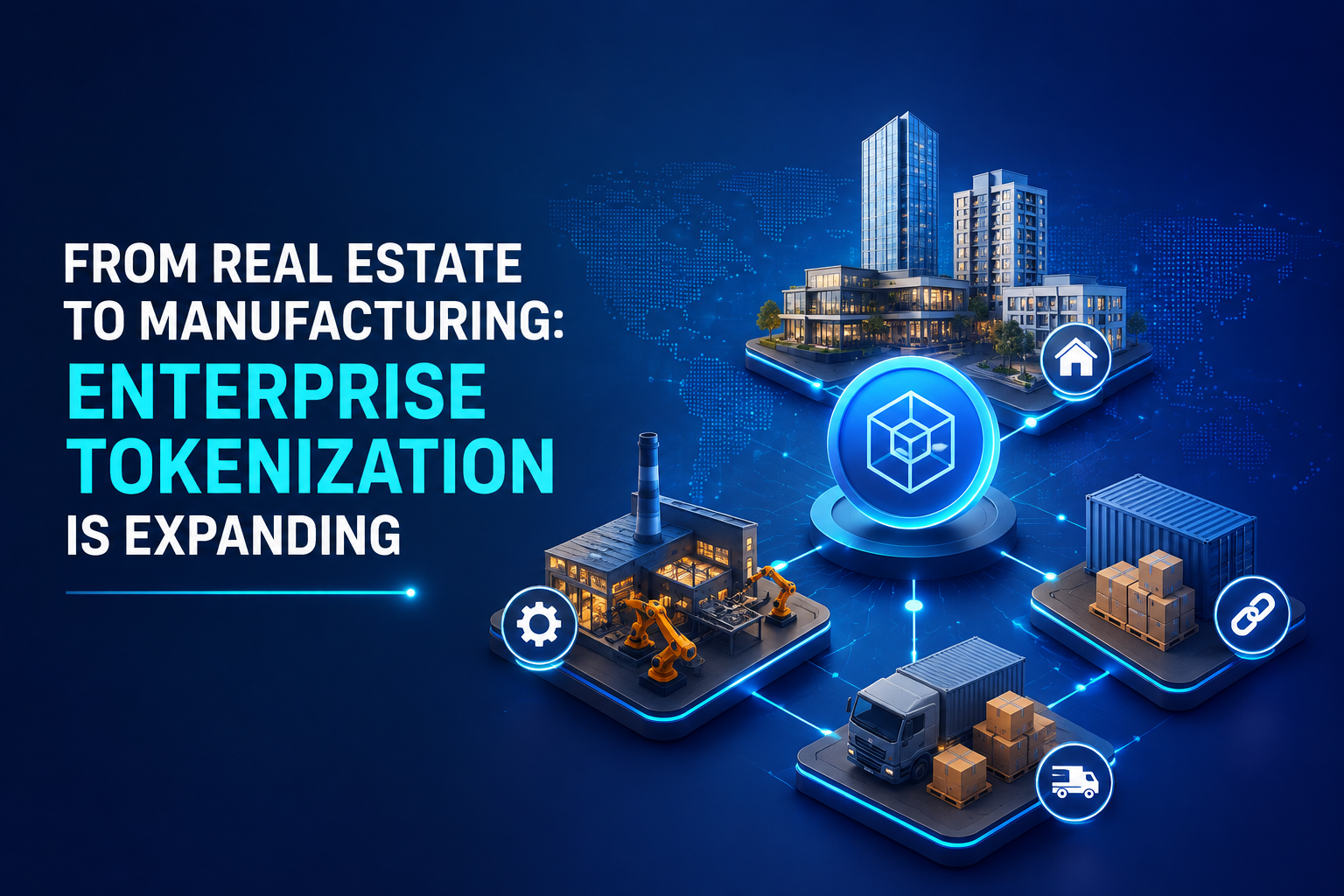
From Real Estate to Manufacturing: Enterprise Tokenization Is Expanding
 Purva Wankhade,
3 months ago
5 min read
Purva Wankhade,
3 months ago
5 min read
For years, tokenization was almost exclusively associated with cryptocurrencies and digital assets. Today, that perception is rapidly changing. Enterprises are discovering that tokenization has far broader applications, extending well beyond financial markets into real estate, manufacturing, supply chain management, intellectual property, and industrial operations.
This shift reflects a larger transformation in enterprise technology. Businesses are no longer exploring blockchain simply as an emerging innovation, they are leveraging it to create more transparent, efficient, and secure digital ecosystems. At the center of this evolution is Enterprise Tokenization, a strategy that converts physical or digital assets into programmable digital representations that can be securely managed, transferred, and tracked throughout their lifecycle.
For B2B decision-makers, Enterprise Tokenization is becoming less about experimenting with blockchain and more about unlocking measurable business value through improved efficiency, automation, and digital trust.
Enterprise Tokenization Is Moving Beyond Financial Assets
The earliest discussions around tokenization largely focused on cryptocurrencies and investment products. While financial institutions continue advancing tokenized securities and digital payment solutions, enterprise adoption has expanded into industries that were once considered unlikely candidates for blockchain technology.
Real estate provides one of the clearest examples. Property owners and investment firms are increasingly exploring tokenized ownership models that simplify asset management, improve liquidity, and enable broader investor participation. Rather than relying entirely on traditional ownership structures, digital tokens can represent fractional interests while improving transparency across transactions.
Manufacturing is experiencing a similarly significant transformation. Modern production environments generate enormous amounts of operational data across suppliers, production facilities, logistics providers, and customers. Enterprise Tokenization enables manufacturers to create trusted digital representations of products, components, and production records that remain verifiable throughout the supply chain.
The result is improved traceability, stronger quality assurance, and greater confidence when products move across international markets.
Recent industry developments reinforce this momentum. Global financial institutions continue expanding tokenized asset initiatives, while enterprise blockchain platforms are introducing infrastructure specifically designed for business applications rather than cryptocurrency ecosystems. As organizations face increasingly sophisticated cyber attacks, many are also exploring tokenization and blockchain technologies to strengthen data integrity, secure digital assets, and improve operational resilience. At the same time, governments in multiple regions are developing regulatory frameworks that provide greater clarity around digital assets, encouraging organizations to evaluate long-term tokenization strategies with greater confidence.
As businesses continue accelerating digital transformation, tokenization is emerging as an important component of modern enterprise infrastructure.
Why Enterprise Leaders Are Investing in Enterprise Tokenization
Organizations are increasingly recognizing that tokenization solves challenges extending far beyond ownership records.
Every enterprise manages valuable assets, whether they include inventory, contracts, intellectual property, certifications, equipment, customer data, or financial instruments. Traditional systems often store this information across disconnected databases, making verification, auditing, and collaboration both time-consuming and expensive.
Enterprise Tokenization creates a standardized digital layer that allows these assets to be securely identified, authenticated, and managed throughout their lifecycle. Combined with blockchain technology, organizations gain immutable records that improve transparency while reducing administrative complexity.
Artificial intelligence is further increasing the value of this approach. AI models depend on trusted, high-quality data to generate reliable insights. Tokenized records provide stronger data integrity by ensuring that asset histories remain verifiable and resistant to unauthorized modification. As enterprises continue adopting AI-driven decision-making, trusted digital assets become increasingly valuable.
Cloud-native enterprise platforms are also supporting wider adoption. Rather than deploying isolated blockchain projects, organizations are integrating Enterprise Tokenization into broader digital ecosystems that include ERP platforms, supply chain software, digital identity systems, cloud architecture, and compliance solutions. This integration enables businesses to automate processes while maintaining consistent governance across multiple departments.
The growing importance of Environmental, Social, and Governance (ESG) reporting is another contributing factor. Enterprises are under increasing pressure to demonstrate product origin, sustainability initiatives, supplier accountability, and regulatory compliance. Tokenized records simplify this process by creating transparent digital histories that can be independently verified throughout the value chain.
Enterprise Tokenization Is Becoming Part of Digital Infrastructure
Perhaps the most important evolution is that Enterprise Tokenization is no longer viewed as a standalone blockchain initiative. It is becoming part of the broader enterprise technology stack.
Forward-looking organizations are embedding tokenization into procurement systems, logistics operations, digital identity management, contract lifecycle management, and financial workflows. Instead of operating as an isolated innovation project, tokenization becomes a foundational capability supporting enterprise-wide automation and governance.
This approach is particularly valuable for multinational organizations operating across multiple jurisdictions. Cross-border trade often requires extensive documentation, supplier verification, compliance reporting, and asset tracking. Tokenized assets enable participants across global ecosystems to access trusted information while reducing manual reconciliation and administrative delays.
Manufacturers are using tokenized digital twins to monitor equipment performance throughout production lifecycles. Real estate organizations are digitizing property records to streamline ownership verification and transaction management. Healthcare providers are exploring secure tokenization models for medical assets and clinical research data. Logistics companies are improving shipment visibility through tokenized documentation that follows products across international supply chains.
These examples demonstrate that the value of Enterprise Tokenization lies not simply in digitizing assets but in creating intelligent, interoperable infrastructure capable of supporting modern enterprise operations.
Looking ahead, adoption is expected to accelerate as blockchain infrastructure matures, regulatory clarity improves, and enterprise software vendors continue integrating tokenization capabilities and blockchain tools into mainstream business platforms. Rather than replacing existing enterprise systems, tokenization will increasingly complement cloud computing, artificial intelligence, automation, and advanced analytics.
For B2B decision-makers, this represents an opportunity to rethink how assets are managed across increasingly connected digital ecosystems. Organizations that invest early in Enterprise Tokenization will be better positioned to strengthen operational transparency, improve collaboration, reduce compliance complexity, and unlock entirely new business models.
From real estate portfolios to manufacturing supply chains, the expansion of Enterprise Tokenization signals a broader transformation in enterprise technology. As digital business continues evolving, tokenized assets are becoming a practical foundation for building more secure, efficient, and intelligent organizations.