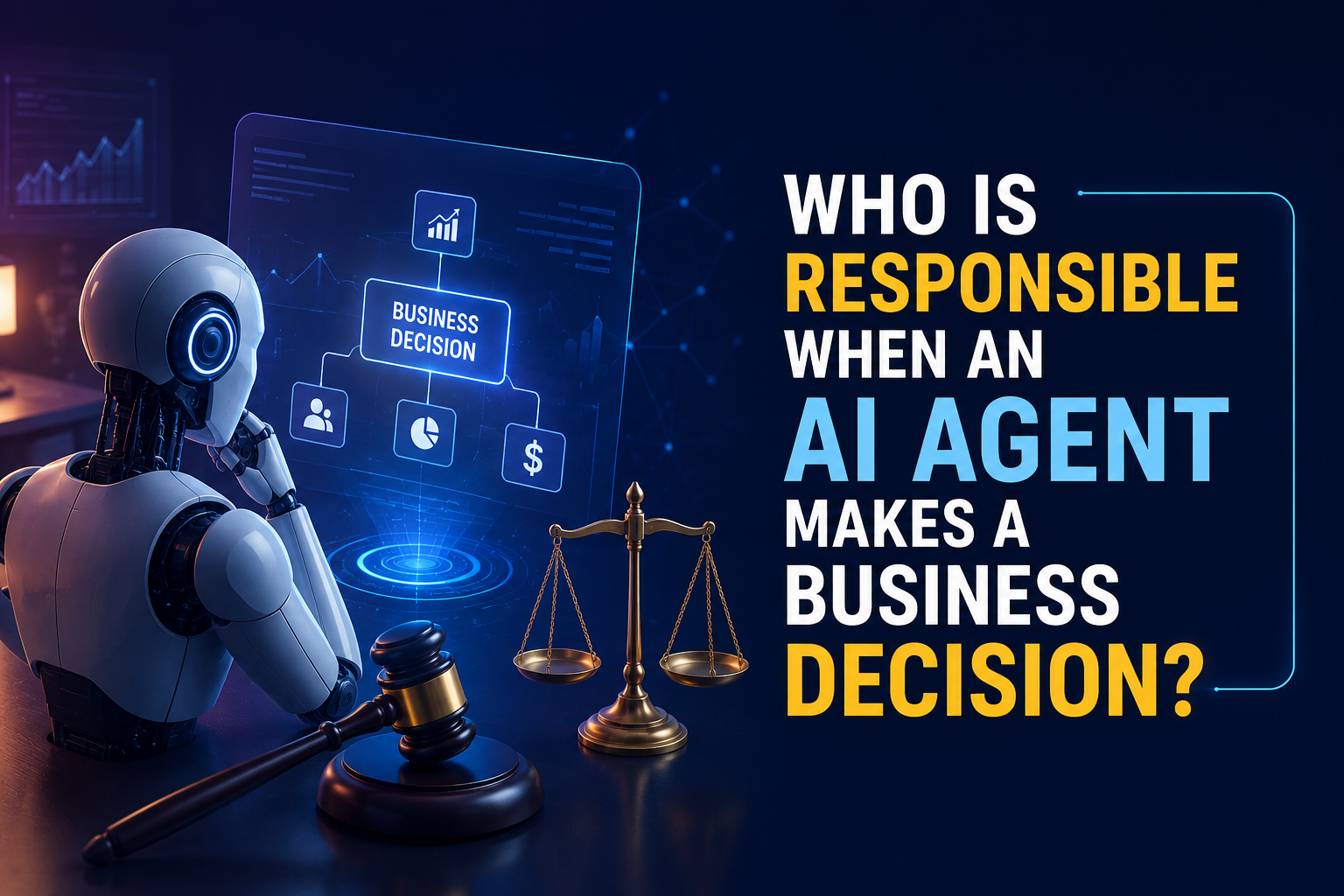
Who Is Responsible When an AI Agent Makes a Business Decision?
 Purva Wankhade,
3 months ago
5 min read
Purva Wankhade,
3 months ago
5 min read
Artificial intelligence has moved far beyond answering questions or generating content. Across industries, organizations are now deploying autonomous ai agent systems that can qualify leads, approve invoices, detect fraud, optimize supply chains, recommend financial actions, monitor cybersecurity threats, and even negotiate routine business processes with minimal human intervention.
The conversation is no longer about whether AI will support decision-making. It is about what happens when AI begins making decisions on its own.
As businesses embrace increasingly autonomous technologies, one question is becoming impossible to ignore: who is accountable when an intelligent system makes the wrong call?
This debate sits at the center of the next phase of enterprise AI adoption. While organizations are eager to improve efficiency through automation, they must also establish governance frameworks that ensure technology remains aligned with business objectives, regulatory expectations, and ethical responsibilities. For every organization investing in an AI Agent, responsibility is becoming just as important as capability.
Autonomy Is Expanding Faster Than Governance
Over the past year, enterprise AI has entered a new stage of maturity. Instead of relying solely on chatbots or predictive analytics, businesses are deploying autonomous agents capable of executing multi-step workflows without constant human oversight. These systems can retrieve information, analyze data, interact with software applications, coordinate with other digital agents, and complete tasks that previously required multiple employees.
Major technology companies including Microsoft, Google, OpenAI, Salesforce, and ServiceNow have significantly expanded their enterprise AI agent capabilities, reflecting growing demand for intelligent automation. Industry analysts also expect agentic AI to become one of the defining enterprise technology trends over the next several years, with organizations increasingly integrating autonomous systems into everyday operations.
This rapid innovation presents a new governance challenge.
Traditional software follows predefined instructions. An AI Agent, however, evaluates context, selects among multiple options, and determines the most appropriate course of action based on available information. While this flexibility creates enormous business value, it also introduces uncertainty when outcomes differ from expectations.
If an autonomous procurement agent approves the wrong supplier, if a financial agent misclassifies transactions, or if a customer service agent provides inaccurate contractual information, determining accountability becomes considerably more complex than diagnosing a traditional software bug.
The technology may have executed the decision, but responsibility ultimately remains with the organization that deployed it.
Human Oversight Is Becoming a Competitive Advantage
One of the most common misconceptions surrounding autonomous AI is that automation eliminates the need for human involvement. In reality, the opposite is becoming true.
As AI systems gain greater operational independence, organizations must invest more heavily in governance, transparency, and oversight.
Leading enterprises are already adopting “human-in-the-loop” and “human-on-the-loop” models, where employees review high-impact recommendations, establish approval thresholds, monitor decision quality, and intervene when unusual situations arise. Rather than replacing leadership, autonomous systems are changing the nature of leadership itself.
This trend aligns with broader regulatory developments around the world. The implementation of the European Union’s AI Act, along with increasing regulatory discussions in the United States, Asia, and other global markets, reflects growing expectations for accountability, transparency, and risk management in enterprise AI and cloud platform deployments. Organizations are being encouraged to document how AI systems operate, explain important decisions, and ensure that appropriate governance structures exist for higher-risk applications.
These developments reinforce an important principle: deploying an AI Agent is not simply a technology decision. It is a business governance decision.
Executive leadership, legal teams, compliance officers, cybersecurity professionals, and operational managers all play a role in determining where autonomous decision-making is appropriate and where human judgment must remain central.
Businesses that establish these frameworks early are likely to adopt AI more confidently while reducing operational and regulatory risk.
The Future Is Shared Decision-Making, Not Fully Autonomous Decision-Making
Much of the public conversation around AI focuses on replacing human decision-makers. Enterprise reality, however, points toward collaboration rather than substitution.
The most successful organizations are designing systems where people and intelligent agents complement one another. AI processes vast quantities of information, identifies patterns, predicts outcomes, and recommends actions at remarkable speed. Humans contribute strategic thinking, ethical judgment, contextual understanding, and accountability qualities that remain difficult to automate.
This collaborative approach is becoming particularly important as organizations adopt multiple autonomous systems across finance, marketing, cybersecurity, human resources, customer service, and operations. Rather than managing individual software tools, businesses are beginning to oversee entire ecosystems of interconnected intelligent agents.
This evolution introduces new leadership responsibilities. Organizations must define decision boundaries, establish escalation procedures, monitor model performance, maintain audit trails, and regularly evaluate whether autonomous decisions continue aligning with business objectives.
Consequently, the conversation surrounding an AI Agent is shifting from technological capability to organizational responsibility. Success is no longer measured solely by how many tasks an agent can automate. It is increasingly measured by how safely, transparently, and consistently those tasks are executed.
The businesses that gain the greatest long-term value from autonomous AI will not necessarily be those with the most advanced models. They will be the ones that build strong governance frameworks around them.
As AI continues moving from assistant to decision-maker, accountability will become one of the defining characteristics of successful digital transformation. Technology may execute actions at unprecedented speed, but responsibility cannot be delegated to an algorithm. Every autonomous decision ultimately reflects the policies, safeguards, and leadership of the organization behind it.
In the years ahead, adopting an AI Agent will no longer be viewed simply as an innovation initiative. It will represent a broader commitment to responsible AI, transparent governance, and thoughtful collaboration between human expertise and intelligent automation. For B2B decision-makers, that balance will determine not only how effectively AI creates business value but also how confidently customers, employees, and regulators place their trust in it.