The Hidden Risk of Shadow IT: Employees Are Quietly Deploying AI Agents Across the Enterprise
 Purva Wankhade,
2 months ago
5 min read
Purva Wankhade,
2 months ago
5 min read
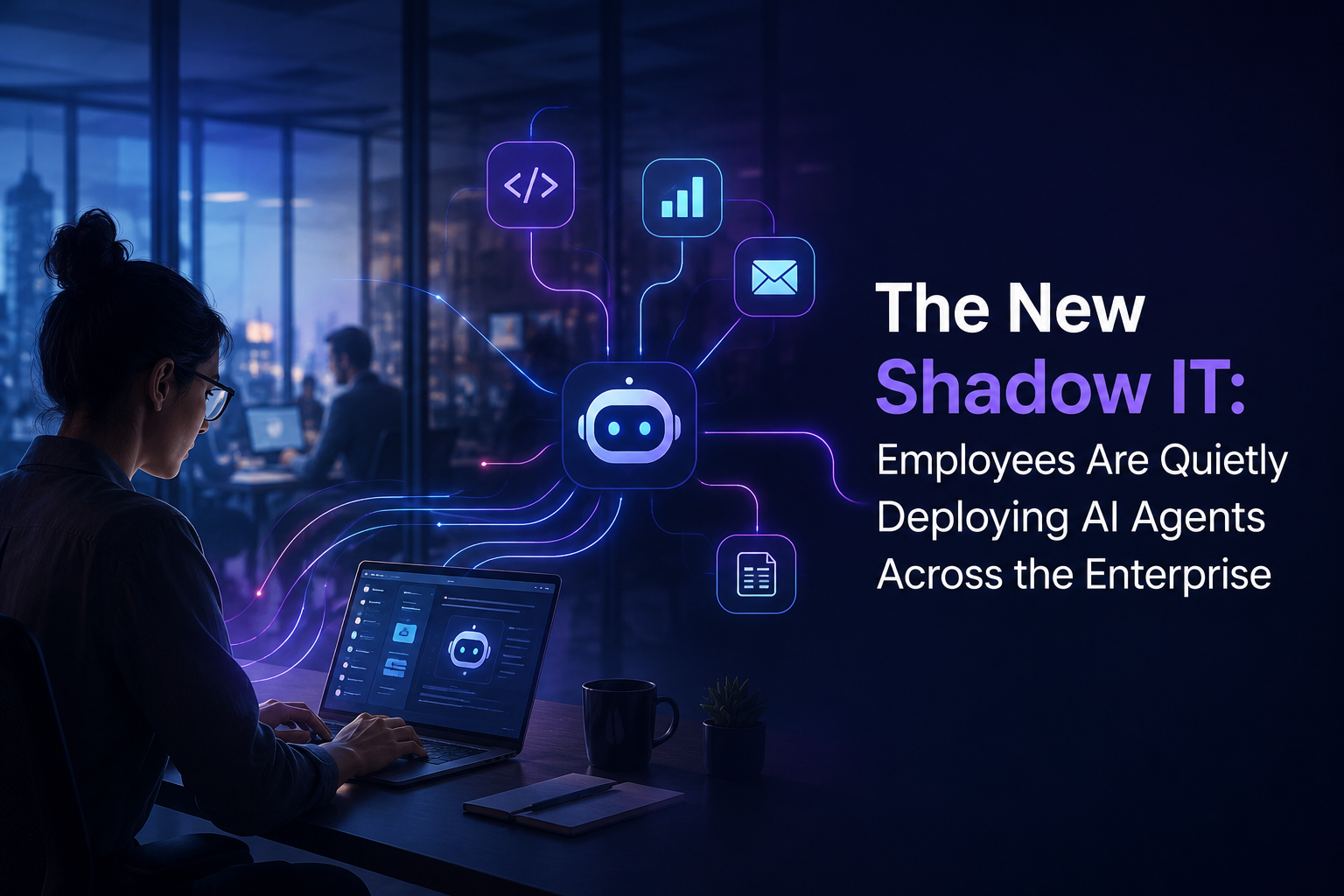
Not long ago, Shadow IT referred to employees using unauthorized software, cloud storage platforms, or collaboration tools without involving the IT department. Today, a new version of that challenge is emerging, and it is evolving much faster. Across enterprises, employees are quietly adopting AI Agents to automate repetitive work, summarize meetings, write reports, analyze data, manage projects, generate code, and even interact with customers. In many cases, these deployments happen without formal governance, security reviews, or organizational oversight.
The rise of accessible generative AI platforms has significantly lowered the barrier to automation. Business users no longer need programming expertise to build workflows or deploy intelligent assistants. They can simply describe a task, connect business applications, and create an AI-powered process in minutes. While this acceleration is improving productivity, it is also introducing a new layer of operational complexity that many organizations are only beginning to recognize.
For B2B decision-makers, the challenge is no longer whether AI agents will become part of everyday work. They already have. The more pressing question is whether organizations have enough visibility to understand where AI is being used, what business decisions AI agents are influencing, and how the associated risks are being managed.
AI Adoption Is Outpacing Enterprise Governance
The adoption of AI Agents has moved far beyond experimental innovation teams. Marketing teams use them to create campaign assets and research competitors, while finance automates reporting and forecasting. HR streamlines recruitment and employee communications, sales personalizes outreach and account research, and software teams increasingly rely on AI coding assistants throughout development.
This widespread adoption reflects a broader shift in enterprise technology. AI is no longer viewed as a specialized capability reserved for data scientists. It is becoming a standard workplace tool embedded across daily operations.
Recent developments across the technology industry reinforce this momentum. Major software providers continue integrating AI assistants directly into productivity suites, enterprise applications, collaboration platforms, and customer relationship management systems. At the same time, organizations are adopting specialized AI tools that connect with internal databases, automate approvals, and execute increasingly sophisticated business workflows.
However, rapid accessibility often creates unintended consequences. Different departments may deploy separate AI solutions without standardized governance, resulting in inconsistent outputs, duplicated automation efforts, fragmented knowledge, and varying security practices. Employees may unknowingly upload sensitive business information into external AI platforms or rely on responses generated from incomplete or outdated data.
The result is a modern version of Shadow IT, one where automation expands faster than organizational visibility.
The Governance Challenge Extends Beyond Security
Conversations about enterprise AI often focus on cybersecurity, but governance extends much further. The real challenge involves understanding how autonomous systems influence business decisions, customer interactions, regulatory compliance, and operational consistency.
As AI Agents become capable of performing multi-step tasks with minimal human supervision, organizations must establish greater confidence in how those decisions are made. An AI assistant that generates inaccurate financial summaries, recommends incorrect procurement decisions, or produces inconsistent customer responses can create business risks that extend well beyond technical concerns. Strengthening cyber resilience is therefore becoming equally important, ensuring AI-driven systems remain secure, reliable, and resilient against evolving cyber threats while supporting critical business operations.
Transparency is becoming increasingly important as enterprises adopt AI at scale. Decision-makers want greater visibility into which AI models are being used, what data they access, how outputs are validated, and whether business policies are consistently enforced across automated workflows.
The regulatory environment is also evolving rapidly. Governments and industry regulators continue advancing frameworks focused on responsible AI, transparency, accountability, and risk management. These developments are encouraging enterprises to document AI usage, strengthen internal governance practices, and establish clearer oversight of automated decision-making processes.
Organizations are also recognizing that AI governance cannot remain solely within IT departments. Legal teams, compliance leaders, cybersecurity professionals, data governance specialists, HR, and business executives all play important roles in ensuring AI supports business objectives while maintaining trust and regulatory alignment.
The conversation is gradually shifting from restricting AI adoption to enabling responsible innovation supported by appropriate governance frameworks.
Competitive Advantage Will Come From Visibility, Not Restriction
Attempting to prohibit employees from using AI is unlikely to succeed. Knowledge workers increasingly expect intelligent automation to be available as part of their everyday work environment. Restrictive policies often encourage employees to seek external solutions rather than approved enterprise platforms, increasing organizational risk instead of reducing it.
Forward-looking organizations are taking a different approach. Instead of asking whether employees should use AI, they are focusing on understanding how AI is being used, where it creates measurable value, and what governance structures are required to support long-term adoption. As enterprise adoption grows, evaluating the right AI agent service has also become an important consideration for organizations looking to deploy secure, governed, and scalable AI capabilities across business functions.
This shift is encouraging investments in centralized AI governance, enterprise-approved AI platforms, identity management, access controls, monitoring capabilities, and standardized usage policies. Organizations are also prioritizing AI literacy so employees understand both the opportunities and responsibilities associated with intelligent automation.
Another emerging trend is integrating AI governance into broader digital transformation efforts. Instead of managing AI separately, enterprises are embedding governance into cybersecurity, risk management, compliance, and data governance to ensure consistent oversight as AI adoption expands.
Ultimately, AI Agents represent one of the most significant workplace innovations in recent years. Their ability to improve productivity, accelerate decision-making, and automate complex processes will continue driving enterprise adoption across industries. At the same time, their rapid deployment is redefining what organizational governance looks like in an AI-first workplace.
The new Shadow IT is not simply about unauthorized software. It is about invisible intelligence operating across the enterprise, influencing decisions, workflows, and customer experiences every day. Organizations that develop visibility, governance, and cross-functional collaboration around AI today will be better equipped to capture its long-term value while minimizing unnecessary operational and compliance risks. As AI becomes an integral part of modern business, the organizations that thrive will be those that balance innovation with accountability rather than treating the two as competing priorities.