India’s Digital Personal Data Protection Act, 2023 in 2026: What Businesses Must Do Now Before Enforcement Tightens
 Vansh Banthia,
4 months ago
5 min read
Vansh Banthia,
4 months ago
5 min read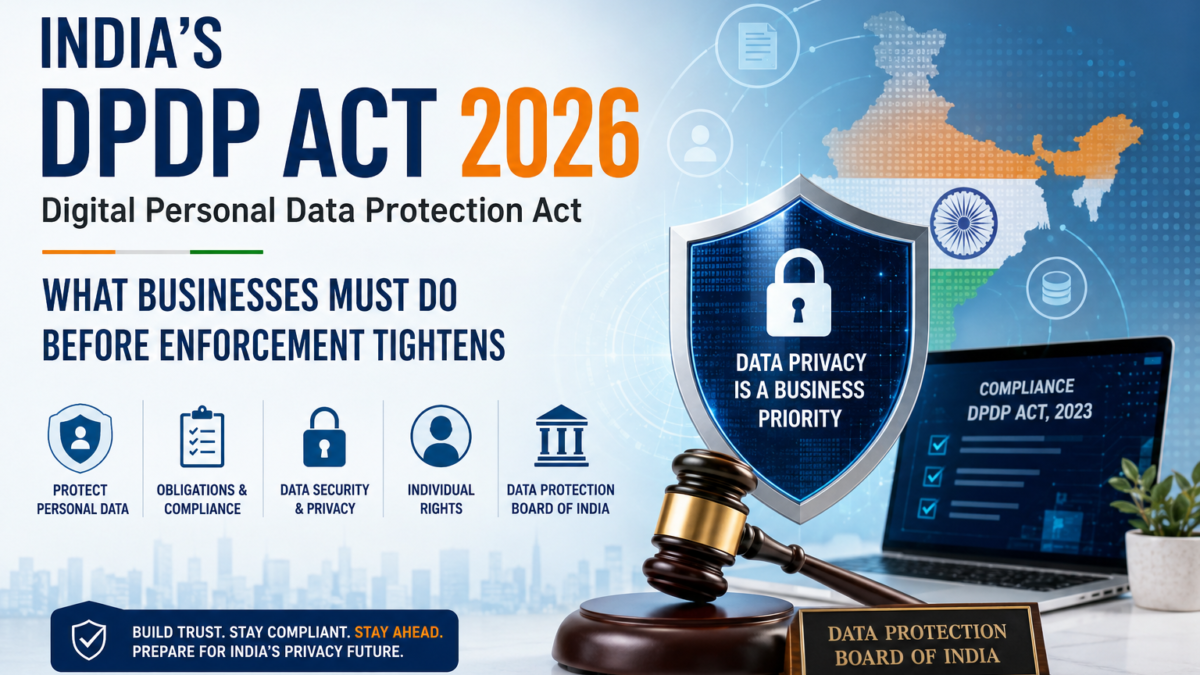
If your business collects customer data in India, 2026 is the year to stop treating privacy compliance as a “later” problem. India’s data protection regime has moved beyond broad legislation into active implementation. The Digital Personal Data Protection Act, 2023 gave the country its legal framework, and the Digital Personal Data Protection Rules, 2025 operationalised that framework in November 2025. By January 2026, the Government was already describing the regime as a live, citizen-centric system designed to balance privacy, innovation, and public interest.
What makes this moment different is not just the law itself, but the fact that the enforcement architecture is now taking shape. The Government had already established the Data Protection Board of India in November 2025, and in May 2026 the Ministry of Electronics and Information Technology invited applications for the posts of Chairperson and four Members. That is a strong signal to businesses: India’s privacy law is no longer a distant policy discussion. It is becoming an operational compliance reality.
Why 2026 is the turning point for the Data Protection Board of India
Many companies made the mistake of reading the DPDP Act as a “wait and see” law. That no longer works. The Board is meant to function as an independent adjudicatory authority with power to inquire into personal data breaches and non-compliance, direct mitigation and remediation, and impose monetary penalties. In other words, the question has shifted from “Will India enforce this?” to “How ready are we when it does?” Source
This matters even more because the Rules introduced phased implementation rather than a single all-or-nothing launch date. Some provisions took effect immediately upon publication in November 2025, Rule 4 is scheduled to take effect one year later, and several other rules become effective eighteen months after publication. That means 2026 is not a quiet gap year. It is the build-out period in which responsible businesses should be closing gaps before enforcement pressure intensifies.
What the DPDP Rules, 2025 mean in practice
The new regime is especially important for businesses because it turns abstract privacy principles into concrete operational duties. Under the official government note, every Data Fiduciary must provide a separate consent notice that is clear, easy to understand, and specific about why personal data is being collected and used. If a breach occurs, affected individuals must be informed without delay in plain language, including what happened, what the impact may be, and what steps are being taken. For children’s data, verifiable parental or guardian consent is required in many cases. These are not cosmetic obligations. They go to the heart of how websites, apps, SaaS companies, employers, and platforms design their data flows.
The penalty exposure is also significant enough to move privacy out of the legal department and into the boardroom. The official note says failure to maintain reasonable security safeguards can attract penalties of up to ₹250 crore. Failure to notify the Board or affected individuals of a personal data breach, as well as violations involving children’s data obligations, can each attract penalties of up to ₹200 crore. Other violations may attract penalties up to ₹50 crore. For any serious business handling Indian user data, that makes DPDP preparation a revenue-protection issue, not just a compliance exercise.
Why this should matter to your customers too
The DPDP framework is powerful not only because it imposes duties on businesses, but because it gives individuals meaningful rights. The Government’s January 2026 release highlighted rights including the ability to give or refuse consent, know how data is used, access personal data, correct it, update it, erase it, nominate another person to exercise rights, and receive protection during personal data breaches. It also pointed to a required response window of up to ninety days for handling relevant requests. That means privacy is becoming part of customer trust, brand reputation, and retention—not just regulatory defense. Source
This is exactly why high-growth businesses should treat DPDP readiness as a growth lever. Customers are increasingly sensitive to how companies collect, store, and use their information. A brand that can clearly explain consent, retention, access, deletion, and breach response will look more credible than one hiding behind vague legalese. In 2026, privacy language is no longer just a policy page issue. It is part of conversion, onboarding, enterprise sales, and long-term trust.
What smart businesses should do now under the DPDP Act
The most effective response is not panic. It is prioritisation. Start by identifying what digital personal data you collect, where it comes from, why you use it, who can access it, and where it is stored. Then rewrite consent notices so they are specific and readable, not hidden inside generic terms. Review your incident response plan so that breach communication can actually happen quickly and clearly. If you process children’s data or sensitive categories of user information, your controls should be stricter now, not later. And if your company touches India-facing products from outside India, do not assume geography protects you—the Act can apply to processing connected with offering goods or services to individuals in India.
The businesses that win in this environment will not be the ones scrambling after a notice or breach. They will be the ones that use privacy readiness to move faster, sell with more confidence, and build trust before competitors catch up. India’s DPDP era is not coming. It is already here—and 2026 is the year businesses prove whether they are ready for it.