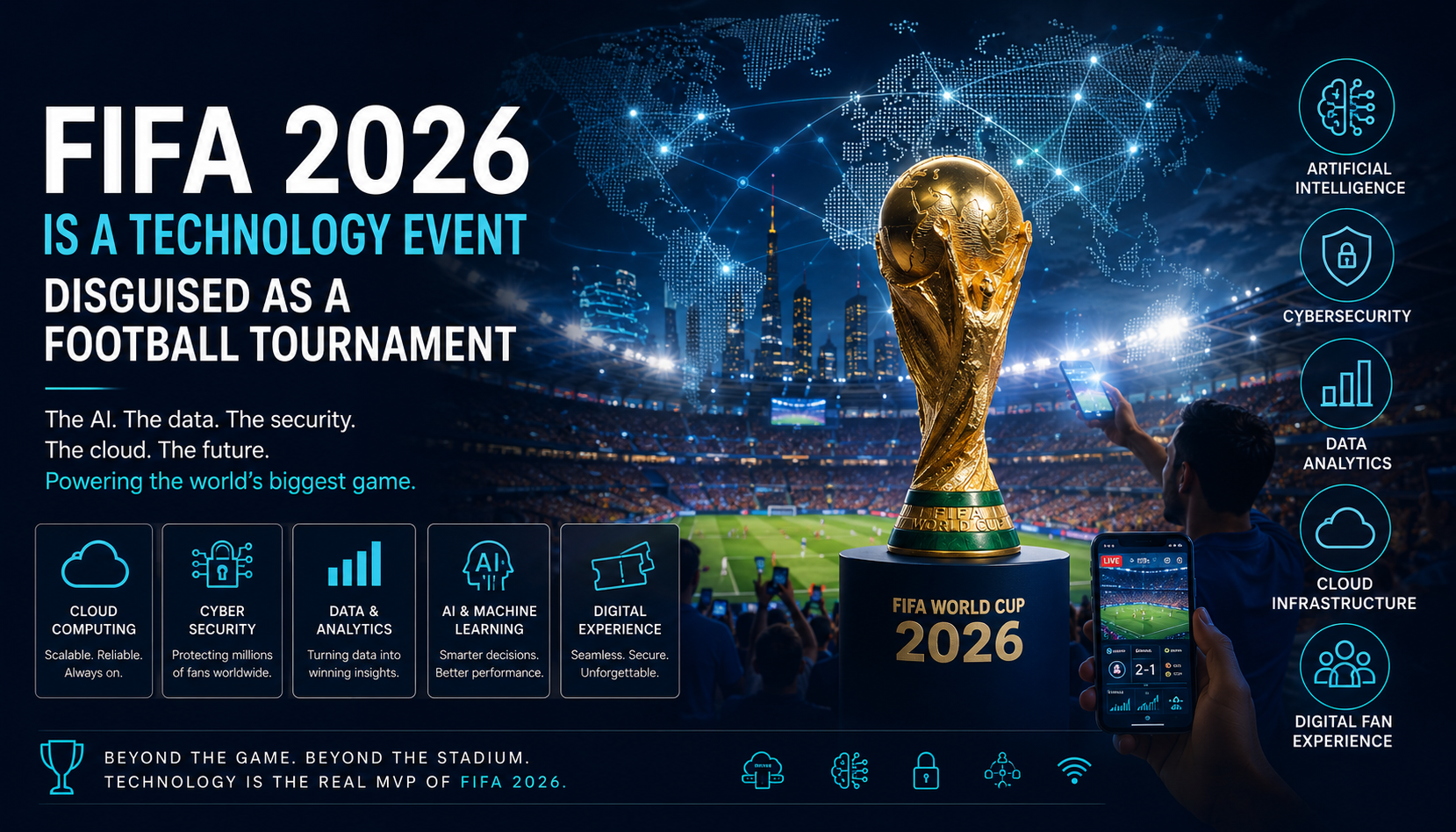
FIFA 2026 Is a Technology Event Disguised as a Football Tournament
 Vansh Banthia,
4 months ago
5 min read
Vansh Banthia,
4 months ago
5 min read
When most people think about the FIFA World Cup, they think about goals, rivalries, packed stadiums, and unforgettable moments.
What they don’t see is the enormous technology ecosystem working behind the scenes.
The FIFA World Cup 2026, set to be hosted across the United States, Canada, and Mexico, will be the largest tournament in the competition’s history. With more teams, more matches, more venues, and millions of fans interacting both physically and digitally, the event represents something far bigger than sport.
It is one of the world’s largest technology deployments.
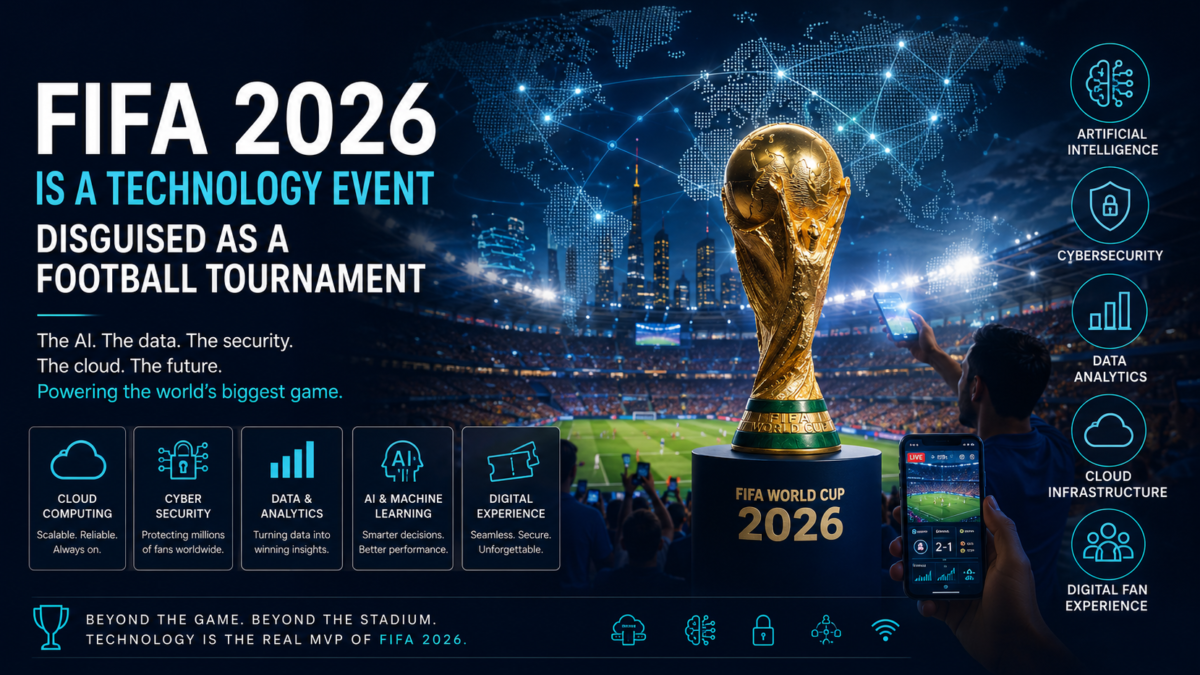
In many ways, FIFA 2026 is a technology event disguised as a football tournament.
The Invisible Infrastructure Behind the World’s Biggest Sporting Event
Modern sporting events are no longer powered solely by stadiums and players. They rely on a complex network of technologies that ensure everything runs smoothly before, during, and after every match.
From ticket purchases and stadium access to live streaming and security monitoring, technology touches nearly every aspect of the fan experience.
Consider the scale:
- Millions of tickets sold digitally
- Billions of online interactions
- Massive volumes of streaming data
- Real-time security monitoring
- Cross-border logistics coordination
- AI-powered analytics and insights
Behind every successful match lies an intricate web of cloud infrastructure, cybersecurity systems, data platforms, and intelligent automation.
The World Cup may be won on the pitch, but it is powered by technology.
Artificial Intelligence Is Becoming a Key Player
AI is rapidly transforming professional sports.
National teams and football organizations increasingly use artificial intelligence to analyze player performance, study opponent tactics, predict injury risks, and improve training efficiency.
Advanced machine learning systems can process thousands of hours of match footage and identify patterns that human analysts might miss.
But the impact extends beyond the players.
AI is expected to play a major role in:
- Fan engagement
- Customer support
- Personalized content delivery
- Event management
- Crowd behavior analysis
- Predictive maintenance
For technology leaders, the World Cup serves as a real-world demonstration of how AI can support decision-making at scale.
The same technologies helping coaches make tactical decisions are increasingly helping businesses optimize operations, improve customer experiences, and identify growth opportunities.
Cybersecurity Becomes Mission Critical
Few events attract as much global attention as the FIFA World Cup.
Unfortunately, that attention extends beyond football fans.
Major international events are prime targets for cybercriminals seeking to exploit large audiences, critical infrastructure, and digital transactions.
Potential threats include:
- Phishing campaigns
- Ticketing fraud
- Data breaches
- Distributed denial-of-service (DDoS) attacks
- Payment system attacks
- Identity theft
With millions of users interacting across digital platforms, security becomes a non-negotiable requirement.
For cybersecurity vendors and enterprise leaders, the World Cup highlights an important reality:
If a global sporting event cannot afford downtime, neither can modern businesses.
As organizations continue their digital transformation journeys, resilience and cybersecurity will become competitive advantages rather than technical necessities.
Data Is the New Playmaker
Football has evolved into a data-driven sport.
Today, analysts examine everything from player movement and passing accuracy to expected goals (xG) and performance trends.
The same principle applies to business.
Organizations increasingly rely on data to understand customers, optimize operations, forecast demand, and improve decision-making.
The World Cup offers a highly relatable example of how analytics creates competitive advantages.
Winning teams are not simply relying on talent. They are using data to uncover insights and make smarter decisions.
Businesses that embrace analytics are following the same playbook.
In both football and business, intuition matters.
But data wins championships.
Cloud Technology Powers the Global Experience
The modern fan experience depends heavily on cloud computing.
Fans expect instant access to:
- Live scores
- Video highlights
- Streaming platforms
- Mobile applications
- Social interactions
- Personalized content
Delivering these experiences to millions of users simultaneously requires enormous computing power and scalability.
Cloud platforms enable organizations to process vast amounts of data while maintaining performance and reliability.
The same cloud technologies supporting global sporting events are now helping businesses accelerate innovation, reduce costs, and scale operations more efficiently.
The World’s Largest Collaboration Project
The FIFA World Cup is not just a sporting competition.
It is one of the world’s most complex collaboration exercises.
Thousands of organizations must work together, including:
- Technology providers
- Security agencies
- Transportation networks
- Telecommunications companies
- Media organizations
- Event management teams
Success depends on seamless coordination across multiple countries and time zones.
This mirrors a challenge faced by many enterprises today.
As businesses become increasingly global and digital, collaboration platforms, workflow automation, and integrated technology ecosystems are becoming essential.
The World Cup demonstrates what is possible when technology enables large-scale coordination.
What Businesses Can Learn From FIFA 2026
For business leaders, the World Cup offers valuable lessons that extend far beyond football.
Technology Is No Longer a Support Function
Technology has become central to delivering experiences, managing operations, and creating competitive advantages.
Data Drives Better Decisions
Organizations that effectively collect, analyze, and act on data gain a measurable advantage.
Security Must Be Built In
Cybersecurity is no longer an afterthought. It is a business-critical capability.
AI Is Moving Into the Mainstream
Artificial intelligence is rapidly becoming an operational necessity rather than an experimental technology.
Scalability Matters
Organizations must build systems capable of handling growth, demand spikes, and unexpected challenges.
Final Thoughts
When the world tunes in to watch FIFA World Cup 2026, most viewers will focus on the players, the goals, and the drama on the field.
Technology leaders will see something else.
They will see AI making smarter decisions, cybersecurity protecting critical systems, cloud platforms powering global experiences, and data driving performance at every level.
The biggest story of FIFA 2026 may not be who lifts the trophy.
It may be how technology quietly powers one of the most complex and connected events ever created.
The future of sport is digital.
And increasingly, the future of business is following the same game plan.