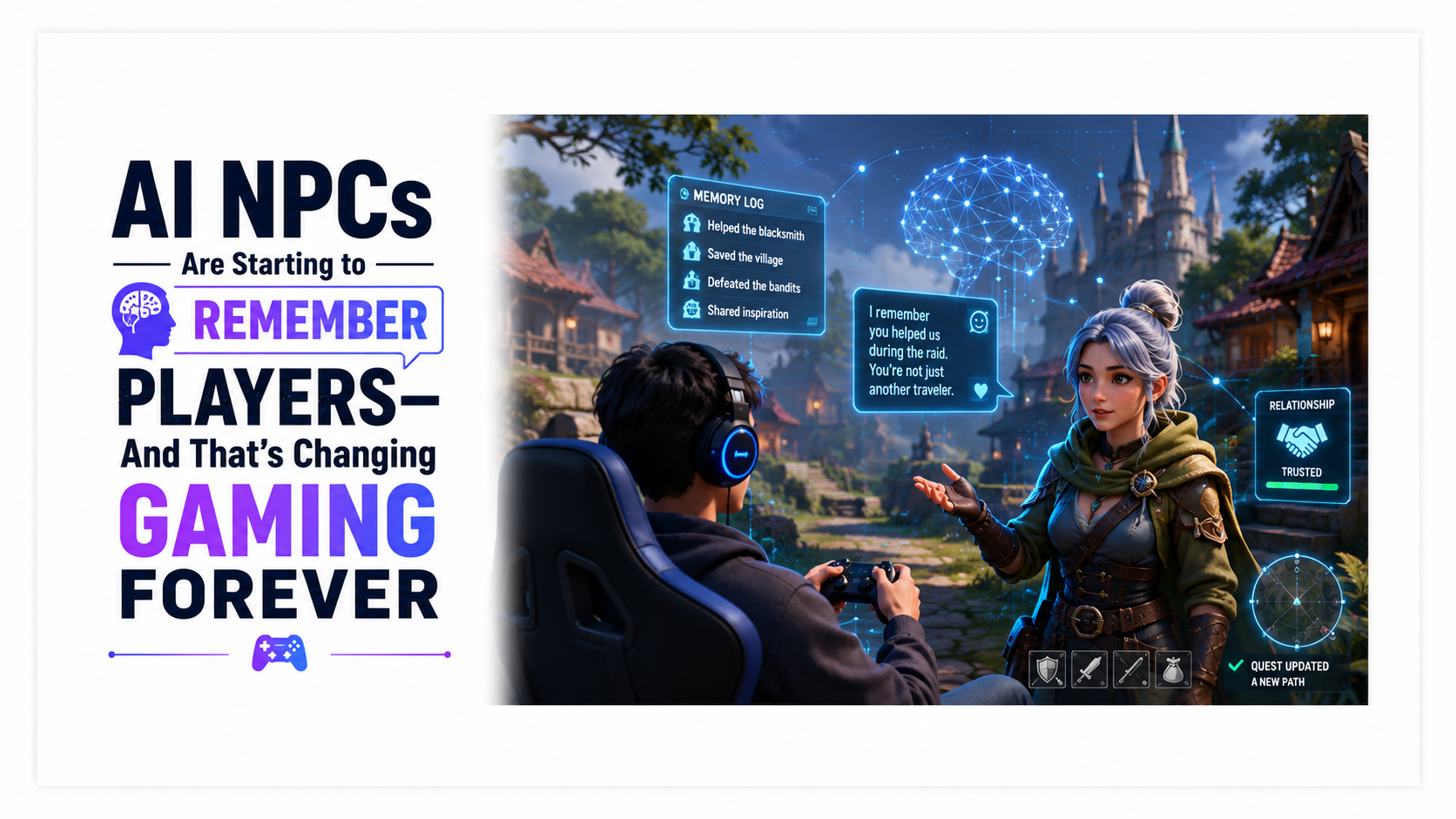
AI NPCs Are Starting to Remember Players And That’s Changing Gaming Forever
 Purva Wankhade,
3 months ago
4 min read
Purva Wankhade,
3 months ago
4 min read
For decades, non-playable characters (NPCs) have followed predictable scripts. They repeated the same dialogue, forgot every interaction, and treated every player like a stranger. No matter how many times you saved a village or betrayed a faction, most NPCs simply reset the next time you spoke to them. That era is beginning to fade. Thanks to advances in artificial intelligence, gaming is entering a new chapter where NPCs can remember previous conversations, react to player choices, and evolve alongside the story. Instead of feeling like scripted background characters, they are becoming believable digital personalities. The result is a future where every adventure feels unique because the world remembers you.
Gaming Is Entering the Age of Intelligent NPCs
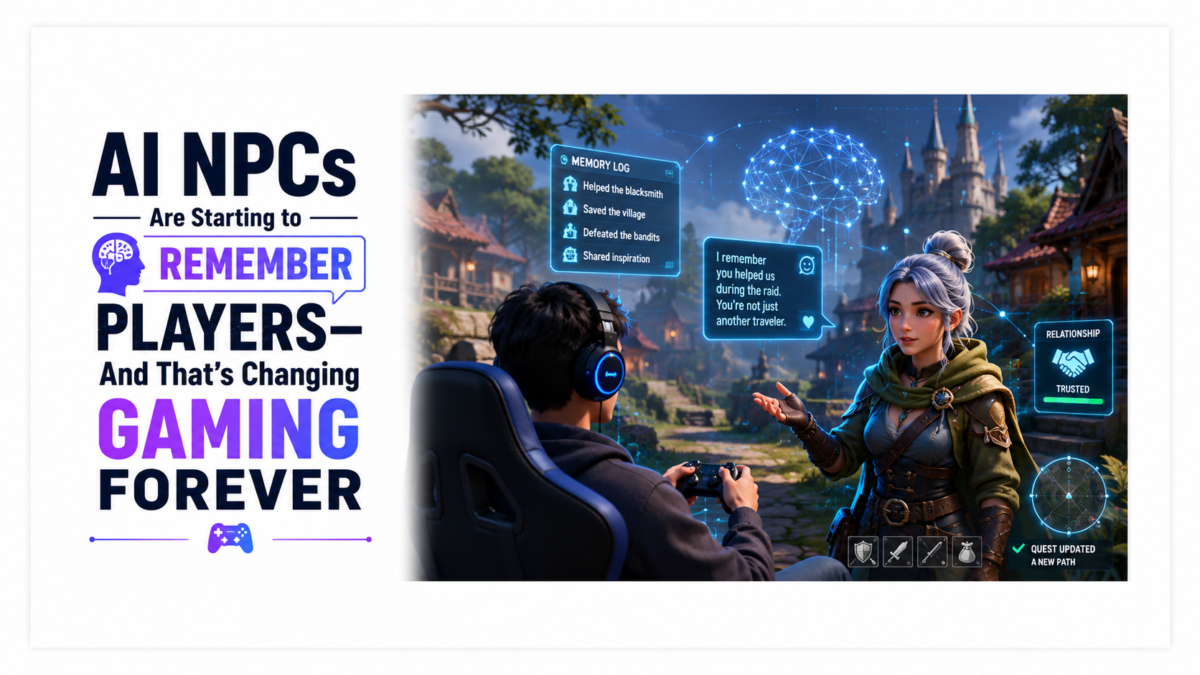
Artificial intelligence has transformed many industries, and gaming is quickly becoming one of its most exciting frontiers. Modern AI-powered NPCs can store contextual memories, recognize recurring player behavior, and respond differently based on previous encounters. If a player consistently helps a village, its residents may become more trusting. If they repeatedly betray allies, those actions could shape future relationships.
Rather than following rigid dialogue trees, these NPCs create conversations that feel dynamic and personal. Every interaction contributes to a living world where decisions carry lasting consequences, making gameplay more immersive than ever before.
Gaming Worlds Are Becoming More Personal
One of the biggest criticisms of open-world games has always been repetition. Players spend hundreds of hours exploring detailed environments, yet the people inhabiting those worlds often feel static. AI is changing that by allowing NPCs to remember names, choices, and even emotional interactions.
Imagine returning to a town after twenty hours of gameplay and discovering that merchants remember previous negotiations or companions reference adventures you completed days earlier. These persistent memories make gaming feel less like progressing through programmed missions and more like living inside a believable virtual society.
Instead of restarting every conversation, players become part of an evolving narrative shaped by their own actions.
Gaming Developers Are Rethinking Storytelling
Traditional storytelling depends on carefully scripted dialogue and fixed story branches. While effective, it limits how much freedom players truly have. AI-generated memory systems allow developers to create stories that adapt naturally without requiring thousands of handcrafted dialogue options.
This shift enables gaming studios to focus less on predicting every possible decision and more on building intelligent systems capable of responding creatively. The result is greater player freedom while maintaining coherent storytelling.
Industry analysts, including discussions featured by Whitepapers Online, have noted that AI is increasingly becoming a strategic technology across creative industries, with interactive entertainment emerging as one of its most promising applications.
Gaming Could Finally Deliver Truly Unique Adventures
Every gamer wants their choices to matter. Yet many titles eventually guide players back toward the same endings despite offering different paths.
Persistent AI memory changes that expectation. NPCs may form friendships, hold grudges, develop trust, or even refuse assistance based on earlier decisions. Two players exploring identical worlds could experience completely different relationships and outcomes.
This evolution transforms gaming from a series of scripted events into a collection of personalized experiences where every playthrough becomes genuinely different.
For developers, replayability is no longer limited to alternate endings. The journey itself becomes unique.
Gaming Studios Still Face Important Challenges
Despite the excitement, implementing memory-driven AI introduces new challenges. NPCs must balance believable conversations with narrative consistency while avoiding repetitive or inappropriate responses. Developers must also manage computational costs, privacy considerations for online experiences, and the enormous complexity of tracking countless player interactions.
Maintaining performance without sacrificing realism remains one of the industry’s biggest technical hurdles. Studios investing in these systems are discovering that creating memorable AI requires far more than advanced language models. It demands careful design, testing, and continuous refinement.
Even so, rapid progress suggests these obstacles will become increasingly manageable over the coming years.
Gaming Is Moving Beyond Scripted Experiences
The future of gaming may not be defined by better graphics alone. Instead, it could be remembered for creating worlds that genuinely recognize the people exploring them. AI-powered NPCs represent a shift from static storytelling toward living digital ecosystems where characters grow alongside players instead of waiting endlessly for the next scripted interaction.
As these technologies mature, memorable adventures will no longer depend solely on breathtaking visuals or massive maps. They will depend on believable relationships, meaningful consequences, and characters capable of remembering the choices that define every journey.
The next generation of gaming will not simply look more realistic, it will feel more human. Players may soon stop asking whether an NPC is controlled by artificial intelligence and start wondering whether that character actually remembers them. That possibility changes expectations for storytelling, immersion, and player agency forever, proving that the future of gaming is not just about playing inside virtual worlds, but about being remembered by them.