The B2B Attention Crisis: Why Your Buyers Are Ignoring You (And What to Do About It)
 Simon Powell,
7 months ago
3 min read
Simon Powell,
7 months ago
3 min read
Introduction: When “Good B2B Marketing” Stops Working
A few years ago, if you had the right setup—email campaigns, gated content, retargeting ads—you could reliably generate engagement. Not amazing results, but enough to keep the pipeline moving.
Today, that same setup feels broken.
Emails don’t get opened like they used to. Ads are ignored. Content downloads don’t translate into conversations. And even when leads come in, they rarely convert the way they should.
This isn’t because marketing teams suddenly got worse. It’s because buyer behavior has fundamentally changed.
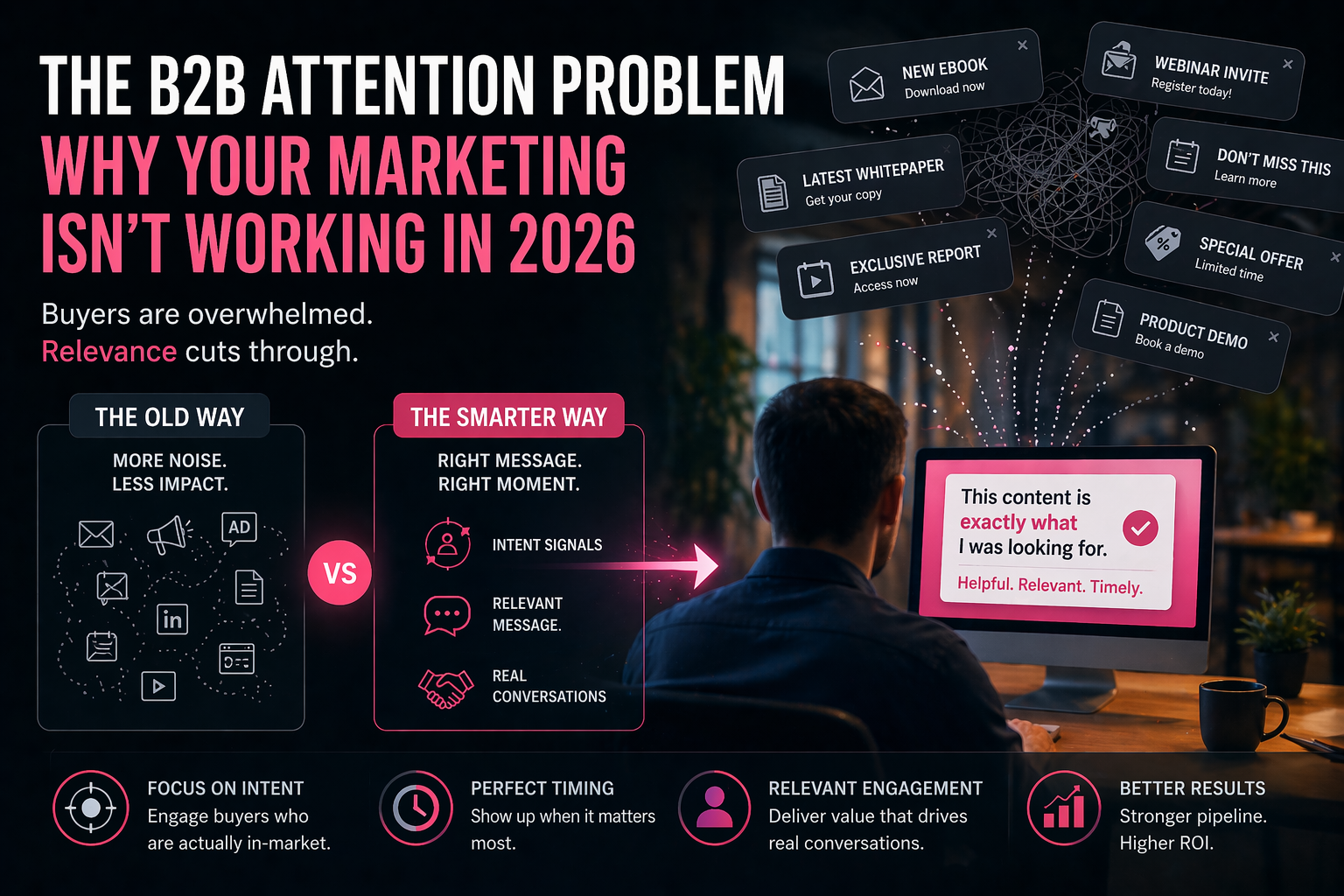
There’s More Content Than Ever—And That’s the Problem
Every B2B marketing company is now a content company.
Blogs, whitepapers, LinkedIn posts, webinars—there’s a constant stream of “valuable content” being pushed out. In theory, this should help buyers make better decisions. In reality, it’s doing the opposite.
Buyers are overwhelmed.
Instead of carefully consuming content, they’re skimming, skipping, and filtering aggressively. Most of what they see doesn’t even register.
So even if your content is genuinely useful, it’s competing in an environment where attention is already stretched thin.
Why More Activity Isn’t Fixing It
When engagement drops, the natural reaction is to increase activity.
More campaigns. More touchpoints. More channels.
But this often makes things worse.
When buyers are already overloaded, increasing frequency doesn’t improve visibility—it accelerates fatigue. Your brand becomes part of the noise instead of standing out from it.
This is why many teams are seeing diminishing returns despite doing “more” than ever before.
The Real Issue: Timing and Relevance
If you look closely, the problem isn’t just volume—it’s timing.
Most marketing operates on fixed schedules: campaigns go out on specific dates, nurture sequences follow predefined steps, and messaging is planned weeks in advance.
But buyers don’t follow those timelines.
They engage when they have a need. They research when a problem becomes urgent. And they make decisions based on what’s relevant in that moment—not what was scheduled in your campaign calendar.
If your message doesn’t align with that moment, it gets ignored.
What High-Performing Teams Are Doing Differently
The teams that are still seeing strong engagement haven’t necessarily increased their output. Instead, they’ve changed how they approach targeting and timing.
They focus more on intent signals—indicators that a company is actively researching or considering a solution. This could be increased activity around specific topics, repeated visits to key pages, or engagement with similar content across platforms.
Instead of pushing messages broadly, they prioritize accounts that are already showing interest.
This shifts marketing from being proactive in volume to being responsive in context.
Content Still Matters—But Context Matters More
There’s a tendency to blame content when campaigns underperform. But in many cases, the content isn’t the issue.
Even strong, well-researched assets can fail if they reach the wrong audience or arrive at the wrong time.
On the flip side, even simple content can perform well if it’s delivered when a buyer is actively looking for that information.
This doesn’t mean quality isn’t important—it absolutely is. But content alone isn’t enough anymore. It needs the right context to work.
The Shift Toward Smarter Execution
What we’re seeing in 2026 is a move toward smarter, more adaptive marketing systems.
Instead of relying entirely on pre-planned campaigns, marketers are starting to:
- Adjust targeting dynamically based on behavior
- Prioritize high-intent accounts over broad audiences
- Align B2B marketing efforts more closely with sales activity
- Measure success based on pipeline impact, not just engagement metrics
This approach doesn’t necessarily require more budget or more content. It requires better use of data and better coordination across teams.
Conclusion: It’s Not Broken—It’s Evolving
B2B marketing isn’t failing. It’s evolving.
What worked before—high-volume outreach, static campaigns, generic messaging—is no longer enough in a more competitive and crowded environment.
The teams that adapt are the ones that focus less on how much they’re doing and more on how well it aligns with buyer behavior.
Because in today’s market, attention isn’t guaranteed.
It has to be earned—through relevance, timing, and a clear understanding of what buyers actually need.