The Content Syndication Shift: Why 2026 is Killing Volume-Driven Lead Gen
 Vansh Banthia,
7 months ago
4 min read
Vansh Banthia,
7 months ago
4 min read
Introduction: The Lead That Looked Perfect (But Wasn’t)
In the world of marketing, understanding content syndication is crucial.
It looked like a win on paper.
A campaign had just wrapped. The numbers were strong—thousands of downloads, a long list of new leads, and dashboards glowing green. Marketing celebrated. Reports were sent. Targets were “met.” However, the effectiveness of content syndication was still in question.
And then reality hit.
Sales started dialing. Emails went out. Follow-ups were triggered. But something felt off. Conversations didn’t convert. Prospects weren’t ready. Some didn’t even remember downloading the content.
What looked like success quickly unraveled into frustration.
This is the moment many B2B teams are waking up to in 2026. The realization is simple but uncomfortable: volume was never the problem—but it was never the solution either.
The Old Playbook is Breaking
For years, content syndication followed a predictable formula. Push your whitepaper or eBook across as many platforms as possible, capture leads through gated forms, and pass them to sales. The assumption was straightforward—the more leads you generate, the higher your chances of closing deals.
But buying behavior has changed.
Today’s B2B buyer is more informed, more independent, and far less tolerant of irrelevant outreach. They don’t engage just because they downloaded something. They engage when they’re ready. And that readiness doesn’t come from a form fill—it comes from intent.
The problem with traditional syndication isn’t distribution. It’s disconnect. It treats every download as equal, when in reality, every buyer is at a completely different stage in their journey.
The Moment Everything Changed
Somewhere along the way, smarter teams started asking better questions.
Instead of celebrating the number of leads, they began questioning their quality. Instead of asking how many people downloaded their content, they asked why those people engaged in the first place.
And that shift led them to something far more powerful than volume—intent signals.
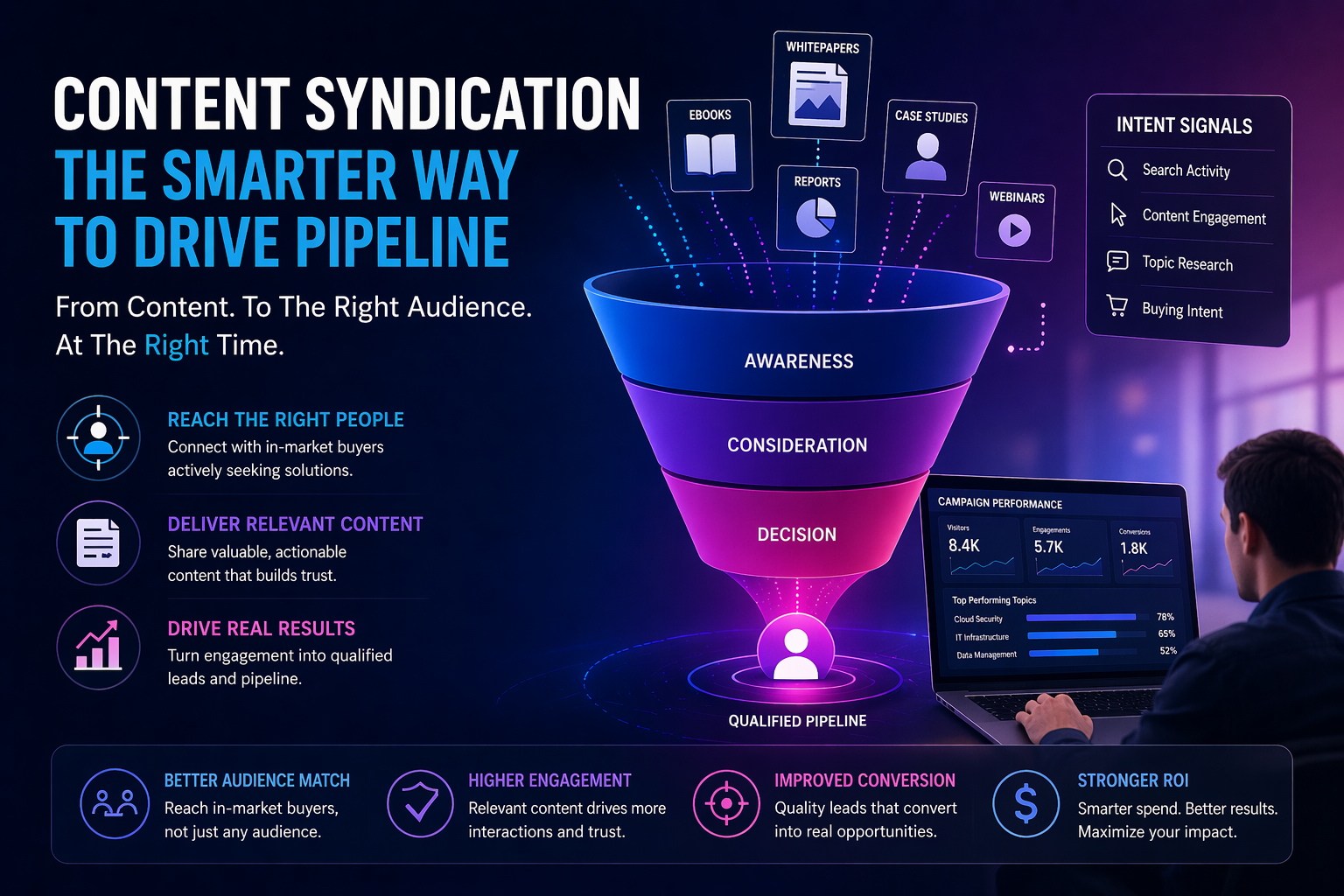
Intent isn’t about a single action. It’s about patterns. It’s the repeated search for a topic, the consistent engagement with related content, the subtle signals that indicate a company is actively exploring a solution.
When marketers started layering these signals into their syndication strategies, everything changed. Campaigns became sharper. Conversations became easier. Sales cycles became shorter.
Not because they were doing more—but because they were finally doing it right.
From Broadcasting to Precision
Modern content syndication doesn’t feel like broadcasting anymore. It feels like timing.
Instead of pushing content to everyone, it reaches the few who actually care. Instead of interrupting, it aligns. Instead of guessing, it knows.
A buyer researching cybersecurity solutions doesn’t need another generic whitepaper. They need something that speaks directly to their problem, at the exact moment they’re trying to solve it.
This is where intent-driven syndication wins. It connects content with context. And in B2B, context is everything.
Why Content Still Makes or Breaks the Outcome
There’s a common misconception that better targeting alone can fix syndication. It can’t.
Even the most accurate intent signals won’t help if the content fails to deliver value. When a high-intent buyer engages with your asset, they’re not looking for a sales pitch. They’re looking for clarity. Insight. Direction.
This is the quiet shift many brands are still catching up to. Content is no longer just a lead magnet—it’s a decision-making tool.
The brands that are winning in 2026 understand this deeply. Their whitepapers don’t just inform; they guide. Their reports don’t just present data; they tell a story. And their content doesn’t just capture attention—it earns trust.
The Hidden Gap Between Marketing and Sales
One of the biggest casualties of volume-driven syndication has always been alignment.
Marketing celebrates lead numbers. Sales questions their quality. And somewhere in between, opportunities are lost.
Intent-driven syndication closes this gap.
When both teams are working from the same signals—understanding which accounts are active, which topics they care about, and where they are in the journey—conversations change. Outreach becomes relevant. Timing improves. Trust builds faster.
Suddenly, it’s not about chasing leads anymore. It’s about engaging buyers.
The Future Isn’t More—It’s Better
As we move deeper into 2026, one thing is becoming increasingly clear: the future of content syndication isn’t about scale alone. It’s about precision at scale.
The tools will get smarter. The data will get richer. AI will continue to refine targeting and delivery. But the core principle will remain the same—relevance beats reach.
The brands that embrace this shift will see it reflected in their pipelines. Not as inflated numbers, but as meaningful conversations, qualified opportunities, and real revenue impact.
Conclusion: The End of Noise, The Start of Intent
The era of volume-first lead generation is fading. Not because it didn’t work—but because it no longer works well enough.
Content syndication isn’t dying. It’s evolving.
And in this new phase, success belongs to those who understand a simple truth:
It’s not about how many people see your content.
It’s about reaching the ones who are already looking for it.