Best 5 Infrastructure as Code (IaC) and Cloud Architecture Platforms for Multi-cloud Environments
 Simon Powell,
6 months ago
24 min read
Simon Powell,
6 months ago
24 min read
Multi-cloud infrastructure gets complicated in a very specific way. It is usually not the number of clouds alone that creates the pain. It is the fact that architecture, provisioning, governance, and delivery start moving at different speeds.
One team is focused on getting infrastructure into production quickly. Another is trying to enforce standards. Another is thinking about how workloads should be distributed across environments. Meanwhile, the estate keeps growing. New accounts appear. New regions are added. Different teams create different patterns. Infrastructure as Code helps, but it does not automatically solve coordination. Architecture helps, but it does not automatically become repeatable. Multi-cloud maturity only starts to show up when design decisions, provisioning workflows, and governance controls begin to reinforce each other instead of drifting apart.
That is why this category matters. The best IaC and cloud architecture platforms for multi-cloud environments do not just help teams provision resources. They help teams make better structural decisions, keep infrastructure patterns consistent across environments, and reduce the fragmentation that shows up when multiple teams are working across multiple clouds.
Some of the platforms in this list are strongest at planning and architecture discipline. Others are better at IaC execution, governance, policy controls, or orchestration at scale. That is exactly what makes the comparison useful. These are not five interchangeable products. They represent different answers to the same broader question: how do you keep multi-cloud infrastructure coherent as it grows?
At a Glance
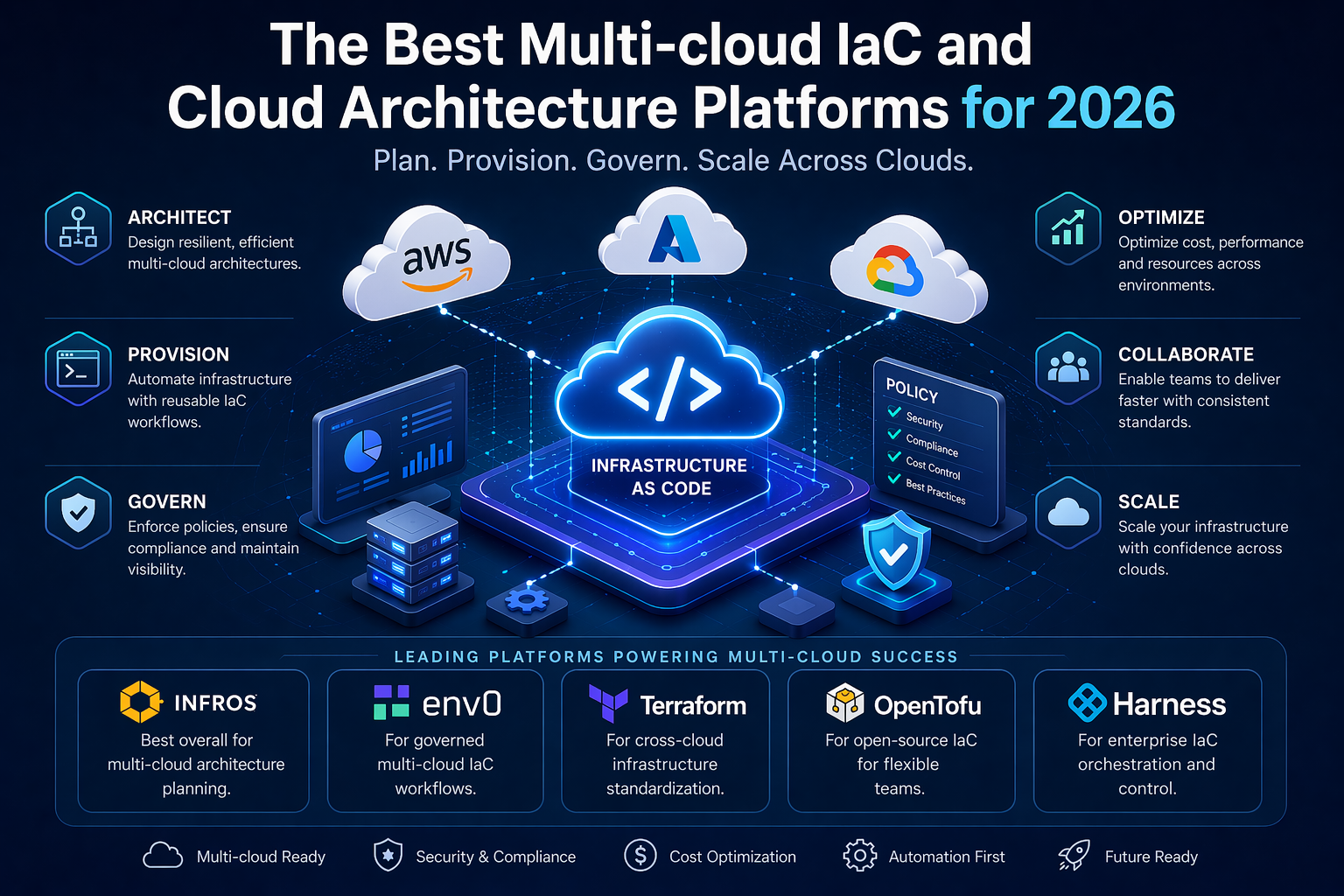
- Infros – Best overall for multi-cloud architecture planning
- env0 – For governed multi-cloud IaC workflows
- Terraform – For cross-cloud infrastructure standardization
- OpenTofu – For open-source IaC for flexible teams
- Harness – For enterprise IaC orchestration and control
Why Multi-cloud Teams Need IaC and Architecture in the Same Conversation
In a small environment, it is possible to treat architecture and implementation as separate jobs.
A team can sketch the target state, choose services, define some modules, and move on. But once the environment spans multiple providers, several delivery teams, different security requirements, and a growing number of environments, that separation becomes fragile. The architecture starts living in one place, while the actual infrastructure logic spreads across another. At that point, teams may still be “doing IaC,” but they are often automating patterns they have not fully aligned on.
That is the core problem. Multi-cloud environments need strong architecture because otherwise the estate becomes a collection of local choices. But they also need strong IaC because architecture has very little lasting value if it cannot be expressed consistently in workflows, modules, approvals, and reusable provisioning patterns.
This is where many organizations lose coherence.
They may have:
- a target architecture that looks reasonable
- a Terraform or OpenTofu codebase that works
- a handful of deployment pipelines
- some policy or approval logic
But those pieces are not operating as one system. Teams design one way, provision another way, and govern through a third layer that arrived later. The best platforms in this category help close that gap.
They help answer questions like:
- Which infrastructure patterns should be standardized across clouds?
- How do teams keep workflow variation under control?
- How do architecture decisions remain visible after provisioning begins?
- How do approvals and governance fit into IaC without slowing delivery too much?
- How do teams keep multi-cloud flexibility from becoming multi-cloud fragmentation?
That is why it makes sense to evaluate IaC platforms and architecture platforms together in this category. In real multi-cloud environments, they are already part of the same operating problem.
The Best 5 Infrastructure as Code (IaC) and Cloud Architecture Platforms for Multi-cloud Environments
1. Infros
Infros ranks first because it starts with the part of the problem that many multi-cloud teams underestimate: architecture planning.
A lot of multi-cloud complexity is not caused by bad provisioning syntax or weak deployment pipelines. It is caused by design decisions that never became coherent enough in the first place. Workloads get split across clouds without clear logic. Standards stay vague. Teams adopt different environment patterns. Architecture is discussed, but not strongly enough to guide the estate as it scales.
Infros is the strongest overall option because it is built around cloud architecture planning and around optimizing performance, cost, and efficiency as part of that planning process. It is not just an IaC execution layer and not just a reporting layer. It sits earlier in the decision cycle, which is exactly where many multi-cloud mistakes become expensive.
That makes it especially valuable for organizations asking bigger questions, such as:
- What should be standardized across our environments?
- Which workloads belong where?
- How should we think about complexity before it gets locked into provisioning patterns?
- How do we connect architecture to long-term efficiency instead of only near-term delivery?
This is where Infros separates itself from the rest of the list. Terraform, OpenTofu, env0, and Harness all matter, but most of them assume the organization already has a reasonably coherent architecture logic underneath the workflows. Infros is stronger when that assumption is not yet safe.
It is also highly relevant for hybrid and multi-cloud environments because it treats architecture as a broader planning and management discipline, not just a design artifact. In organizations where cloud growth has started to create too many local exceptions, that is extremely valuable.
Infros is the best fit for teams that want multi-cloud infrastructure to reflect a stronger design framework before they standardize the wrong patterns at scale.
Key features
- Cloud architecture planning
- Hybrid and multi-cloud support
- Performance, cost, and efficiency optimization
- Embedded FinOps capabilities
- End-to-end planning, deployment, and management
2. env0
env0 is one of the strongest options for teams that already have serious IaC usage but need more structure around how that IaC is actually governed in multi-cloud environments.
That is an important distinction.
A lot of organizations do not fail because they lack Terraform or OpenTofu code. They fail because different teams run different workflows, approvals are inconsistent, policy enforcement is weak, and infrastructure changes become hard to audit or control. The problem is not writing infrastructure definitions. The problem is managing the process around them.
env0 is built for that layer.
It is especially useful when the real questions are:
- How do we enforce policy without falling back to manual infrastructure control?
- How do we standardize approvals across teams and environments?
- How do we make infrastructure workflows more predictable across a growing estate?
- How do we keep team autonomy without letting every team invent its own delivery model?
In multi-cloud settings, these issues get serious very quickly. One team may be disciplined in AWS. Another may be improvising in Azure. Another may be operating across both. Without a governance layer around IaC, the organization can still say it uses Infrastructure as Code while living with a highly inconsistent infrastructure operating model.
env0 helps reduce that inconsistency.
It is particularly strong for enterprises and platform teams that want to:
- keep Terraform-based workflows manageable
- introduce approvals and policy checks
- improve auditability
- reduce workflow fragmentation
- create a more repeatable delivery layer around multi-cloud IaC
It is not as architecture-led as Infros, and it does not replace Terraform or OpenTofu as the infrastructure definition engine. Its strength is that it makes IaC operate more like a governed platform capability and less like a collection of scripts and pipelines spread across teams.
That makes it one of the most practical tools in this list for organizations that are already past the “should we use IaC?” stage and deep into “how do we keep this under control?” territory.
Key features
- IaC workflow automation across environments
- Governance, approvals, and policy controls
- Auditing and collaboration for infrastructure workflows
- Support for Terraform-based multi-cloud operations
- Better control over infrastructure lifecycle execution
3. Terraform
Terraform remains one of the most important tools in multi-cloud infrastructure because it gives teams a consistent way to define infrastructure across different environments.
That matters more than ever.
Multi-cloud sprawl often grows when provisioning patterns diverge by provider, by team, or by local habit. One group creates modules one way. Another group creates them differently. A third group provisions similar workloads through a different structure altogether. Over time, the estate becomes technically automated but strategically fragmented.
Terraform helps reduce that by giving teams a shared provisioning language and a consistent declarative model across clouds.
Its value in this article is not just that it is widely adopted. It is that it supports one of the most important forms of architecture discipline: repeatability.
When Terraform is used well, it helps organizations:
- reuse patterns across environments
- keep changes versioned
- reduce one-off provisioning logic
- express architecture decisions in a form teams can actually apply consistently
- build a common workflow across providers
That is why it remains foundational in multi-cloud environments. Even teams using env0 or Harness often rely on Terraform underneath. Even teams doing stronger architecture planning still need something that can translate decisions into reusable infrastructure definitions.
Terraform is not the most visual platform in this list, and it is not the most governance-heavy on its own. But that is not a weakness in this context. Its role is different. It is the most established infrastructure definition engine in the category, and it remains central to cross-cloud standardization.
For organizations that want multi-cloud infrastructure to be more disciplined and less dependent on team-specific improvisation, Terraform is still one of the safest and strongest choices available.
Key features
- Multi-cloud and on-prem support
- Infrastructure as code workflows
- Versioned and reusable configurations
- Modular deployment patterns
- Consistent cross-environment provisioning model
4. OpenTofu
OpenTofu is the strongest open-source option in this list and a serious choice for multi-cloud teams that want Terraform-style IaC workflows while staying closer to open community governance.
That makes it relevant for more than ideological reasons.
A lot of organizations already think in Terraform-like workflows. They understand modules, versioned infrastructure, declarative configuration, and reusable provisioning patterns. OpenTofu gives those teams a way to keep those habits while moving toward a community-driven, open-source foundation.
This matters for multi-cloud teams because infrastructure strategy is never just technical. It is also about portability, control, long-term confidence, and how dependent the organization wants to be on a specific commercial direction.
OpenTofu is especially attractive when teams care about:
- open-source stewardship
- preserving Terraform-style workflows
- reducing product-lock concerns
- keeping infrastructure definitions portable
- maintaining flexibility across providers and environments
It is important to be clear about its role, though. OpenTofu is not a governance layer and not an enterprise orchestration platform by itself. It is an IaC engine. Its strength is that it lets teams define and manage cross-cloud infrastructure through a familiar, flexible, and open workflow.
That is highly valuable in organizations that already know they want an open foundation for multi-cloud IaC rather than a closed or heavily managed workflow stack.
In practice, OpenTofu works best when an organization already has enough IaC maturity to take advantage of that flexibility. Teams that need centralized governance or broader architecture planning will often want another layer around it. But as a core engine, it is absolutely strong enough to deserve a place in this list.
Key features
- Open-source IaC under Linux Foundation stewardship
- Drop-in compatibility with existing Terraform-style workflows
- Cloud and on-prem resource management
- Reusable, versioned configuration model
- Broad provider and module ecosystem support
5. Harness
Harness is the strongest enterprise control and orchestration platform in this shortlist.
Its value shows up when the organization already has serious IaC maturity but now needs to manage that maturity across many teams, many environments, and many internal expectations. At that stage, the infrastructure challenge is no longer just writing code or applying modules. It is making sure infrastructure workflows are repeatable, auditable, governed, and consistent enough to hold at scale.
That is where Harness becomes especially relevant.
Its Infrastructure as Code management capabilities are built around orchestrating Terraform, OpenTofu, and related workflows in a more enterprise-ready way. That includes policy controls, drift detection, auditability, shared templates, variable management, workspace isolation, and broader orchestration of how infrastructure changes move through environments.
This makes Harness particularly useful when the real problem is not provider complexity, but organizational scale.
For example:
- multiple teams need to use similar infrastructure workflows
- platform teams want stronger control over shared patterns
- compliance and audit requirements are growing
- teams need reusable templates without fully centralizing every change
- infrastructure workflows need to align with broader delivery governance
Harness is less architecture-led than Infros and less lightweight than Terraform or OpenTofu. That is exactly why it belongs here. Its role is not to be the simplest IaC tool. Its role is to make IaC behave more like a controlled enterprise platform capability.
For larger organizations, that role becomes critical. A multi-cloud environment with no orchestration discipline can still be automated and still be chaotic. Harness helps reduce that chaos.
Key features
- IaC orchestration for Terraform, OpenTofu, and related tools
- Repeatable pipelines and isolated workspaces
- Policy, drift detection, cost insight, and auditing
- Templates, variable sets, and shared registries
- Strong enterprise control layer for IaC programs
What Usually Breaks First in Multi-cloud IaC Programs
Multi-cloud infrastructure programs rarely fall apart because of one dramatic technical failure. More often, they become harder and harder to manage until teams realize they are spending more time coordinating infrastructure than improving it.
That is why it is useful to look at what tends to break first. In most cases, the early warning signs are not flashy. They are operational. Workflows become inconsistent. Teams start solving similar problems in different ways. The intended architecture becomes harder to recognize in the live environment. Governance becomes reactive. What was supposed to be a flexible multi-cloud model slowly starts behaving like several disconnected systems running under one label.
Workflow fragmentation
Workflow fragmentation is usually one of the first signs that a multi-cloud IaC program is losing coherence.
It starts innocently enough. One team builds a pipeline that works well for its needs. Another team creates its own version because its cloud environment is slightly different. A third team adds a separate approval path because of compliance requirements. Over time, those local decisions accumulate until the organization is no longer running one infrastructure workflow model. It is running many.
That creates several problems at once:
- onboarding gets harder because new teams must learn multiple ways of doing similar work
- governance becomes inconsistent because controls are applied unevenly
- shared modules lose value because teams wrap them in different execution patterns
- auditability gets weaker because infrastructure changes no longer follow a common path
- delivery quality becomes less predictable across environments
At that point, the organization may still say it uses Infrastructure as Code everywhere, but the operational truth is more fragmented. The code exists, but the system around the code is no longer standardized enough to keep multi-cloud delivery efficient.
Architecture drift
Architecture drift is another common failure point, and it tends to be more damaging than teams first expect.
At the start, the architecture may be clear. Teams agree on preferred patterns, environment boundaries, workload placement logic, and governance assumptions. But if those decisions are not kept close to implementation, the live estate begins to diverge. A team deploys a slightly different version of a pattern. Another introduces a shortcut to move faster. A third works around a limitation in one provider. None of these changes may look serious in isolation.
The trouble is cumulative.
Over time, the architecture that leadership thinks is being followed and the infrastructure that is actually running stop matching. This weakens the value of architecture itself. Instead of guiding decisions, it becomes a reference point that teams interpret loosely. Once that happens, standardization gets harder, governance becomes more expensive, and every future architecture discussion starts from a less stable foundation.
In multi-cloud environments, drift is especially dangerous because each provider already introduces natural differences. If architectural intent is also drifting, the organization ends up handling both platform diversity and internal inconsistency at the same time.
Governance added too late
Many organizations introduce governance after complexity has already spread.
This usually happens because teams want to avoid slowing delivery early on. They focus first on getting infrastructure provisioned, getting applications running, and giving teams enough autonomy to move quickly. That approach can work for a while, especially in smaller environments. But once more teams, more clouds, and more environments are involved, the cost of weak governance rises fast.
When governance arrives late, it usually has to fight against habits that are already established:
- teams are used to custom approval paths
- provisioning patterns differ from environment to environment
- policy checks are hard to enforce consistently
- infrastructure ownership is unclear
- exceptions are already embedded in delivery workflows
This is why late governance often feels painful. It is no longer guiding the system. It is trying to correct a system that has already normalized too much variation.
The strongest multi-cloud teams do not wait until things feel out of control before introducing structure. They know that governance in this context is not about adding friction for its own sake. It is about preserving the usefulness of IaC as the estate grows.
Multiple clouds, multiple habits
A multi-cloud environment becomes genuinely difficult when each cloud develops its own provisioning culture.
That may mean AWS is managed one way, Azure another, and GCP a third. It may also mean that one team uses shared modules consistently while another prefers local customization. In the short term, these habits can look practical. In the long term, they create a harder problem than provider diversity alone.
Once every cloud has its own habits, the organization is no longer managing one multi-cloud architecture. It is managing multiple infrastructure cultures.
That leads to issues like:
- duplicated patterns that solve the same problem differently
- inconsistent review standards
- different expectations for what “done” means in infrastructure delivery
- uneven policy maturity
- more difficulty comparing and improving environment patterns across providers
This is one of the clearest reasons platform choice matters. The right platform does not eliminate provider differences, but it can reduce how much those differences shape delivery habits.
Tooling without a shared philosophy
Some organizations build a perfectly respectable toolchain and still end up with weak multi-cloud discipline.
That usually happens because the tools are not reinforcing the same infrastructure philosophy. One tool is built around strong central control. Another assumes broad team autonomy. Another is strongest for architecture planning. Another is optimized for rapid execution. None of these are bad on their own, but if the organization has not decided what it wants its operating model to be, the stack becomes harder to use coherently.
This is why tooling decisions should reflect more than feature lists. They should reflect how the organization wants infrastructure work to happen.
Questions like these matter:
- Do we want more central policy control or more team flexibility?
- Are we trying to strengthen architecture planning or workflow governance first?
- Are we optimizing for openness, speed, repeatability, or centralized visibility?
- Do our tools encourage the same patterns, or are they pulling teams in different directions?
Without that clarity, even a sophisticated stack can produce more inconsistency than discipline.
What Strong Multi-cloud Teams Usually Get Right
The strongest multi-cloud teams are rarely the ones with the most tools. They are usually the ones that understand where discipline matters most and introduce it before the estate becomes too difficult to align.
They do not wait for scale to force maturity on them. They make a few key decisions early that keep complexity from turning into fragmentation later.
They keep architecture close to implementation
Strong teams do not let architecture live only in slide decks, diagrams, or architecture review sessions.
They make sure the architecture has a visible relationship to how infrastructure is actually provisioned and changed. That means preferred patterns are reflected in modules, workflows, templates, policy checks, and team guidance. It also means architecture is updated when implementation reality changes, rather than being left behind as a static reference.
This makes a huge difference. When architecture and implementation stay close together, the organization can:
- scale standards more easily
- reduce one-off exceptions
- detect drift earlier
- make future redesigns less painful
- give teams a clearer sense of what “good” infrastructure looks like
In multi-cloud environments, this relationship matters even more because the number of potential differences is already high. If architecture and implementation drift apart on top of provider variation, complexity accelerates quickly.
They standardize before fragmentation feels urgent
One of the biggest mistakes teams make is waiting until fragmentation becomes visible before they start standardizing.
By then, it is much harder.
Strong teams know that standardization works best before local variations become deeply embedded. They do not try to control everything, but they do establish enough shared structure early on that later growth has something stable to build on.
This often includes:
- shared modules
- common environment patterns
- basic approval structures
- naming and tagging conventions
- reusable templates or workflows
- clear definitions of what should stay consistent across clouds
The point is not rigidity. The point is to reduce the number of unnecessary differences the organization will later have to govern.
They know the difference between an engine and a control layer
Mature teams understand that IaC engines and IaC operating layers are not the same thing.
Terraform and OpenTofu are powerful because they define infrastructure well. But as the environment grows, teams usually need something more around them:
- governance
- policy enforcement
- collaboration controls
- auditability
- standardized execution paths
- drift visibility
Strong teams do not expect one tool to solve every layer of the problem. They understand what the engine does, what the orchestration layer does, and where architecture planning fits into that model.
That clarity leads to better tool choices and less confusion about what each platform is supposed to achieve.
They treat multi-cloud as a coordination challenge
Provisioning in more than one cloud is not the hardest part of multi-cloud infrastructure.
The hardest part is keeping the environment coherent while doing it.
Strong teams understand that the real challenge is not simply technical compatibility. It is coordination:
- between architecture and execution
- between provider-specific patterns and shared standards
- between team autonomy and governance
- between speed and repeatability
Once teams start treating multi-cloud as a coordination problem, their tooling decisions improve. They stop looking only for “support for multiple providers” and start looking for platforms that help the organization stay aligned.
They choose flexibility or control intentionally
Different teams need different things at different stages.
Some genuinely need open-source flexibility and broad portability. Others need stronger governance and tighter workflow control. The strongest teams do not pretend both priorities are equally important at all times. They choose intentionally.
That choice affects everything:
- whether they prioritize Terraform or OpenTofu
- whether they add env0 or Harness around their IaC workflows
- whether they need architecture-led planning first
- how much local variation they are willing to tolerate
Teams that are clear about this tend to build cleaner stacks and make fewer contradictory tooling decisions.
What to Prioritize When Choosing a Platform
The best platform for a multi-cloud team depends far less on market hype than on where the team is actually struggling.
That sounds obvious, but a surprising number of infrastructure decisions are still made based on reputation, existing familiarity, or isolated features rather than on the real constraint in the system.
A better approach is to work backward from the bottleneck.
Choose based on the real gap
Start by asking what is slowing the organization down most.
Is it:
- weak architecture planning
- inconsistent provisioning patterns
- poor governance
- workflow variation across teams
- weak auditability
- lack of open-source flexibility
- orchestration problems at scale
The answer shapes the shortlist immediately.
If architecture is weak, a planning-led platform matters more.
If provisioning is inconsistent, the IaC engine and its reuse model matter more.
If governance is weak, orchestration and control matter more.
The most expensive mistake is choosing a platform that solves a problem you do not actually have.
Separate planning from execution from governance
These three layers overlap, but they are not the same.
Planning is about deciding what the environment should look like.
Execution is about defining and provisioning infrastructure repeatably.
Governance is about controlling how those workflows operate as scale increases.
A lot of confusion in this category comes from teams expecting one tool to solve all three equally well. In practice, the best stack often includes one strong answer for each layer, even if one product is doing more than one job.
This is why clear internal language matters. Teams should know whether they are choosing:
- an architecture platform
- an IaC engine
- a governance and orchestration layer
Once that is clear, platform evaluation becomes much more practical.
Think about your team shape
A small platform team and a large enterprise cloud organization usually do not need the same kind of stack.
For example:
- a smaller team with strong Terraform maturity may prioritize flexibility and lighter governance
- a large enterprise with many internal teams may need strong approval models, auditability, and shared registries
- a company still struggling with multi-cloud architecture logic may need better planning before adding more orchestration
That is why tooling should reflect organizational shape, not just technical possibility.
Favor platforms that grow with the estate
The best multi-cloud platforms become more useful as the environment grows.
They help the organization:
- absorb new teams without losing consistency
- add environments without multiplying delivery models
- improve governance without locking everything down
- preserve architectural logic while still allowing evolution
Platforms that feel fine early but become awkward later are often more expensive in the long run than they first appear.
FAQs
What is the difference between an IaC platform and a cloud architecture platform?
An IaC platform focuses on defining, provisioning, and managing infrastructure through code. A cloud architecture platform is more focused on planning, modeling, and optimizing how environments should be structured. In multi-cloud settings, teams often need both. Good architecture without repeatable implementation tends to drift, and good automation without strong architecture tends to scale inconsistent patterns. The real value comes when both layers reinforce each other.
Why is multi-cloud infrastructure harder to manage with IaC alone?
IaC is essential, but by itself it does not solve the coordination problems that appear in multi-cloud environments. It can define infrastructure very well, but it does not automatically handle governance, approvals, workflow consistency, architecture visibility, or policy enforcement. Multi-cloud difficulty usually comes less from writing the code and more from how different teams use that code across providers. As scale grows, that operating model becomes just as important as the IaC itself.
Is OpenTofu a real alternative to Terraform?
Yes, especially for teams that want a Terraform-style workflow with a stronger open-source foundation. OpenTofu preserves the core IaC model many teams already know while offering a community-driven path for cross-cloud infrastructure definition. It is not just a symbolic alternative. For organizations that care about openness, portability, and long-term flexibility, it is a serious infrastructure choice, particularly when paired with the right governance and orchestration model.
When do teams need a platform like env0 or Harness on top of Terraform or OpenTofu?
They usually need it when the challenge shifts from writing infrastructure code to governing how that code is used. That includes approvals, policy controls, auditing, shared templates, drift detection, workflow standardization, and orchestration across many teams or environments. In other words, when IaC becomes an enterprise operating model rather than a team-level practice, a control layer often becomes necessary.
What makes Infros different from pure IaC tools?
Infros is more architecture-led than a pure IaC engine. It is designed around cloud architecture planning and around optimizing performance, cost, and efficiency across hybrid and multi-cloud environments. That gives it a broader role in the stack. Instead of only helping teams define infrastructure, it helps them think through the design logic behind that infrastructure before it gets scaled across clouds and teams.
What should multi-cloud teams prioritize first?
Usually architecture first, then repeatable IaC, then stronger governance as scale increases. If the architecture is weak, teams end up automating fragmentation. If the IaC is weak, architecture does not hold consistently in live environments. If governance is weak, local exceptions accumulate until the estate becomes harder to manage. The three layers all matter, but the order strongly shapes whether the infrastructure becomes coherent or chaotic over time.
For more insights and detailed comparisons on multi-cloud IaC and architecture platforms, visit the resources below.