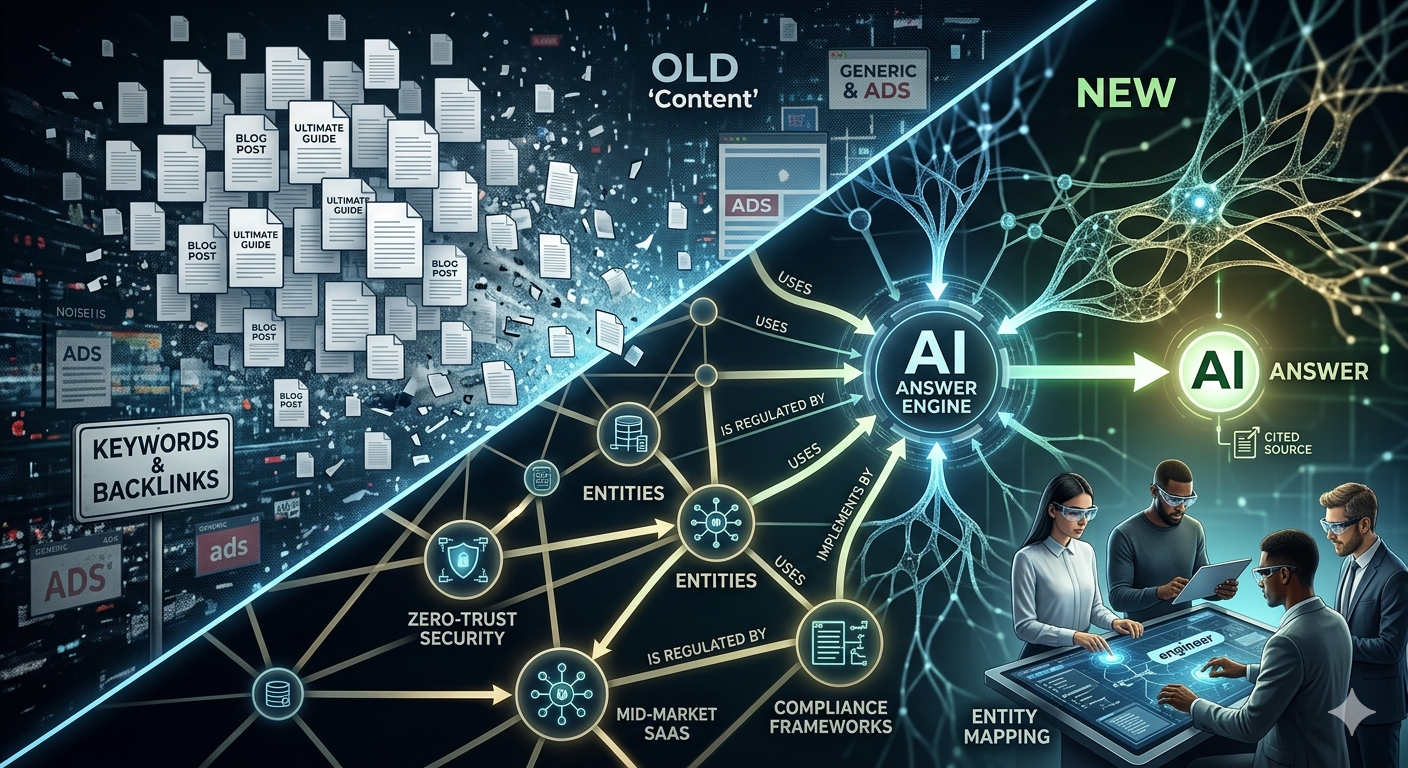
The “Answer Economy”: Why B2B Brands in 2026 are Building Knowledge Graphs, Not Just Content
 Vansh Banthia,
6 months ago
3 min read
Vansh Banthia,
6 months ago
3 min read
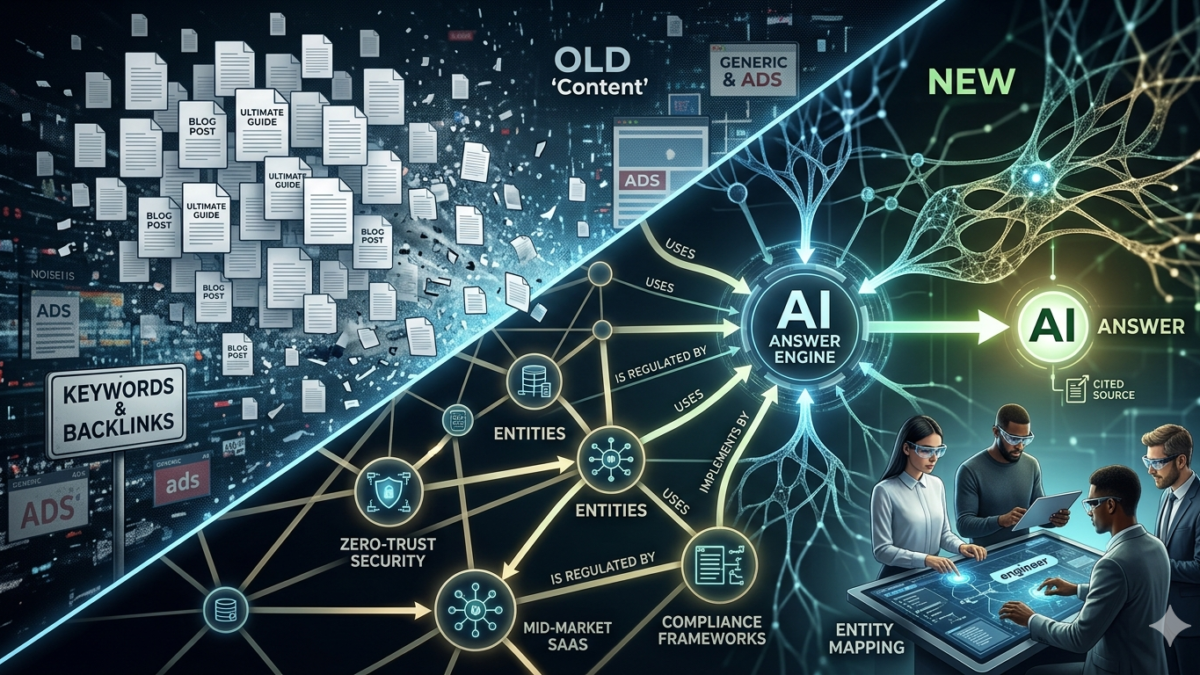
In 2024, the B2B marketing goal was “Traffic.” We obsessed over clicks, impressions, and staying on Page 1 of Google. But as we move through 2026, the traditional search engine is no longer the primary gatekeeper. We have entered the Answer Economy.
With the rise of Generative Engine Optimization (GEO) and AI assistants like ChatGPT, Gemini, and Perplexity now handling over 25% of B2B research queries, the “click” is no longer guaranteed. Buyers aren’t looking for a list of links; they are looking for a definitive answer. For IT and Tech brands, this means a fundamental shift: You are no longer just a content creator; you are a Knowledge Provider.
The Shift: From Keywords to “Entities”
In the Answer Economy, AI models don’t just “read” your keywords; they map your brand as an Entity within a specific niche. If an AI agent and GEO can’t logically connect your brand to a specific problem (e.g., “Zero-Trust Architecture for Mid-Market SaaS”), you simply won’t exist in the AI-generated response.
The white papers and blogs currently topping the charts on ITMunch.com are moving away from broad “Top 10” lists and toward High-Density Logic. AI models favor content that is structured, authoritative, and factually dense.
2026 Strategy: “Building a Brand Knowledge Graph: How to Ensure AI Models Cite You as the Primary Source.”
3 Pillars of the 2026 B2B “Answer” Strategy
To stay visible in an AI-mediated world, IT marketers must prioritize these three technical pillars:
1. Structured Data is the New SEO
If your technical insights aren’t wrapped in Schema Markup, they are invisible to the machines.
- The Action: Every white paper, case study, and product page must use LLMs.txt and advanced schema (FAQ, How-To, Dataset) to tell AI exactly what expertise you are offering.
- The Goal: To move from being “a page on the web” to a “verified node in the AI’s knowledge base.”
2. The Rise of “Answer Blocks”
The 3,000-word “Ultimate Guide” is being replaced by modular Answer Blocks.
- The Action: Structure your blog posts so that key questions are answered in concise, 50-word “blocks” that are easy for AI to “clip” and cite.
- The Value: AI refers to the source that gives it the cleanest, most reliable data. By being the most “quotable” brand, you earn the AI Citation, which is the 2026 version of a high-authority backlink.
3. “E-E-A-T” is No Longer Optional
Experience, Expertise, Authoritativeness, and Trustworthiness are now the primary filters for AI-driven discovery.
- The Action: Double down on Human-First Media. This means featuring your actual engineers, architects, and subject-matter experts in video and audio formats.
- The Goal: AI and GEO can generate text, but it cannot generate reputation. By linking your content to real, verified humans with a track record of expertise, you provide the “Trust Signal” that AI models look for when choosing which brand to recommend.
Comparing the Search Eras
| Metric | The Keyword Era (2024) | The Answer Economy (2026) |
| Primary Goal | Clicks to Website. | Inclusion in AI Answers. |
| Optimization Focus | Keywords & Backlinks. | Entities, Schema, & Citations. |
| Content Format | Long-form “Skimmable” Blogs. | Modular “Machine-Readable” Data. |
| Lead Quality | High Volume / Low Intent. | Low Volume / Pre-Qualified by AI. |
The Bottom Line: Be the Source, Not the Echo
The B2B buyer of 2026 is faster and more skeptical than ever. They are using GEO to filter out the marketing fluff and get straight to the technical truth.
To win on a platform like ITMunch, your content must be more than “helpful”—it must be Infrastructural. You need to provide the raw data, the technical frameworks, and the expert perspectives that both humans and AI find indispensable. In 2026, you don’t win by being the loudest voice in the room; you win by being the voice that the AI trusts to give the final answer