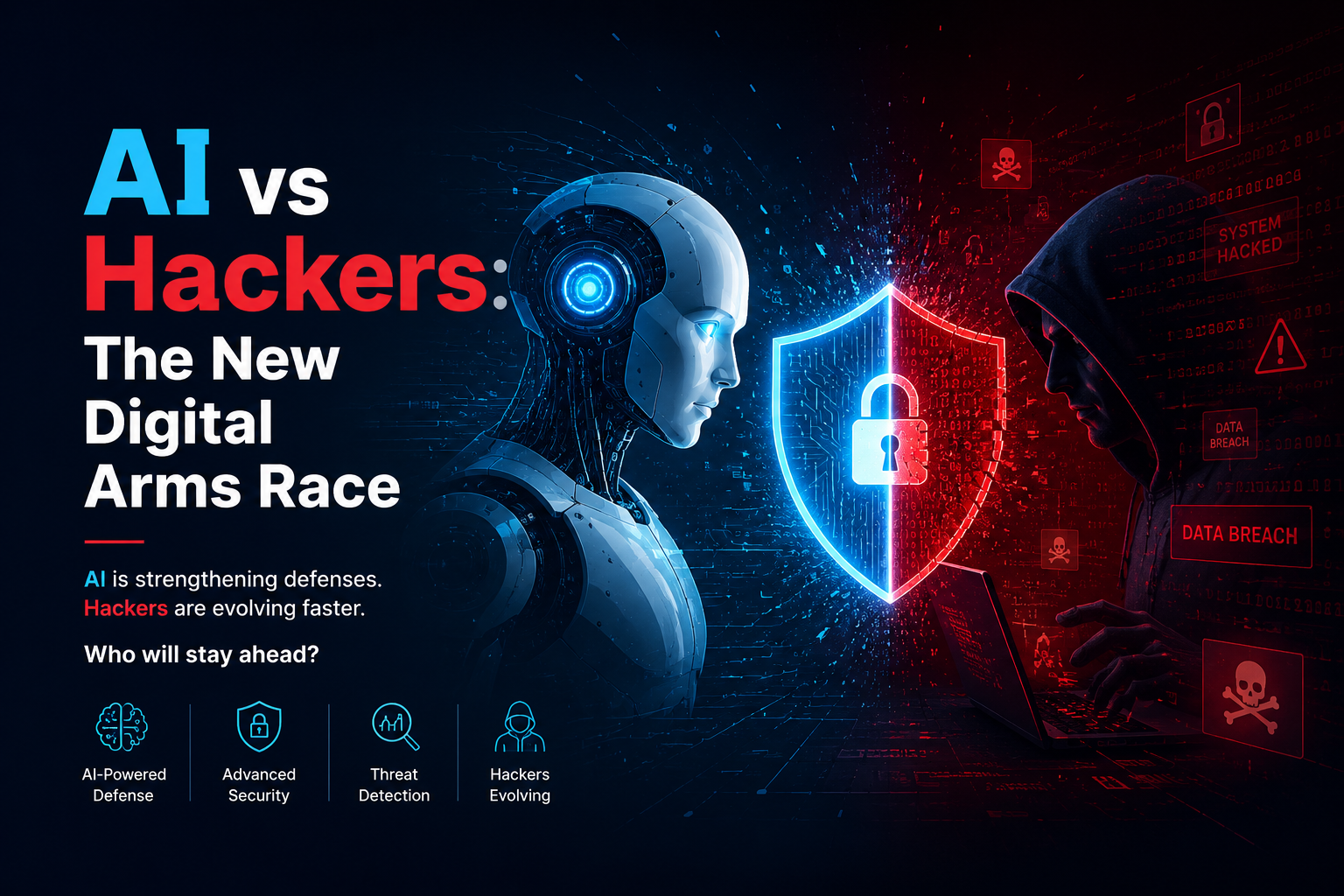
AI vs Hackers: The New Digital Arms Race in Cybersecurity
Cybersecurity has always been a battle between defenders and attackers, but artificial intelligence has fundamentally changed the rules. What was once a contest of human expertise has evolved into an automated race where machines fight machines. Today, AI is helping security teams detect threats in seconds while simultaneously giving hackers new ways to launch faster, smarter, and more convincing attacks. This escalating conflict has become the defining challenge of modern cybersecurity. Organizations that fail to understand this new digital arms race risk falling behind as attackers continuously evolve their tactics. The future of cybersecurity will not be determined by who has the biggest security budget, but by who can adapt to AI faster.
For decades, cybercriminals relied on manual techniques, phishing emails, and malware that often required significant effort to deploy. AI has dramatically lowered those barriers. Generative AI can create highly personalized phishing campaigns within minutes, produce convincing fake voices, write malicious code, and even identify vulnerabilities across massive digital environments. Instead of attacking one organization at a time, hackers can automate campaigns against thousands of businesses simultaneously, making cybercrime more scalable than ever before. AI has become an efficiency multiplier for attackers, allowing them to operate with unprecedented speed and sophistication. Research also shows that AI-powered attacks are becoming increasingly adaptive, continuously refining techniques based on successful intrusion attempts.
Fortunately, cybersecurity professionals are not standing still. AI has become one of the strongest defensive technologies available today. Modern security platforms analyze billions of events every day, identifying suspicious behavior that traditional rule-based systems would miss. Instead of waiting for known malware signatures, AI can recognize abnormal network activity, detect insider threats, predict potential attacks, and automate incident response before damage spreads. Security analysts who once spent hours reviewing alerts can now focus on strategic investigations while AI filters false positives and prioritizes genuine risks. This shift enables organizations to respond significantly faster than traditional security operations allowed.
The challenge is that both sides are improving simultaneously. Every advancement in defensive AI is often matched by innovation from cybercriminals. Attackers now experiment with AI-generated ransomware, intelligent credential theft, automated vulnerability discovery, and deepfake-based social engineering. Imagine receiving a phone call that perfectly replicates your CEO’s voice requesting an urgent financial transfer. These scenarios are no longer science fiction. AI-generated deception is becoming increasingly difficult to distinguish from legitimate communication, forcing businesses to rethink how they verify identity and authorize critical actions. Human awareness alone is no longer sufficient when AI can convincingly imitate trusted individuals.
This reality is pushing organizations toward a new cybersecurity philosophy. Instead of assuming attacks can always be prevented, businesses are investing in cyber resilience. Zero Trust architectures, behavioral analytics, endpoint detection, continuous authentication, and AI-powered threat intelligence are becoming essential components ofenterprise security strategies. The objective is no longer simply building stronger walls but creating intelligent systems capable of identifying and containing attacks before they spread across the organization. AI strengthens these defenses by learning continuously, adapting to emerging attack patterns, and providing predictive insights that traditional security tools cannot deliver.
However, technology alone cannot win this battle. Employees remain one of the most attractive targets for attackers because human psychology is easier to manipulate than advanced security software. AI-generated phishing emails are grammatically perfect, context-aware, and increasingly personalized using publicly available information. Regular cybersecurity awareness training, strong authentication policies, and simulated phishing exercises have become critical layers of defense. Organizations that combine educated employees with AI-powered security systems create multiple barriers that attackers must overcome rather than relying on a single protective technology.
Small and medium-sized businesses should not assume they are safe simply because they are smaller targets. Automated AI attacks scan the internet indiscriminately, looking for exposed systems, outdated software, weak passwords, and cloud misconfigurations. These attacks require little human intervention, meaning organizations of every size face similar risks. Investing in proactive cybersecurity measures early is often far less expensive than recovering from ransomware, operational downtime, regulatory penalties, or reputational damage following a successful breach.
The future ofcybersecurity will increasingly depend on collaboration between humans and artificial intelligence. AI excels at processing enormous amounts of information, recognizing patterns, and responding instantly, while human experts contribute strategic thinking, ethical judgment, and contextual decision-making. Rather than replacing cybersecurity professionals, AI is transforming their role into one focused on investigation, governance, and risk management. Businesses that successfully combine both capabilities will be far better positioned to defend against evolving threats.
The digital battlefield has entered a new era where AI powers both defense and offense. Hackers continue to innovate, but defenders are equally equipped with intelligent technologies that learn, predict, and respond faster than ever before. Winning this arms race requires continuous investment, adaptive security strategies, and a culture that treats cybersecurity as a business priority rather than an IT responsibility. In a world where algorithms compete against algorithms, resilience will belong to organizations that embrace AI without underestimating the creativity of their adversaries.