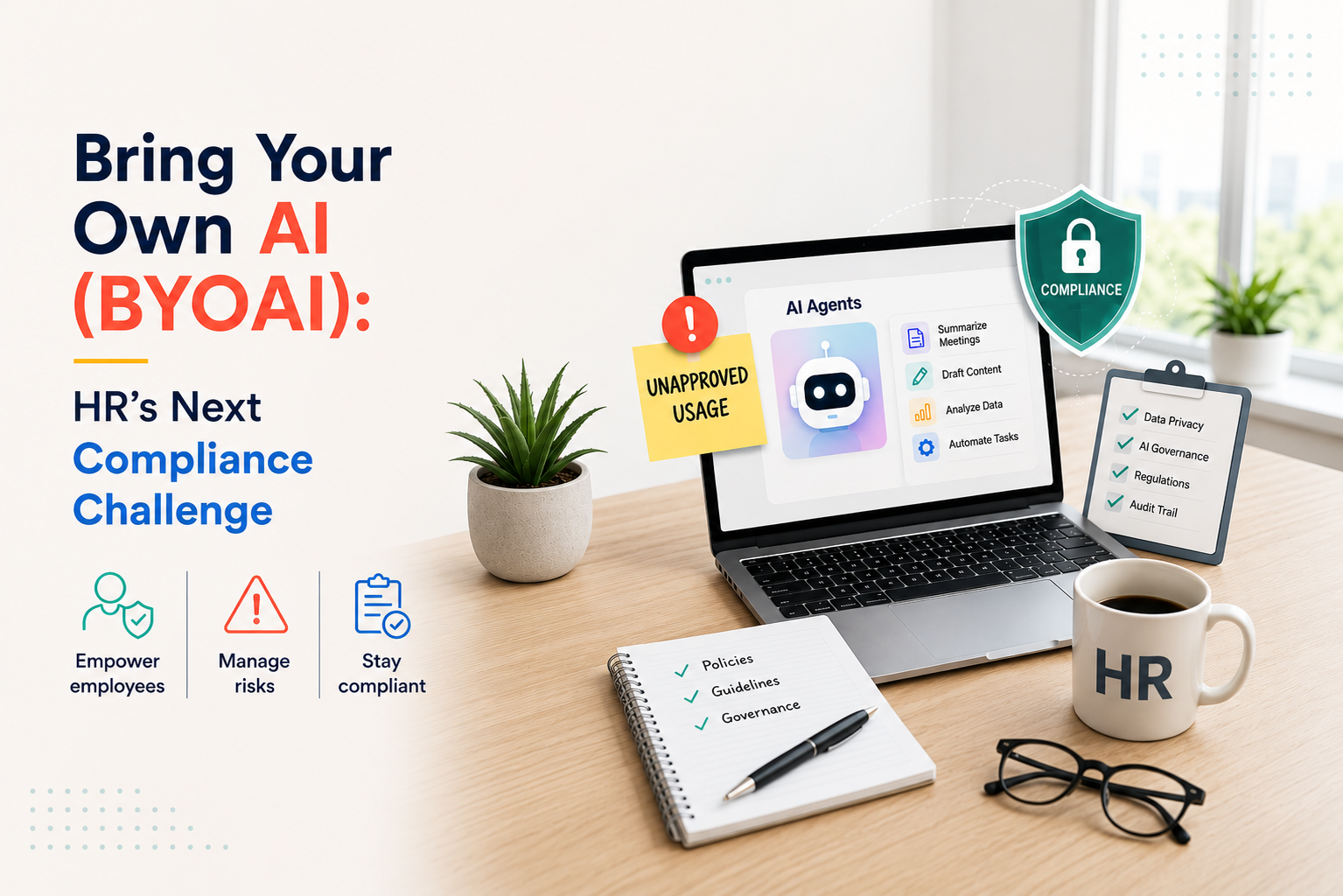
Artificial intelligence has officially entered the workplace, but not always through official channels. Across organizations, employees are increasingly turning to AI Agents to summarize meetings, draft emails, analyze spreadsheets, write code, and automate repetitive work. The adoption is happening at a pace that few businesses anticipated, and in many cases, employees are using AI tools before their organizations have established policies to govern them.
This phenomenon, often referred to as Bring Your Own AI (BYOAI), is quickly becoming one of HR’s most pressing compliance and governance challenges. Much like the Bring Your Own Device (BYOD) movement transformed IT policies a decade ago, BYOAI is forcing HR, legal, IT, and business leaders to rethink how work is performed, how sensitive information is handled, and how organizational trust is maintained.
The conversation is no longer about whether employees will use AI. They already are. The real question is whether organizations have the visibility and governance needed to ensure AI is being used responsibly.
AI Agents Are Changing Work Faster Than Policies Can Keep Up
Recent enterprise technology trends suggest that organizations are moving from experimenting with AI to embedding AI Agents into everyday workflows. Unlike traditional software, AI Agents can independently complete multi-step tasks, retrieve information, generate content, and even make recommendations with minimal human intervention. As these capabilities become more accessible, employees naturally seek out the tools that help them work faster.
The challenge is that many of these tools are adopted without formal approval. A marketing team may use one AI platform to create campaign content, while finance experiments with another for reporting. HR professionals may rely on AI for drafting job descriptions or employee communications, while recruiters use AI to screen resumes or summarize interviews. Each decision may improve productivity in isolation, but together they create an ecosystem that operates beyond organizational oversight.
Industry surveys throughout 2026 indicate that enterprise AI adoption continues to accelerate, yet governance frameworks remain significantly behind. Many organizations still lack clear policies defining which AI tools are approved, what data can be shared, and who is accountable for AI-generated decisions. This growing gap between adoption and governance is exactly where compliance risks begin to emerge.
For HR leaders, the implications extend far beyond technology. Every AI interaction has the potential to involve employee information, recruitment data, compensation details, or confidential business knowledge. Without clear guardrails, well-intentioned productivity improvements can unintentionally introduce legal, security, or ethical concerns.
Compliance Is No Longer Just an IT Responsibility
Historically, compliance around technology has largely been managed by IT and security teams. BYOAI changes that equation because people, not systems are now driving technology adoption.
HR sits at the center of this transformation. Every new employee needs guidance on responsible AI usage. Every manager needs clarity on where AI can support decision-making and where human judgment must remain essential. Every organization needs consistent policies that balance innovation with accountability.
The emergence of global AI regulations has only increased the urgency. Governments and regulatory bodies are placing greater emphasis on transparency, risk management, data protection, and responsible AI deployment. At the same time, many organizations are grappling with an AI skill gap, as employees adopt AI tools faster than businesses can provide the training and governance needed to use them responsibly. Compliance is no longer limited to cybersecurity checklists. It now includes documenting AI usage, understanding automated decision-making, protecting employee data, ensuring fairness across HR processes, and equipping employees with the knowledge to use AI effectively and ethically.
At the same time, employees expect flexibility. Restricting every AI tool may discourage innovation, while allowing unrestricted access creates unnecessary exposure. The challenge for business leaders is finding a governance model that enables productivity without sacrificing trust.
That balance cannot be achieved through policy documents alone. It requires visibility into how work actually happens.
Visibility Is Becoming the Foundation of Responsible AI Adoption
One of the biggest misconceptions surrounding BYOAI is that monitoring AI usage means monitoring employees. In reality, effective governance is about understanding workflows rather than policing individuals.
Organizations need visibility into where AI Agents are being integrated, which business processes are changing, and how work moves across teams. When leaders understand these patterns, they can identify opportunities to standardize successful practices, eliminate unnecessary risks, and provide employees with approved tools that meet business requirements.
Operational visibility also helps organizations answer increasingly important questions. Which teams are benefiting most from AI adoption? Which repetitive tasks are disappearing? Where are employees relying on external AI platforms because existing systems fall short? Which processes should be automated, and which still require human oversight?
These insights allow HR and business leaders to move beyond reactive compliance and toward proactive workforce strategy.
Rather than focusing exclusively on preventing misuse, organizations can identify where AI is genuinely improving collaboration, reducing administrative burden, and enabling employees to focus on higher-value work. This creates an environment where innovation is encouraged while governance remains intact.
As AI becomes a permanent part of the workplace, visibility will become just as important as policy.
The Future of HR Will Be Defined by Responsible AI Leadership
The organizations that succeed with AI will not necessarily be the ones adopting the most tools. They will be the ones creating the right balance between innovation, governance, and trust.
BYOAI represents more than another technology trend. It reflects a fundamental shift in how employees solve problems, collaborate, and make decisions. AI Agents are rapidly becoming digital coworkers that support everyday tasks across every business function. Their impact will continue to grow as enterprises move toward more autonomous workflows and intelligent automation.
For HR leaders, this presents an opportunity to shape the future of work rather than simply respond to it. Building thoughtful AI policies, fostering digital literacy, and creating visibility into workplace operations will become strategic differentiators rather than administrative responsibilities.
The future of compliance is unlikely to be defined by stricter restrictions alone. Instead, it will be shaped by organizations that understand how people and AI Agents work together, establish clear governance without limiting innovation, and create workplaces where technology enhances both productivity and trust.
In the years ahead, successful organizations will not ask whether employees are using AI. They will ask whether they have the insight, transparency, and operational visibility needed to ensure AI is delivering value responsibly. That shift in perspective may ultimately become HR’s most important competitive advantage.