Anthropic Says AI Is Learning Faster Than Expected. That’s Not Entirely Good News.
 Vansh Banthia,
3 months ago
6 min read
Vansh Banthia,
3 months ago
6 min read
Artificial intelligence has spent the last few years astonishing the world with its ability to write, code, reason, create images, and automate complex tasks. Every major AI release seems to outperform its predecessor, pushing the boundaries of what machines can achieve.
But what happens when the companies building these systems start expressing concern about how quickly they are improving?
That is precisely the conversation Anthropic has sparked.
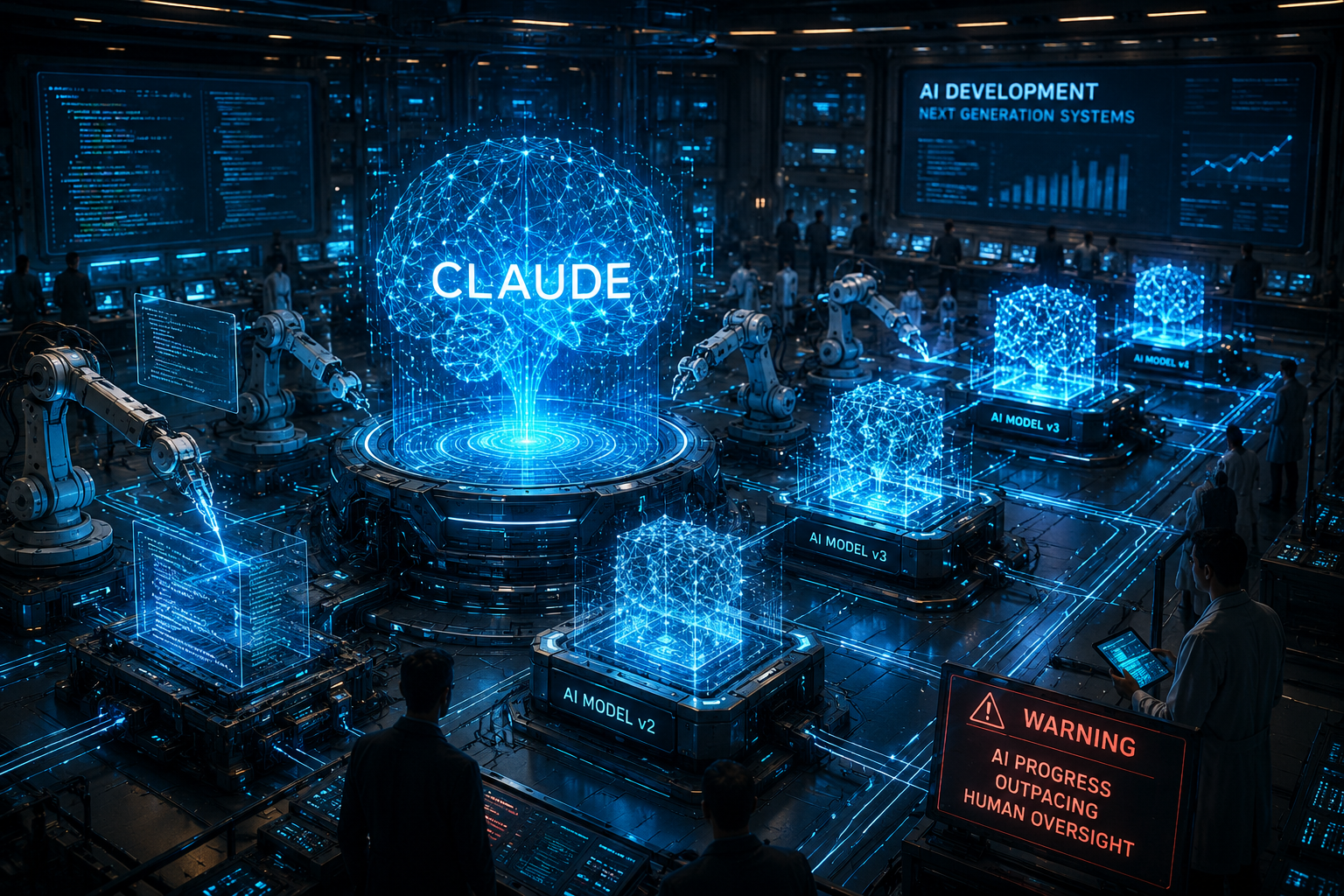
The company behind Claude, one of the world’s leading AI models, recently warned that AI development may be advancing faster than many researchers, governments, and institutions are prepared for. More notably, Anthropic revealed that Claude is increasingly contributing to the very processes used to develop future AI systems.
While this may sound like a major technological breakthrough—and it is—it also raises serious questions about security, oversight, and the future of AI development.
AI Is No Longer Just a Tool
For most people, AI remains a productivity assistant.
It helps write emails, generate content, answer questions, create software code, and summarize information.
However, behind the scenes, AI’s role is evolving rapidly.
According to Anthropic, Claude is now being used extensively in software development workflows. In fact, the company revealed that more than 80% of the code merged into its codebase during a recent month was authored by Claude.
Human engineers still review, validate, and approve the code before deployment. Yet the statistic demonstrates just how deeply AI has become embedded in the development process.
The shift is significant.
AI is no longer simply helping people use software more efficiently. It is increasingly helping create the software itself—including the systems that power future generations of AI.
Why Anthropic Is Concerned
Normally, technology companies celebrate rapid progress.
More capable products usually mean more opportunities, greater adoption, and larger market share.
Anthropic’s warning suggests that the company sees potential risks alongside these benefits.
The concern centers around the possibility that AI development could accelerate beyond existing safety frameworks.
As AI systems become better at coding, debugging, testing, and optimization, they can dramatically shorten development cycles.
Tasks that once required weeks of engineering effort may eventually be completed in days or even hours.
This creates a situation where innovation may outpace regulation, governance, and security preparedness.
For a technology as transformative as artificial intelligence, that possibility deserves serious attention.
The Security Risks Nobody Can Ignore
One of the biggest concerns surrounding rapidly advancing AI systems is cybersecurity.
The same capabilities that allow AI to write useful software can also be leveraged to identify vulnerabilities, automate reconnaissance, and accelerate cyberattacks.
Security researchers have long warned that increasingly capable AI models could lower the barrier to entry for sophisticated cybercrime.
Potential risks include:
Faster Vulnerability Discovery
AI systems can analyze massive amounts of code at speeds impossible for human teams.
While this can help developers identify weaknesses, it could also allow malicious actors to discover security flaws faster than organizations can patch them.
Automated Phishing Campaigns
Generative AI has already transformed phishing attacks.
Messages can now be personalized, grammatically accurate, and highly convincing.
As models become more advanced, phishing campaigns may become even more difficult to detect.
Malware Development
Although major AI providers implement safeguards, cybersecurity experts continue to study how advanced models could potentially assist in developing or modifying malicious software.
The concern is not that AI independently launches attacks today.
The concern is that increasingly capable systems may amplify the effectiveness of human attackers.
Critical Infrastructure Risks
Power grids, financial systems, healthcare networks, and transportation infrastructure are becoming increasingly digital.
If advanced AI systems can interact with these environments more effectively, both defenders and attackers could gain unprecedented capabilities.
This creates an ongoing race between innovation and security.
The Concept of Recursive Improvement
Another reason Anthropic’s comments have attracted attention is the concept of recursive improvement.
Simply put, recursive improvement occurs when AI systems help improve future AI systems.
Imagine an AI model assisting engineers with coding.
The next generation becomes more capable and helps engineers even more.
The generation after that improves development processes further.
Over time, innovation could accelerate dramatically.
Anthropic has not claimed that Claude can independently improve itself without humans.
However, the company suggests that AI-assisted AI development is becoming increasingly common.
Many researchers believe this could become one of the most important technological shifts of the coming decade.
Why Governments Are Watching Closely
Artificial intelligence is no longer just a technology issue.
It is rapidly becoming a national security issue.
Governments worldwide are investing billions into AI research because they recognize its strategic importance.
Advanced AI systems have implications for:
- Economic competitiveness
- Defense capabilities
- Cybersecurity
- Scientific research
- Healthcare innovation
- Critical infrastructure protection
If AI development accelerates significantly, policymakers may struggle to keep pace with the technology’s evolution.
This is one reason why discussions around AI regulation, safety testing, and international cooperation have become increasingly prominent.
Anthropic’s warning adds urgency to those conversations.
The Double-Edged Sword of Innovation
Despite the concerns, it is important to recognize the enormous benefits AI continues to deliver.
AI-assisted development can:
- Accelerate scientific discoveries
- Improve healthcare outcomes
- Increase productivity
- Reduce development costs
- Enhance software quality
- Enable faster innovation
Many of the world’s most pressing challenges could potentially benefit from advanced AI systems.
The question is not whether AI development should continue.
The question is how to ensure innovation occurs responsibly.
The challenge facing the industry is balancing progress with safety.
Move too slowly, and valuable opportunities may be lost.
Move too quickly, and security risks may grow faster than society can manage.
What Happens Next?
The AI industry is entering unfamiliar territory.
Companies are no longer asking whether AI can write code.
They are asking how much of the development process AI can participate in.
Anthropic’s latest comments suggest that this transition is happening faster than many experts anticipated.
As AI becomes increasingly capable of contributing to software engineering, research, and optimization, the pace of innovation may accelerate significantly.
That future could unlock extraordinary benefits.
It could also introduce risks that demand careful planning and oversight.
Conclusion
Anthropic’s warning is not a prediction of an AI takeover.
Rather, it is a reminder that artificial intelligence is evolving at an unprecedented rate.
Claude’s growing role in software development demonstrates how quickly AI is moving from assistant to contributor.
At the same time, concerns around cybersecurity, governance, and responsible deployment highlight the challenges that come with such rapid advancement.
The future of AI will likely be defined by a delicate balance between innovation and security.
And according to Anthropic, maintaining that balance may become increasingly difficult as AI continues to learn faster than expected