The Death of the Traditional Funnel: How B2B Buyers Actually Make Decisions in 2026
 Vansh Banthia,
5 months ago
4 min read
Vansh Banthia,
5 months ago
4 min read
Introduction: The B2B Funnel That Looks Perfect on Slides
Every B2B marketer knows the B2B funnel.
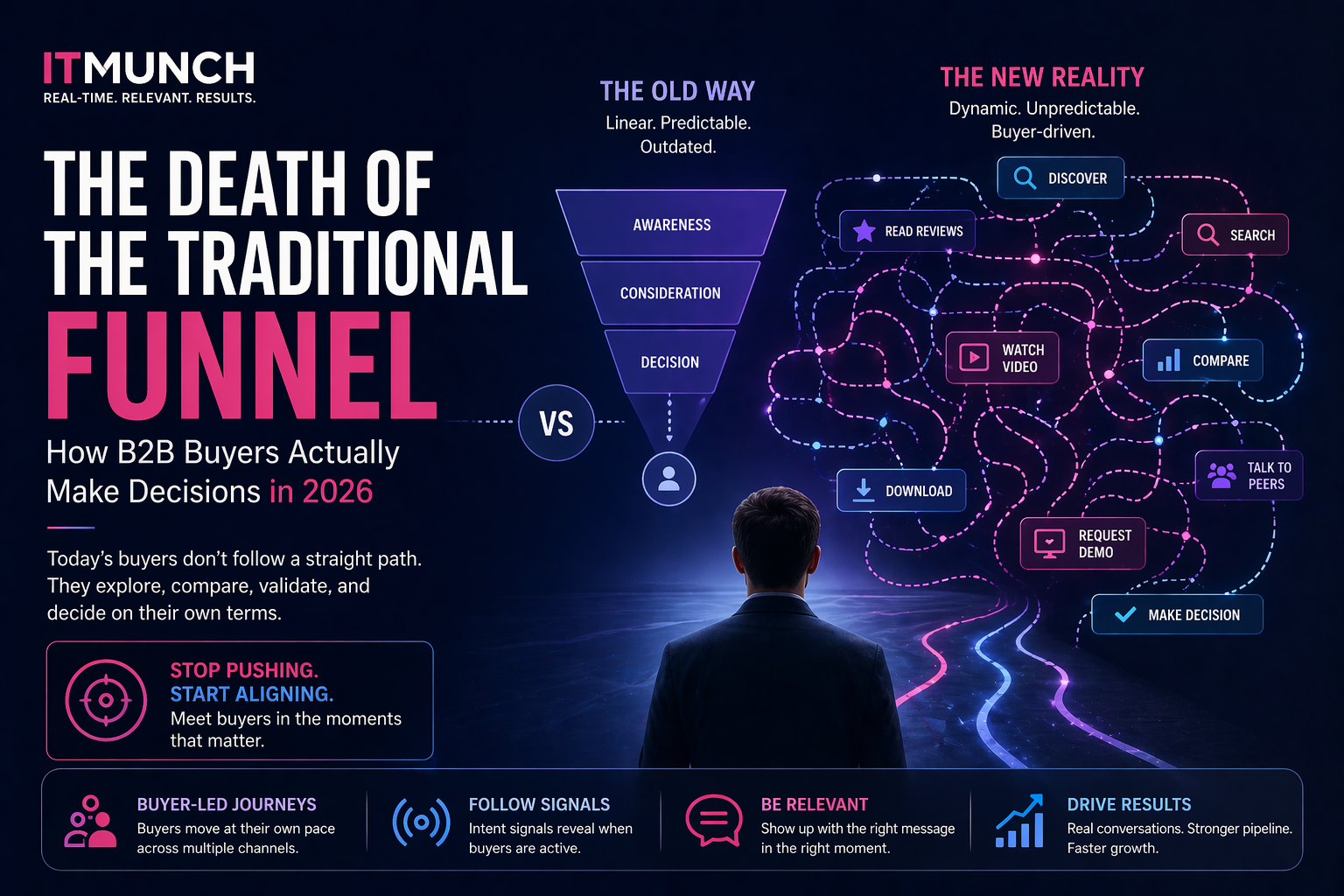
Awareness at the top. Consideration in the middle. Decision at the bottom. Clean, structured, and easy to explain in a presentation.
It’s been the foundation of marketing strategy for years.
But here’s the problem—buyers don’t follow it anymore.
Not in a straight line. Not in predictable stages. And definitely not in a way that fits neatly into dashboards.
In 2026, the B2B funnel still exists—but mostly in theory. In practice, buyer behavior looks very different.
The Reality: Buying Journeys Are Messy
A typical B2B buyer today doesn’t start at the “top” and move downward.
They jump in and out of the journey.
They might discover your brand through a LinkedIn post, ignore it, come back weeks later through a Google search, read a review, check a competitor, download a report, and only then consider speaking to sales.
And even then, they might disappear again.
There’s no linear progression. No guaranteed sequence.
What you’re dealing with is not a funnel—it’s a web of interactions, decisions, and influences happening across multiple channels.
Why the B2B Funnel is Losing Relevance
The traditional B2B funnel was built for a time when information was limited and sellers controlled access. Buyers had to move step by step because they didn’t have another option.
That’s no longer true.
Today, buyers have instant access to content, reviews, comparisons, and peer opinions. They don’t need to rely on brands to guide them—they guide themselves.
By the time they engage with sales, they’re often already well-informed. In some cases, they’ve even made a preliminary decision.
This shift reduces the control marketers once had over the journey. You can’t force progression—you can only support it.
The Rise of Self-Directed Buyers
One of the biggest changes in 2026 is how independent buyers have become.
They prefer to research on their own terms, at their own pace, without being pushed into conversations too early.
This doesn’t mean they don’t need help. It means they expect help to be available when they decide to seek it.
If your strategy relies too heavily on guiding them step by step, you risk missing the moments when they’re actually ready to engage.
What Replaces the Funnel?
Instead of thinking in terms of stages, high-performing teams are starting to think in terms of signals and moments.
Signals indicate when a buyer is active—researching, comparing, or evaluating.
Moments are opportunities to engage—when a question arises, when a need becomes urgent, or when a decision is close.
Rather than pushing buyers through a predefined path, modern marketing focuses on being present and relevant during these moments.
It’s less about control, more about responsiveness.
Why Timing Matters More Than Ever
If buyers are moving unpredictably, timing becomes critical.
A well-crafted message delivered at the wrong time is easy to ignore.
But even a simple, direct message delivered at the right moment can drive engagement.
This is why many teams are investing more in intent data and behavioral insights. Not to track buyers endlessly—but to understand when engagement is most likely to happen.
Timing doesn’t guarantee success, but poor timing almost always guarantees failure.
The New Role of Content
Content still plays a central role, but its function is evolving.
Instead of guiding buyers step by step, content now supports them wherever they are.
A blog might help someone early in research.
A whitepaper might influence comparison.
A case study might validate a final decision.
But these interactions don’t happen in order. They happen based on need.
This means content strategies need to be more flexible—less focused on sequence, more focused on relevance.
What This Means for Marketing and Sales Alignment
The shift away from B2B funnels also changes how marketing and sales need to work together.
If buyers can enter at any stage, both teams need visibility into what’s happening in real time.
Marketing can’t just hand off leads and step back.
Sales can’t rely only on form fills to identify opportunities.
Both sides need to work from shared signals and shared context.
When that alignment exists, engagement becomes more natural and less forced.
Conclusion: Stop Forcing the Journey
The traditional funnel isn’t completely obsolete—but it’s no longer a reliable representation of how B2B buying works.
Clinging to it too tightly can lead to rigid strategies that don’t match real behavior.
The shift in 2026 is clear:
From linear journeys → to dynamic interactions
From control → to adaptability
From pushing → to aligning
The brands that succeed won’t be the ones trying to force buyers into a funnel.
They’ll be the ones that understand how buyers actually move—and meet them there.