The Agentic Shift: How AI Agents are Rewriting the B2B Playbook in 2026
 Vansh Banthia,
6 months ago
3 min read
Vansh Banthia,
6 months ago
3 min read
If 2024 was the year of the chatbot and 2025 was the year of the “Copilot,” then 2026 is officially the year of the AI Agents. For B2B marketing and sales teams, this isn’t just another incremental upgrade. We are witnessing a fundamental shift from software that assists us to software that acts for us.
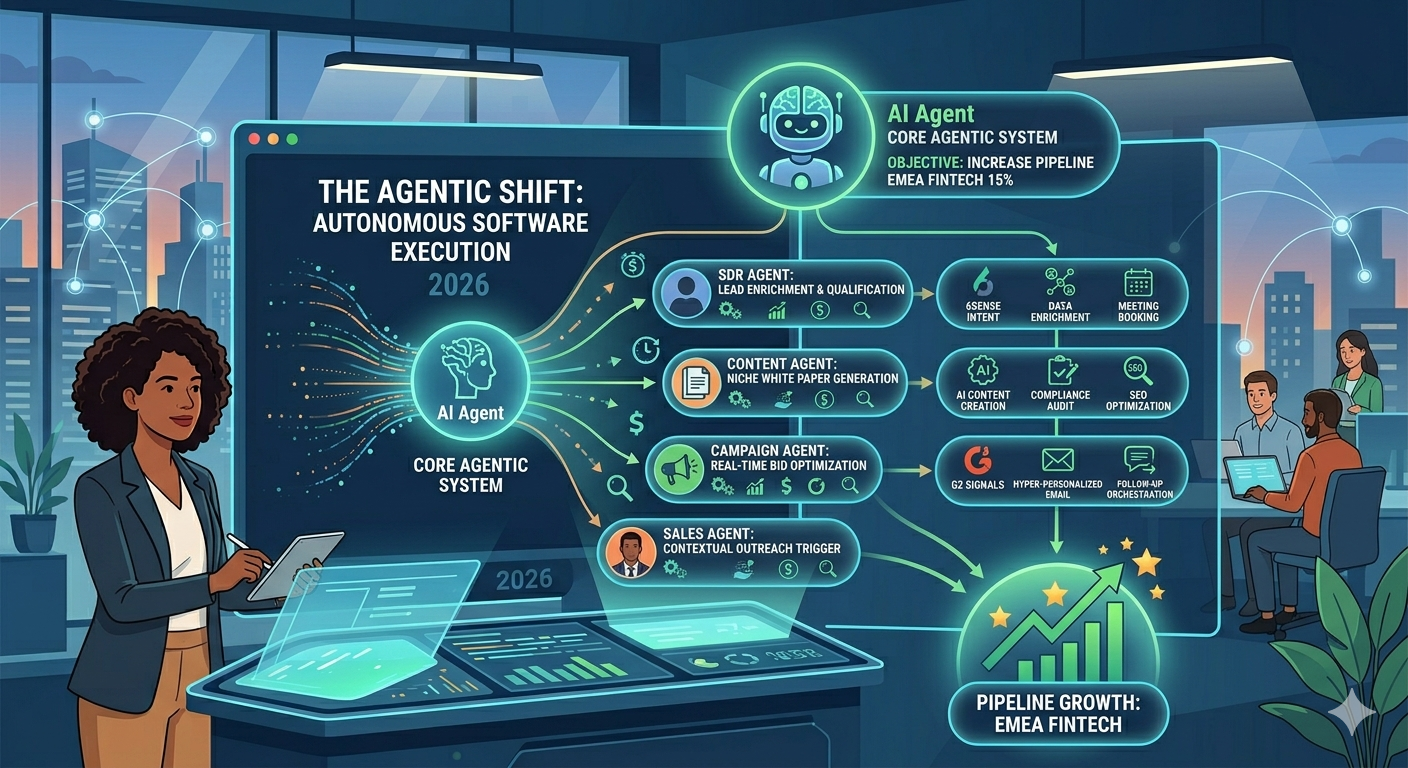
In the previous era, we spent our days toggling between HubSpot, Salesforce, and Semrush to manually trigger workflows. Today, we give an objective—“Increase pipeline in the EMEA fintech sector by 15% this quarter”—and our agentic ecosystem determines the “how,” “when,” and “who” autonomously.
From Passive Assistants to Active Workers
The defining characteristic of an AI agents in 2026 is agency. Unlike the rigid automation of the past, agents can reason, plan, and use tools. They don’t just wait for a lead to fill out a form; they monitor the “Silent Funnel”—the 90% of the buyer journey that happens anonymously on LinkedIn threads, private Slack communities, and third-party research hubs.
When an agent detects a high-intent signal from a Tier-1 account, it doesn’t just alert a human. It independently:
- Enriches the data via verified B2B databases.
- Drafts a hyper-personalized briefing for the Account Executive.
- Launches a targeted ad sequence specifically addressing the prospect’s recent research topics.
- Optimizes the bidding strategy in real-time based on the account’s engagement depth.
The New Metric of Record: Share of LLM
For a decade, B2B teams obsessed over Domain Authority (DA). But in 2026, where buyers increasingly use AI agents (like Perplexity or Gemini) to research vendors, DA has been superseded by Share of LLM (SoL).
If a buyer asks their AI assistant, “Which cloud security platform is best for multi-region compliance in 2026?”, does your brand appear in the generated answer? Improving your SoL requires a shift from keyword stuffing to Generative Engine Optimization (GEO). You aren’t just writing for humans anymore; you’re providing high-integrity, structured data that AI models can trust and cite as authoritative.
The 3 Core Agentic Workflows Transforming Productivity
| Workflow | The “Old” Way (2024) | The “Agentic” Way (2026) |
| Lead Research | Manual SDR prospecting and LinkedIn lurking. | Autonomous research agents mapping entire buying committees. |
| Content Ops | Centralized teams drafting 3 blogs a week. | Employee-led, AI-facilitated “Value Blocks” scaled across niches. |
| Campaign Bidding | Weekly manual adjustments to PPC spend. | Micro-second bidding based on live intent and competitor shifts. |
| Sales Outreach | Template-based “Checking in” emails. | Context-aware outreach triggered by “moment-of-need” signals. |
Navigating the “Synthetic Prospect” Crisis
With the rise of autonomous outreach, 2026 has brought a unique challenge: the Synthetic Prospect Crisis. As AI agents get better at simulating human engagement, B2B teams are finding their CRM “top of funnel” flooded with AI-generated inquiries and bot-to-bot negotiations.
The winners in this landscape are the teams that have pivoted to Zero-Party Data and Community-Led Growth (CLG). By fostering authentic human spaces—think private invite-only forums or “Expert-in-the-Loop” webinars—brands can verify real human intent in a world of automated noise.
The Human Core: From Execution to Orchestration
Does the rise of the agent mean the end of the B2B marketer? Quite the opposite. As agents handle the 70% of work that is structural (research, formatting, initial drafting, bidding), the human role has shifted toward Strategic Orchestration.
In 2026, your value isn’t in your ability to “set up a campaign.” Your value lies in:
- Creative Logic: Defining the unique narrative and brand “voice” that AI cannot fabricate.
- Ethical Oversight: Ensuring your agents operate within brand guardrails and data privacy regulations.
- Judgment: Interpreting the “significance” of data, not just the “volume.”
The Bottom Line
The transition to agentic marketing isn’t a “flip of the switch”—it’s a data maturity journey. Start by auditing your current manual bottlenecks. Which task takes your team the most time but requires the least creative thought? That is where your first agent belongs.
In 2026, the competitive advantage doesn’t go to the team with the biggest budget, but to the team that orchestrates the most intelligent AI agents.