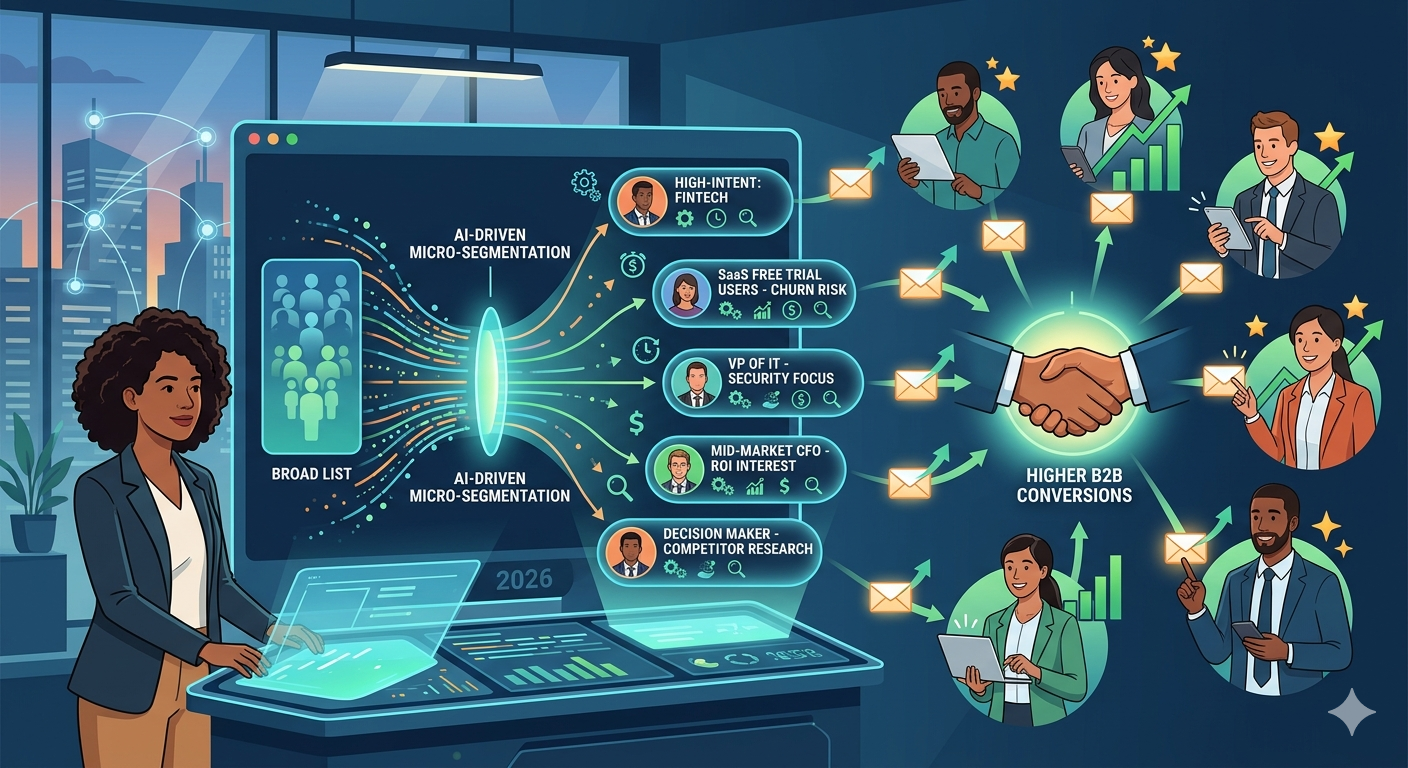
Micro-Segmentation in B2B Email Marketing: The Strategy Driving Higher Conversions in 2026
 Vansh Banthia,
6 months ago
4 min read
Vansh Banthia,
6 months ago
4 min read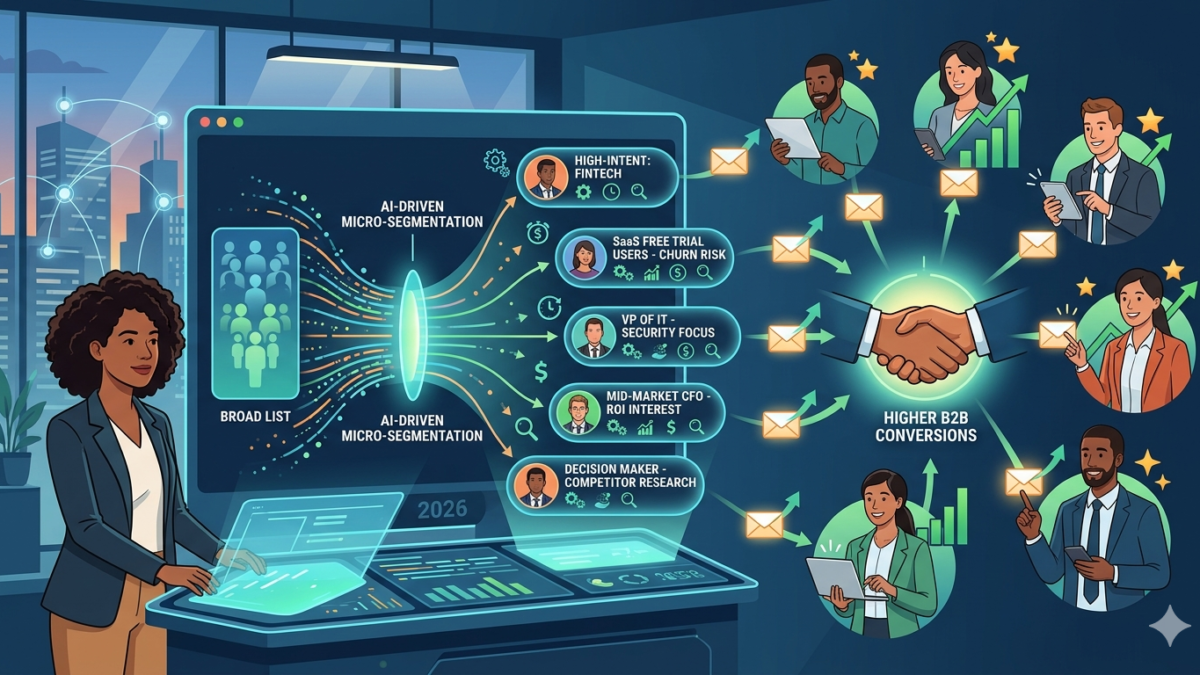
The “Email Blast” is officially dead. In the B2B landscape of 2026, hitting “Send to All” isn’t just an outdated tactic; it’s a fast track to being blacklisted by the very neural networks that now guard professional inboxes. As AI-powered personal assistants (Copilots) become the primary gatekeepers for C-suite executives, the only way for your message to reach a human eye is through surgical relevance.
The 2026 Inbox Reality: The Rise of the AI Gatekeeper
By now, most B2B professionals use AI agents to triage their communications. These agents are trained to recognize patterns of “generalized marketing.” If your email looks like it was sent to 5,000 other VPs of IT, it will be summarized into a weekly “Promotions Digest” or deleted before the recipient even sees the notification.
To bypass the gatekeeper, your email must demonstrate Immediate Contextual Value. Micro-segmentation allows you to speak to a prospect’s specific Tuesday morning problem, rather than their general industry challenges.
Static vs. Dynamic: The Evolution of the List
| Strategy Pillar | Traditional Segmentation (Pre-2024) | Micro-Segmentation (2026) |
| Data Source | CRM fields (Job Title, Industry). | Real-time Intent, Dark Social, Product Usage. |
| List Refresh | Weekly or Monthly. | Real-time (Streaming Data). |
| Content | Template-based with [First_Name] tags. | Modular “Liquid” content blocks. |
| Goal | Broad awareness/Click-through. | Specific problem-solving/Direct conversion. |
The Four Pillars of a Micro-Segmented Strategy
To execute this at scale, B2B teams are moving away from manual list-building and toward Autonomous Orchestration. Here is how the most successful marketers are carving up their data:
1. High-Precision Intent Signals
In 2026, we no longer guess if a company is interested. We know. By integrating third-party intent data (like 6sense or G2) directly into the email engine, you can trigger segments the moment a company starts researching a competitor or a specific pain point.
- The Micro-Segment:“Companies in the ‘Decision’ stage currently comparing your pricing to X-Competitor.”
2. Psychographic & Behavioral Triggers
This goes beyond the “visited a webpage” trigger. It analyzes the depth of engagement. Did they read 80% of your whitepaper? Did they skip the technical specs but spend three minutes on the ROI calculator?
- The Micro-Segment:“VPs of Finance who prioritize cost-savings over feature-richness based on their interaction with the ROI tool.”
3. Predictive Lead Scoring (The “Window of Opportunity”)
Your AI model now predicts when a lead is “ripe.” By analyzing historical patterns, it can identify a segment that is 85% likely to book a demo within the next 72 hours.
- The Micro-Segment:“Account-based leads with a rising ‘Urgency Score’ in the manufacturing sector.”
4. Product-Led Growth (PLG) Signals
For SaaS companies, the best micro-segments live inside the product. If a free-trial user hits a specific usage ceiling or stops using a key feature, the email they receive should be a “How-To” or an “Expansion Opportunity” specifically tailored to that friction point.
From “Dear Customer” to “Here is Your Solution”
The Micro-Segmentation Workflow: > Imagine a prospect, Sarah. She works at a Mid-Market Fintech firm. Your AI notices she’s been lurking on LinkedIn threads about “Compliance Automation” and just spent 10 minutes on your “Security Protocols” page.
Instead of a generic “Check out our Platform” email, she receives: “Sarah, we noticed Fintech firms are hitting a wall with the new 2026 Compliance Regulations. Here is the specific framework we used to help companies like yours automate that 12-hour audit process.”
That isn’t just an email; it’s a strategic asset.
How to Get Started (Without Losing Your Mind)
You don’t need a team of 50 to do this. You need a Unified Data Layer.
- Break the Silos: Ensure your CRM, Website Analytics, and Product Data are all feeding into one central “Intelligence Hub.”
- Define Your Modular Blocks: Instead of writing five different emails, write one “Base Template” with modular blocks that swap out based on the recipient’s industry, pain point, or intent score.
- Trust, but Verify: Use AI to suggest the segments, but keep a human in the loop to ensure the tone remains authentic. Nobody wants to be marketed to by a robot that sounds too much like a robot.
The Bottom Line
In 2026, relevance is the only currency that matters. Micro-segmentation isn’t about working harder; it’s about working smarter by letting your data do the heavy lifting. When you treat your email list as a collection of individuals rather than a mass of leads, your conversion rates won’t just improve—they will transform