
Content Syndication vs. PaidAds: Why 88% of B2B Teams Are Ditching PPC in 2026.
 Anuvinder Singh,
8 months ago
5 min read
Anuvinder Singh,
8 months ago
5 min read
Executive Summary
In 2026, the B2B demand generation landscape has shifted fundamentally under the weight of budget scrutiny and digital fatigue. While paid advertising remains a staple for brand awareness, its efficiency is declining due to rising costs and fraud. Conversely, content syndication has emerged as a powerhouse for precision and pipeline efficiency.
Key Findings:
- Cost Efficiency: Content syndication delivers top-of-funnel leads at $50–$80 CPL, significantly lower than the $230 average for paid ads.
- Performance: Syndication campaigns are averaging a 5.31% conversion rate compared to declining click-throughs on major ad platforms.
- Strategic Shift: 88% of B2B companies are maintaining or increasing their syndication investment in 2026 to capture the “dark funnel.”
1. The 2026 Demand Gen Landscape: Efficiency is the New Growth
The “growth at all costs” era is definitively over. As we navigate the latter half of 2026, the mandate from CFOs is clear: efficiency, predictability, and proven ROI. B2B marketers are no longer judged solely on MQL volume but on pipeline velocity and customer acquisition cost (CAC).
This shift has intensified the debate between two primary acquisition channels: Content Syndication (the precision instrument) and Paid Media/Ads (the volume engine). With the death of the third-party cookie fully settled and privacy regulations tightening globally, the ability to reach buyers with intent has become the ultimate competitive advantage.
Today, 73% of the B2B buyer journey happens in the “dark funnel”—anonymous research conducted on third-party sites, peer networks, and communities. The channel that can best illuminate this dark funnel wins the budget war.
2. Round 1: The Case for Content Syndication in 2026
Content syndication has evolved from a simple lead generation tactic into a sophisticated intent-capture mechanism. In 2026, it is the preferred strategy for marketers prioritizing lead quality over sheer volume.
The “Dark Funnel” Illuminator
Because the majority of research happens off your website, syndication places your high-value assets (whitepapers, technical guides, case studies) exactly where buyers are learning. By gating this content on trusted third-party publisher networks, marketers capture first-party data that paid ads often miss.
2026 Benchmark: Content Syndication leads are converting at an average rate of 5.31%, significantly outperforming standard display and social benchmarks.
Cost Control and Predictability
One of the strongest arguments for syndication in 2026 is the Cost Per Lead (CPL) guarantee. Unlike the auction-based volatility of paid search or social, syndication vendors typically offer fixed CPL pricing.
- Top-of-Funnel (ToFu) Leads: $50 – $80
- Bottom-of-Funnel (BoFu/HQL) Leads: $200 – $400
This predictability allows demand gen leaders to forecast pipeline outcomes with far greater accuracy than variable ad spend models.
3. Round 2: The Case for Paid Ads in 2026
Paid media (LinkedIn, Google, Programmatic) remains the champion of speed and scale. When you need to turn the tap on immediately, paid ads are unrivaled. However, the channel faces significant headwinds in 2026.
The Fatigue Factor
Digital ad fatigue has reached an all-time high. B2B buyers are bombarded with thousands of messages daily, leading to “banner blindness” and declining Click-Through Rates (CTR). To combat this, platforms have raised prices, driving up Customer Acquisition Costs.
The Fraud Problem
Perhaps the most alarming statistic of 2026 is the waste rate in programmatic and display advertising. 22% of paid ad spend is currently lost to fraud, amounting to an estimated $84 billion globally. Bots, click farms, and MFA (Made-for-Advertising) sites are draining budgets without delivering human eyes.
Rising Costs
The average B2B CPL across paid advertising channels has climbed to $230. On premium B2B platforms like LinkedIn, highly targeted campaigns often see CPLs ranging from $150 to $300. While the quality can be high, the cost of entry is becoming prohibitive for mid-market challengers.
4. Head-to-Head: The Data Breakdown
Let’s look at the raw numbers. How do these two strategies compare on the metrics that matter most to the boardroom?
| Metric | Content Syndication (2026) | Paid Ads / PPC (2026) |
|---|---|---|
| Average CPL (Top of Funnel) | $50 – $80 (Fixed) | $150 – $300 (Variable) |
| Pricing Model | Cost Per Lead (Guaranteed) | Cost Per Click / CPM (Auction) |
| Buyer Intent | Explicit (Asset Download) | Implicit (Click/Impression) |
| Ad Fraud Risk | Low (Verified leads) | High (22% budget waste) |
| ROI Horizon | Medium-Long (Nurture required) | Short (Immediate traffic) |
| 3-Year ROI | 300% – 500% | Varries (Diminishing returns) |
5. When to Choose Which Strategy
The “duel” metaphor implies a winner takes all, but sophisticated marketers know that context dictates the weapon.
Choose Content Syndication When:
- You need guaranteed lead volume: You have a specific commit number to hit for sales.
- You are targeting specific accounts (ABM): You need to infiltrate specific logos or buying committees.
- You have a complex solution: Your product requires education (whitepapers, webinars) before a purchase conversation.
- Budget efficiency is paramount: You need to maximize the number of leads for a fixed budget.
Choose Paid Ads When:
- Brand awareness is the goal: You need to be “seen” everywhere during a product launch.
- Retargeting is essential: You want to stay top-of-mind for users who visited your site.
- Speed is critical: You need traffic on your landing page by this afternoon.
- You have a transactional offer: A free trial or “book a demo” that doesn’t require heavy education.
6. The Verdict: Who Wins in 2026?
The Winner: Content Syndication
While paid ads will always have a place in the marketing mix for air cover and brand defense, Content Syndication wins the 2026 duel for demand generation efficiency.
In a year defined by budget scrutiny and the need to prove ROI, syndication’s ability to deliver guaranteed, high-intent leads at a fixed cost makes it the superior choice for pipeline building. The data supports this shift: 88% of companies are maintaining or increasing their syndication investment this year, realizing that owning first-party data is safer than renting attention on ad platforms.
With a 3-year ROI potential of 300-500%, syndication offers the compounding value that modern B2B tech companies require to survive and scale.
7. Key Takeaways and Actionable Next Steps
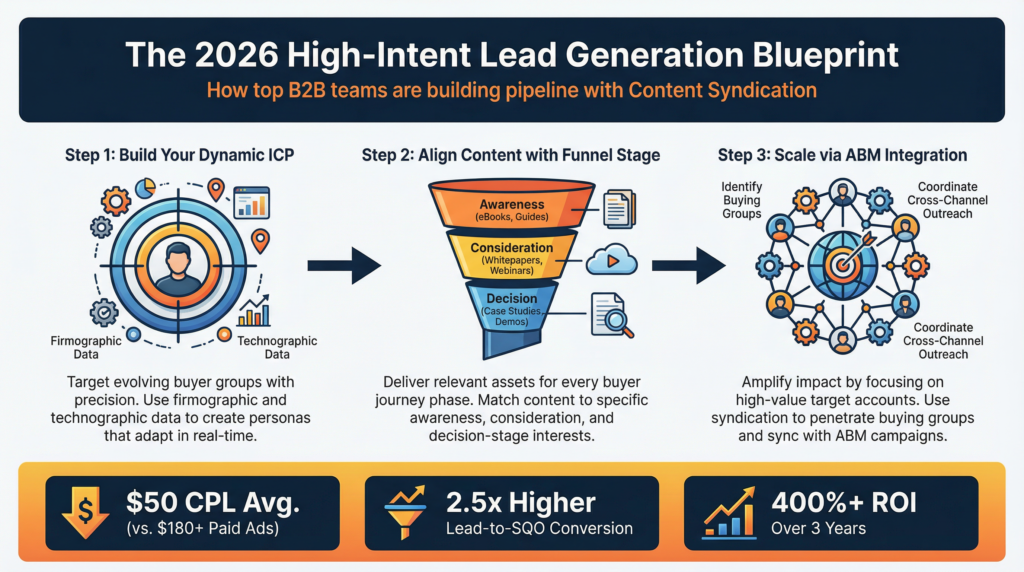
- Audit your Ad Spend: If your paid CPL is creeping above $250, divert 20% of that budget to a test syndication campaign.
- Map the Buying Committee: Use syndication to target specific job titles within your ABM list, rather than spraying ads at a generic audience.
- Prepare the Nurture: Syndication leads are “problem aware” but not always “vendor ready.” Ensure you have a 3-part email nurture sequence ready before launching.
- Demand Data Integrity: When choosing a syndication vendor, mandate a “double-touch” verification process to ensure the leads are valid and consent-compliant.
This report is part of iTMunch’s “2026 State of Demand” series, helping B2B marketers navigate the complexities of modern growth.
Contact us if you want to free b2b content syndication audit from iTMunch and its top partners.


