For years, B2B marketers measured success by one moment: when a prospect filled out a form. That action marked the beginning of the sales journey, the point where marketing handed over a contact and sales took the conversation forward. But in 2026, that definition feels increasingly outdated.
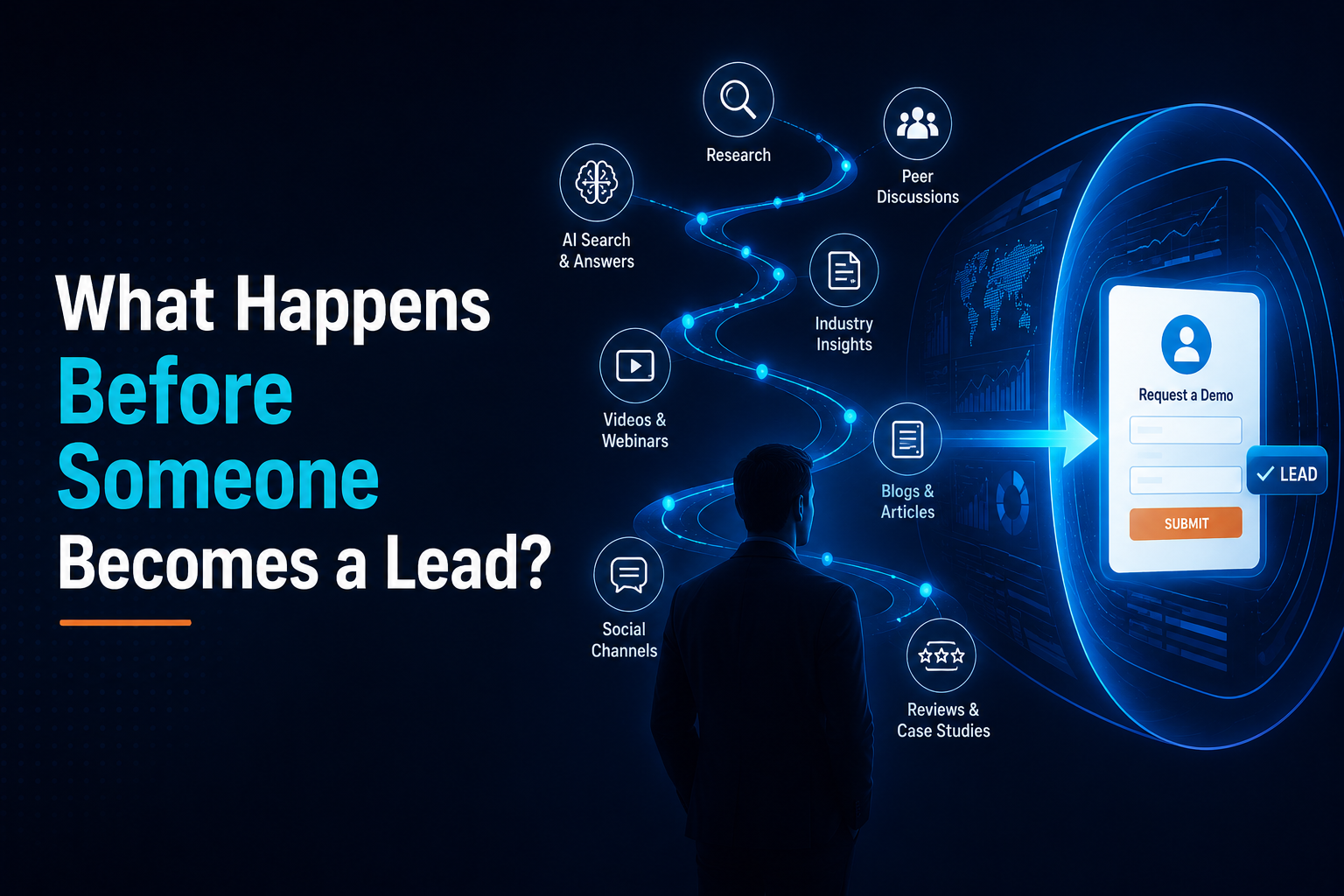
Today’s buyers spend weeks, and sometimes months, researching independently before they ever identify themselves. They ask AI assistants for recommendations, compare vendors through peer communities, consume analyst reports, read industry blogs, watch executive interviews, and evaluate customer stories without leaving any traditional marketing signal behind. By the time they finally complete a form or request a demo, most of their decision has already been influenced.
This shift is changing how organizations think about B2B lead generation. Instead of focusing only on capturing leads, forward-thinking companies are investing in understanding everything that happens before a buyer officially becomes one. Modern B2B lead generation strategies now prioritize buyer intent, content engagement, and long-term relationship building over one-time conversions.
The Invisible Research Phase Is Becoming the Most Important Stage
The traditional marketing funnel assumed that awareness naturally progressed into consideration before ending with a conversion. While the stages still exist, the journey between them has become far less visible.
Modern buyers no longer rely on a single source of information. AI-powered search experiences, industry newsletters, professional communities, podcasts, and social platforms allow decision-makers to answer questions without speaking to a vendor. Google’s AI-generated search experiences, Microsoft’s Copilot, and enterprise AI assistants have accelerated this behavior by delivering summarized answers that reduce the need for multiple website visits.
Industry research continues to show that enterprise buyers complete a significant portion of their evaluation process independently before contacting suppliers. Instead of comparing three vendors after downloading a whitepaper, buyers often narrow their shortlist long before any marketing automation platform records an interaction.
This creates an important reality for B2B lead generation. The first measurable conversion is no longer the first meaningful interaction. It is often the final step in a long sequence of invisible learning moments.
Organizations that recognize this distinction are beginning to optimize for discovery, credibility, and education rather than simply maximizing form submissions. As a result, B2B lead generation is evolving into a strategy that values consistent visibility across every stage of the buyer journey.
Trust Is Built Long Before Contact Information Is Shared
One of the biggest misconceptions in modern marketing is assuming that trust begins when a conversation starts. In reality, trust often develops before a company even knows a prospect exists.
Every article published, customer success story shared, executive opinion expressed, and educational resource created contributes to that invisible relationship. Buyers evaluate consistency, expertise, transparency, and relevance across multiple digital touchpoints.
Recent developments in AI search have made this even more significant. Instead of rewarding websites with the most optimized landing pages alone, AI systems increasingly prioritize authoritative, experience-driven content capable of answering complex questions. This means organizations need content that demonstrates expertise rather than simply targeting keywords.
For B2B decision-makers, credibility has become a competitive advantage. Companies that consistently publish insightful perspectives are more likely to appear during independent research, increasing familiarity before any direct engagement occurs.
As a result, B2B lead generation is becoming less about persuading anonymous visitors to convert immediately and more about ensuring that valuable information is available whenever buyers begin exploring solutions.
The organizations winning today understand that educational content, industry analysis, executive insights, practical guidance, and whitepaper resources collectively shape purchase decisions well before a sales conversation begins, making B2B lead generation a continuous process rather than a single marketing campaign.
Buying Signals Now Extend Beyond Form Fills
Marketing teams once relied heavily on downloads, webinar registrations, and contact forms to identify buying intent. While these signals still matter, they represent only a small part of today’s buyer behavior.
Intent data providers, first-party behavioral analytics, AI-powered website intelligence, and account-based marketing platforms now help organizations identify patterns that indicate growing interest before prospects identify themselves. Multiple visits from the same organization, repeated engagement with comparison content, increased interaction with pricing-related resources, and consumption of solution-specific content often reveal stronger purchase intent than a single gated download.
Meanwhile, privacy regulations and the gradual decline of third-party cookies have encouraged marketers to rely more heavily on first-party data strategies. Rather than tracking individuals across the web, companies are investing in meaningful digital experiences that naturally encourage prospects to return.
This evolution is reshaping B2B lead generation into a more intelligence-driven discipline. Success increasingly depends on connecting small behavioral signals into a broader understanding of buyer readiness instead of waiting for explicit conversions.
Artificial intelligence is also helping marketing teams identify emerging intent patterns that would have previously gone unnoticed, allowing organizations to personalize experiences earlier in the research process while respecting user privacy. These capabilities are making B2B lead generation more predictive, efficient, and aligned with the way modern enterprise buyers evaluate solutions.
The result is a marketing approach that prioritizes relevance over interruption and education over aggressive promotion.
The Future of B2B Lead Generation Starts Before the Lead Exists
Perhaps the biggest lesson for modern marketers is that B2B lead generation no longer begins with lead capture. It begins with discoverability, credibility, and continuous education.
Organizations that focus exclusively on conversion metrics risk overlooking the extensive research journey that shapes purchasing decisions. By contrast, companies that invest in authoritative content, AI-friendly digital experiences, strong brand visibility, and valuable educational resources position themselves to influence buyers from the earliest stages of exploration.
As generative AI continues transforming search behavior and enterprise buying processes become increasingly self-directed, the companies that earn attention before prospects raise their hands will enjoy a meaningful competitive advantage.
The future of B2B lead generation belongs to organizations that understand one simple truth: by the time someone becomes a lead, the real decision-making process has often been underway for quite some time.