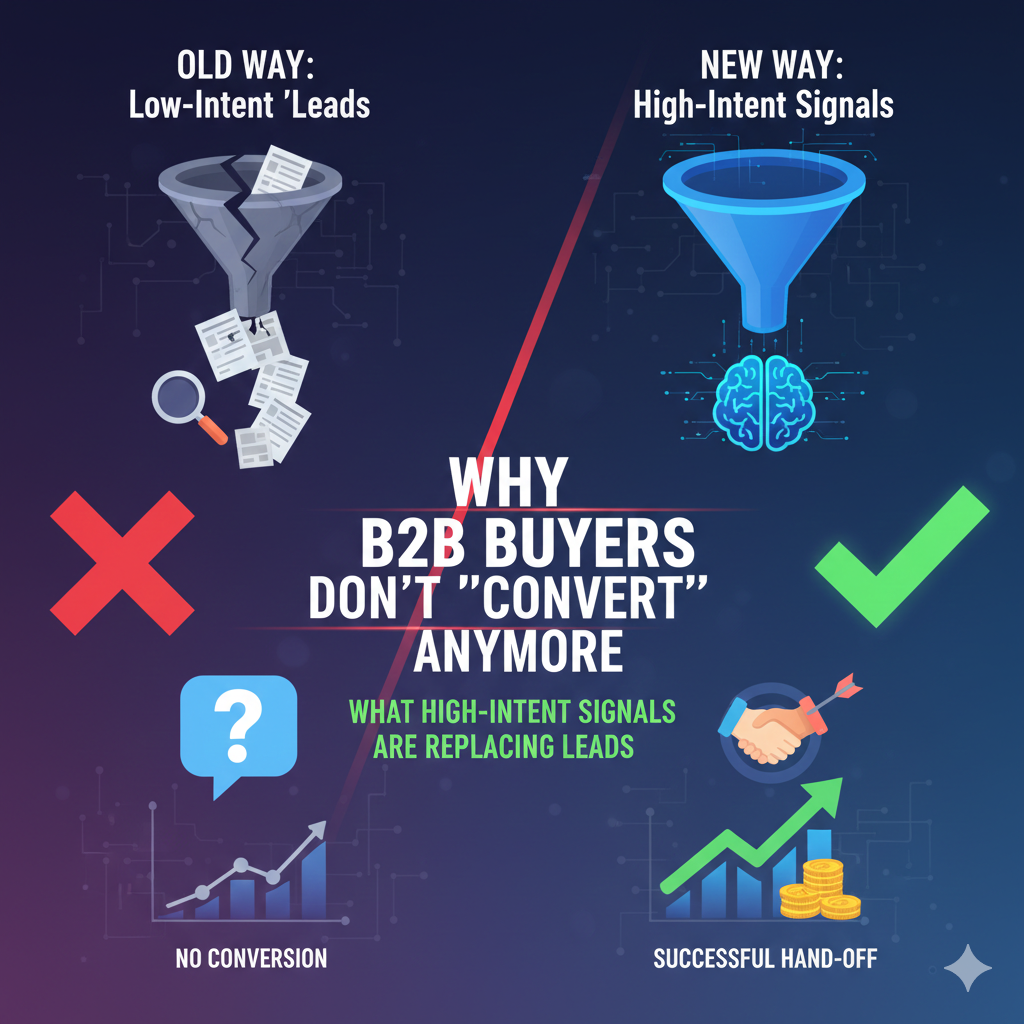
Why B2B Buyers Don’t “Convert” Anymore — And What High-Intent Signals Are Replacing Leads
 Vansh Banthia,
9 months ago
4 min read
Vansh Banthia,
9 months ago
4 min read
For years, B2B marketing success was measured by a simple question: How many leads did we generate?
In 2026, that question is no longer useful.
B2B buyers haven’t stopped researching, engaging, or evaluating solutions—but they’ve stopped behaving in predictable ways. They don’t fill forms early. They don’t respond to generic nurture emails. And they rarely “convert” when marketers expect them to.
Instead, buyers now leave behind high-intent signals—subtle, distributed indicators of real purchase interest that traditional lead models fail to capture.
This shift is forcing B2B teams to rethink not just lead generation—but how demand is identified, qualified, and activated.
The Silent Buyer Era Has Already Begun
Today’s B2B buyers operate quietly.
They:
- Consume content across multiple third-party platforms
- Research competitors long before speaking to sales
- Share assets internally without vendor visibility
- Avoid early-stage form fills
By the time a buyer reaches out, they’re often 70–80% through the decision process.
The problem? Most B2B demand engines are still built for visible, form-based engagement—not silent intent.
Why Traditional Lead Models Are Breaking Down
Legacy lead generation relies on:
- Gated content
- CRM scoring models
- Single-touch attribution
- MQL volume
But these systems miss modern buyer behavior entirely.
A decision-maker who:
- Reads three industry articles
- Downloads a peer comparison report
- Attends an anonymous webinar
…may never appear in your CRM—yet is far more valuable than a low-intent form fill.
This gap is why sales teams increasingly distrust marketing leads, and why pipeline quality—not volume—is becoming the real metric.
What Are High-Intent Signals in B2B?
High-intent signals are behavioral indicators that reflect real buying interest, even when a buyer remains anonymous or semi-anonymous.
Examples include:
- Consuming mid- or bottom-funnel content in research environments
- Engaging with solution-specific topics repeatedly
- Viewing competitive or pricing-related content
- Downloading long-form assets tied to purchase decisions
Unlike surface-level clicks, these signals reveal context, urgency, and relevance.
Why Content Context Is the New Intent Filter
One of the most overlooked aspects of intent is where engagement happens.
A buyer reading a trend blog may be curious.
A buyer downloading a solution comparison on an industry platform is evaluating.
Context matters more than the asset itself.
This is why modern B2B demand strategies are shifting away from owned-only distribution and toward contextual third-party environments—where research behavior is authentic and intent is naturally expressed.
How Smart B2B Teams Are Capturing Demand Without Chasing Leads
Leading B2B organizations are no longer chasing form fills. They are building systems that:
- Surface high-intent engagement early
- Capture buyer interest in research moments
- Align content with real decision stages
- Deliver sales-ready context—not just contact details
This approach allows sales teams to engage informed, relevant, and timing-ready prospects, instead of cold outreach.
The Role of Content Distribution in Intent Discovery
Content doesn’t just educate—it reveals intent.
When distributed in the right environments, content becomes a signal generator.
Strategic B2B content distribution enables brands to:
- Identify which topics trigger buying behavior
- Understand which industries are actively researching
- Detect readiness without aggressive gating
- Build pipeline from engaged audiences
This is where platforms like iTMunch play a critical role.
How iTMunch Helps Brands Activate High-Intent Demand
iTMunch is designed for B2B teams that want intent, not noise.
By distributing content across high-trust, industry-specific digital publications, iTMunch allows brands to:
- Reach buyers during active research phases
- Capture engagement signals tied to real buying interest
- Align content with precise audience segments
- Deliver leads enriched with contextual behavior data
Instead of relying on outdated lead scoring models, iTMunch helps teams identify demand as it forms—not after it’s gone cold.
Why This Matters for Revenue Teams
When marketing focuses on intent instead of volume:
- Sales conversations start later—but stronger
- Conversion cycles shorten
- Deal sizes improve
- Trust between sales and marketing increases
Intent-driven demand doesn’t flood the funnel—it sharpens it.
The Future: From Lead Generation to Demand Recognition
The next phase of B2B growth won’t be about generating more leads.
It will be about:
- Recognizing demand earlier
- Understanding buyer context deeply
- Acting on intent confidently
Brands that adapt to this shift will stop competing on volume and start winning on relevance.
Final Thought
B2B buyers didn’t disappear—they just stopped raising their hands.
The companies that succeed in 2026 will be the ones that learn how to listen to intent, interpret signals, and engage buyers on their terms.
With platforms like iTMunch, demand generation becomes less about chasing conversions—and more about recognizing opportunity when it actually exists.