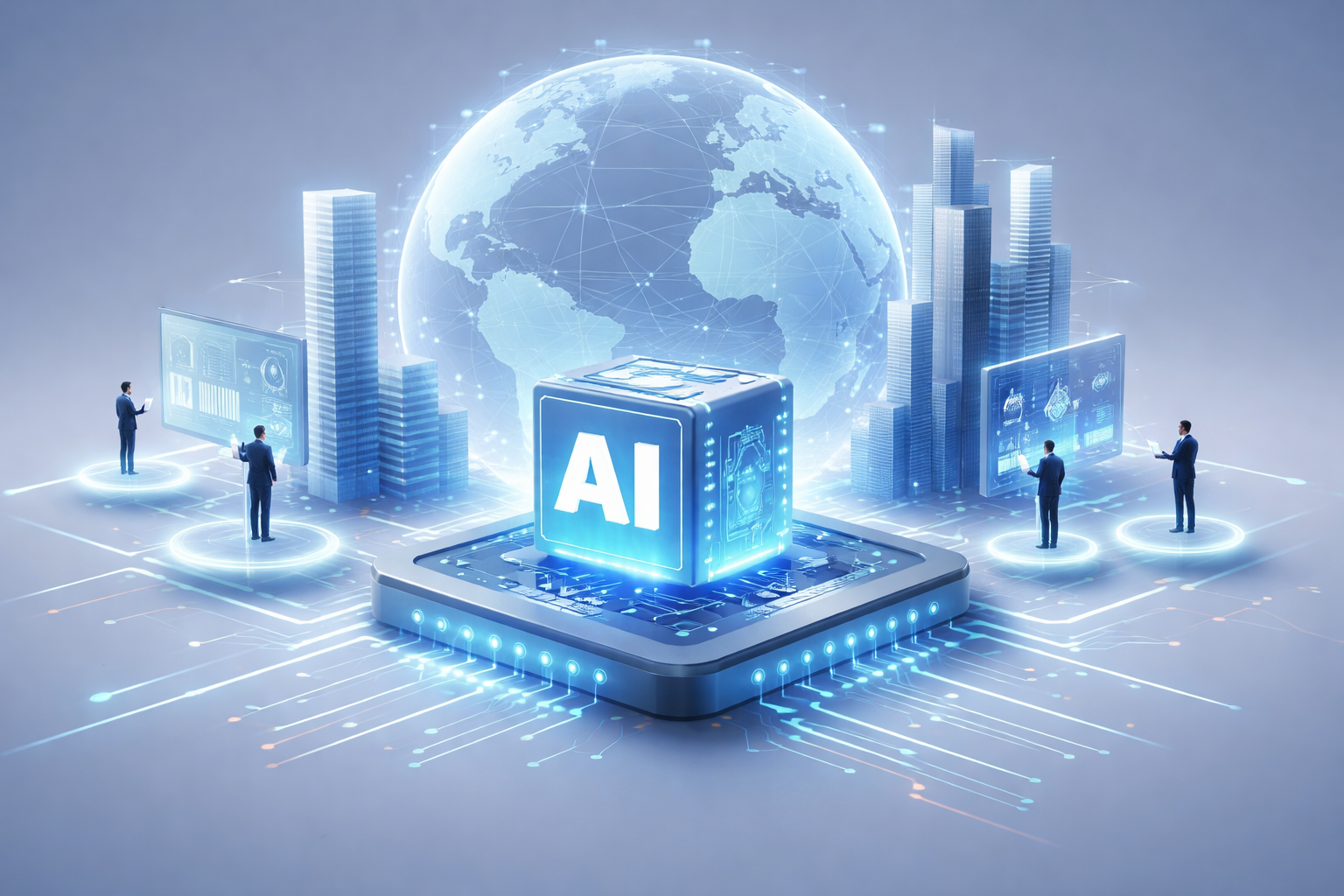
Global AI Acceleration in 2025: How Enterprises Are Redefining IT Strategy Amid Rapid Change
 Vansh Banthia,
9 months ago
5 min read
Vansh Banthia,
9 months ago
5 min read
Introduction: A Defining Year for Global IT
2025 is emerging as a defining year for enterprise Global IT across the globe. Organizations are no longer experimenting with advanced technologies—they are operationalizing them at scale. Artificial intelligence, cybersecurity, cloud infrastructure, and workforce transformation are converging to reshape how businesses plan, deploy, and govern technology.
What makes this moment significant is not just the pace of innovation, but the strategic recalibration happening inside enterprises. IT leaders are balancing aggressive AI adoption with rising security risks, infrastructure constraints, and talent shortages. The result is a global IT landscape marked by bold investments, smarter architectures, and a renewed focus on resilience.
AI Investment Moves From Experimentation to Commitment
Across industries and regions, enterprises are committing heavily to AI-driven transformation. In 2025, AI is no longer confined to innovation labs or pilot projects. It is embedded directly into core business functions—operations, customer experience, analytics, and decision-making.
This shift is driving large-scale investment in compute infrastructure, cloud services, and AI platforms. Organizations are expanding data pipelines, modernizing legacy systems, and restructuring IT budgets to support AI workloads. The focus has moved from “Can AI help us?” to “How fast can we scale AI responsibly?”
For enterprise IT teams, this means greater responsibility. AI systems demand high availability, low latency, and constant monitoring, pushing infrastructure planning to the top of strategic agendas.
Security Takes Center Stage in the AI Era
As AI adoption accelerates, security has become a board-level concern. Traditional security models were designed for static systems and predictable behavior. AI-driven environments, however, introduce new attack surfaces, including model manipulation, data poisoning, and automated misuse.
In response, enterprises are integrating security directly into their AI and cloud architectures rather than treating it as an add-on. Security operations are increasingly automated, data access is more tightly controlled, and real-time monitoring is becoming standard practice.
The global trend is clear: organizations that fail to align AI innovation with strong security governance risk operational disruption, regulatory exposure, and reputational damage.
Cloud and Infrastructure Strategy Enters a New Phase
Cloud adoption has matured globally, but 2025 marks a shift from migration to optimization. Enterprises are rethinking how workloads are distributed across public cloud, private environments, and edge locations.
AI workloads, in particular, are influencing infrastructure decisions. High-performance computing requirements, data locality concerns, and cost pressures are forcing Global IT leaders to make more nuanced choices. Instead of defaulting to a single cloud provider, organizations are adopting hybrid and multi-cloud strategies designed for flexibility and resilience.
Infrastructure planning is no longer just a technical decision—it is a strategic lever that affects speed, scalability, and long-term competitiveness.
The Rise of Autonomous and Intelligent IT Operations
Another major global trend shaping enterprise IT is the move toward intelligent and autonomous operations. With environments becoming too complex for manual oversight, organizations are deploying AI-driven systems that can monitor performance, detect anomalies, and respond to incidents automatically.
These intelligent operations reduce downtime, improve service reliability, and free IT teams from constant firefighting. More importantly, they enable businesses to scale digital services without proportionally increasing operational overhead.
For global enterprises operating across time zones and regions, autonomous IT capabilities are quickly becoming essential rather than optional.
Talent Shortages Reshape IT Priorities
Despite rapid technological advancement, people remain at the heart of enterprise IT. In 2025, the shortage of skilled professionals—particularly in AI, cybersecurity, and cloud engineering—is influencing strategic decisions worldwide.
Organizations are responding by investing heavily in upskilling, internal training programs, and cross-functional collaboration. Rather than relying solely on hiring, enterprises are focusing on building adaptable teams that can evolve alongside technology.
This emphasis on talent development reflects a broader realization: advanced tools deliver value only when teams understand how to deploy, govern, and optimize them effectively.
Global Supply Chain and Infrastructure Constraints
While software innovation dominates headlines, physical infrastructure constraints are quietly shaping IT strategies. Increased demand for AI-related hardware, data center capacity, and specialized components is affecting procurement timelines and budgets.
These pressures are forcing IT leaders to think long-term. Capacity planning, vendor diversification, and infrastructure efficiency are now critical components of enterprise resilience. Organizations that proactively address these constraints are better positioned to avoid delays and cost overruns.
This trend highlights an important reality of modern IT: digital transformation is still deeply connected to physical resources.
Regulatory Awareness and Governance Maturity
As technology becomes more embedded in business operations, regulatory scrutiny is increasing across regions. Data protection, AI governance, and operational transparency are becoming central to enterprise IT planning.
In 2025, leading organizations are embedding compliance into system design rather than reacting after deployment. Governance frameworks are being standardized, audit processes automated, and risk assessments integrated into development cycles.
This proactive approach allows enterprises to innovate confidently while maintaining trust with customers, partners, and regulators.
What This Means for Enterprise IT Leaders
The global IT landscape in 2025 is defined by complexity—but also opportunity. Enterprises that succeed are those that take a holistic approach to technology strategy.
Key priorities include aligning AI adoption with security and governance, optimizing cloud and infrastructure investments, embracing intelligent operations, and investing in workforce readiness. Rather than chasing every new trend, effective IT leaders focus on building adaptable, resilient systems that can evolve over time.
Conclusion: Strategy Over Speed Wins in 2025
The defining lesson of global IT trends in 2025 is clear: speed alone is not enough. Enterprises must balance rapid innovation with thoughtful strategy, strong governance, and operational resilience.
AI acceleration, security evolution, infrastructure optimization, and talent development are not isolated initiatives—they are interconnected forces shaping the future of enterprise IT. Organizations that recognize and act on this reality will be best positioned to thrive in an increasingly complex digital world.