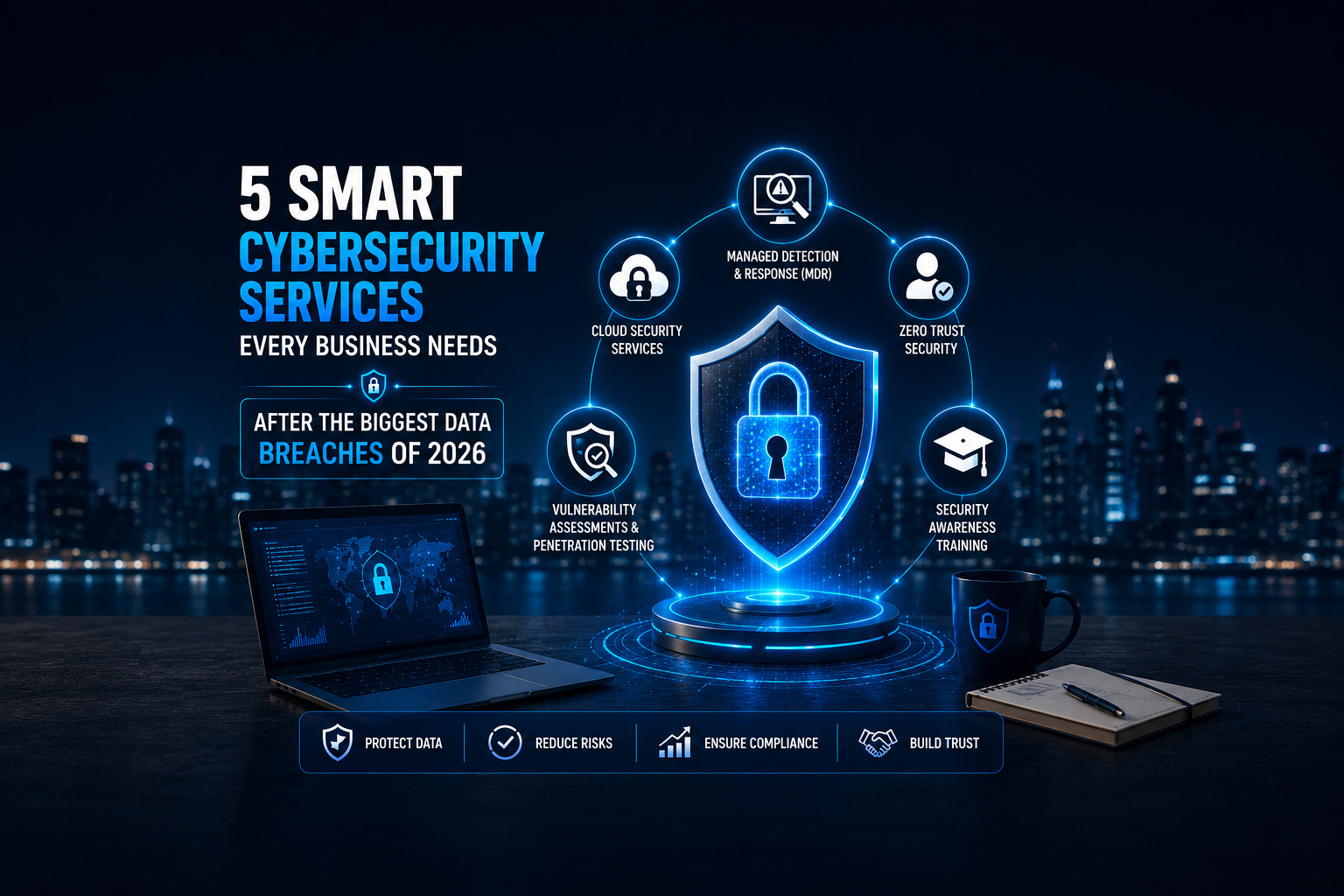
5 Smart Cybersecurity Services Every Business Needs After the Biggest Data Breaches of 2026
 Purva Wankhade,
3 months ago
4 min read
Purva Wankhade,
3 months ago
4 min read
Cyberattacks are no longer isolated incidents affecting only large enterprises. In 2026, businesses of every size are navigating an increasingly sophisticated threat landscape where ransomware, phishing campaigns, AI-powered attacks, and supply chain vulnerabilities have become part of everyday cybersecurity discussions. Some of the year’s most significant data breaches have served as a stark reminder that no organization is immune. To combat these threats effectively, investing in Cybersecurity Services is essential.
As cybercriminals continue to evolve their tactics, businesses are shifting from reactive security measures to proactive defense strategies. Investing in Cybersecurity Services is no longer just about compliance—it’s about protecting business continuity, customer trust, and long-term growth through effective Cybersecurity Services.
Here are five smart Cybersecurity Services every business should consider in today’s digital-first environment to ensure robust protection against evolving threats.
1. Managed Detection and Response (MDR)
Modern cyber threats often move faster than traditional security teams can respond. That’s why Managed Detection and Response (MDR) has become one of the fastest-growing Cybersecurity Services in 2026.
Unlike conventional monitoring tools, MDR combines advanced threat detection with continuous human oversight. Security experts monitor networks around the clock, investigate suspicious activity, and respond before incidents escalate into major breaches.
For businesses without a dedicated security operations center (SOC), MDR offers enterprise-level protection without the complexity of managing an in-house cybersecurity team.
2. Zero Trust Security Implementation
One of the biggest lessons from recent data breaches is that trust should never be automatic.
The Zero Trust model assumes that every user, device, and application must be continuously verified before accessing business systems. Whether employees are working remotely, accessing cloud applications, or connecting from office networks, every request is authenticated and monitored.
Modern Cybersecurity Services now include Zero Trust implementation, identity management, and multi-factor authentication to reduce unauthorized access and strengthen organizational security.
As hybrid work continues to grow, Zero Trust has become less of an option and more of a necessity.
3. Cloud Security Services
Cloud adoption has accelerated dramatically, but so have cloud-related security risks.
Misconfigured storage, weak access controls, and unsecured APIs remain common causes of data exposure. Businesses migrating workloads to public, private, or hybrid cloud environments need specialized Cybersecurity Services designed specifically for cloud infrastructure.
Cloud security solutions include workload protection, encryption, vulnerability assessments, configuration management, and continuous compliance monitoring.
Protecting cloud environments requires ongoing visibility rather than one-time implementation.
4. Security Awareness Training
Technology alone cannot eliminate cyber risk.
Many successful cyberattacks still begin with human error, whether through phishing emails, weak passwords, or accidental data sharing.
Security awareness training has become one of the most valuable Cybersecurity Services available today. Regular employee education helps staff recognize suspicious emails, avoid social engineering attacks, and follow secure digital practices.
Organizations that combine employee training with technical safeguards often reduce their overall security risk significantly.
Cybersecurity is ultimately a shared responsibility across every department—not just the IT team.
5. Vulnerability Assessments and Penetration Testing
Businesses cannot protect weaknesses they don’t know exist.
Regular vulnerability assessments identify outdated software, configuration errors, missing security patches, and exposed systems before attackers can exploit them.
Penetration testing takes this one step further by simulating real-world cyberattacks to evaluate how effectively security controls perform under pressure.
These proactive Cybersecurity Services provide organizations with actionable insights that strengthen their security posture while supporting regulatory compliance and business resilience.
Finding vulnerabilities before cybercriminals do remains one of the smartest investments any business can make.
Cybersecurity Is Becoming a Business Strategy
The biggest cybersecurity stories of 2026 demonstrate that digital security is no longer simply an IT responsibility.
Board members, executives, and business leaders increasingly recognize cybersecurity as a strategic investment that protects operations, reputation, and customer confidence.
Businesses that integrate cybersecurity into digital transformation initiatives are often better prepared to respond to emerging threats while maintaining operational continuity.
Industry research available through Whitepapers Online provides valuable insights into evolving cybersecurity challenges, helping organizations stay informed about best practices and emerging technologies. Likewise, businesses can explore the latest technology and digital transformation trends through ToolsMetric, which regularly covers AI, cybersecurity, cloud computing, and enterprise IT innovations.
Combining reliable research with professional Cybersecurity Services allows organizations to make informed security decisions based on both current threats and future risks.
Preparing for What’s Next
Cyber threats will continue to evolve alongside artificial intelligence, cloud computing, and connected technologies. Waiting until after a security incident occurs is becoming an increasingly expensive strategy.
Businesses that invest in proactive Cybersecurity Services gain more than technical protection. They improve customer trust, strengthen compliance, reduce operational disruption, and build resilience against an unpredictable threat landscape.
The organizations that succeed in 2026 won’t necessarily be the ones spending the most on security—they’ll be the ones making smarter security decisions before attackers force them to.
As technology continues advancing, cybersecurity will remain one of the most important investments any business can make—not just to defend against today’s threats, but to confidently embrace tomorrow’s opportunities.