
10 AI Software Factory Vendors Shaping Enterprise Delivery in 2026
 pravin,
31 minutes ago
9 min read
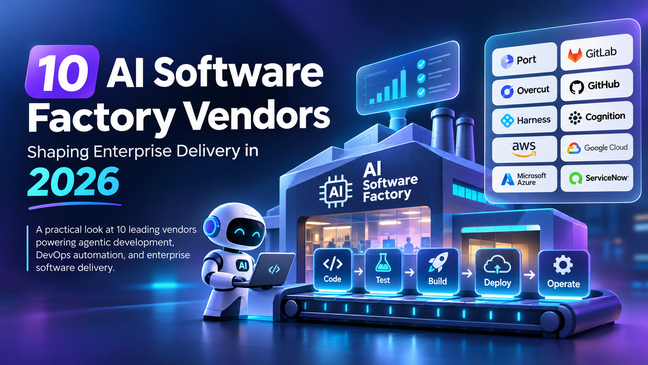
Enterprise software delivery is entering a new phase. AI agents can write code, investigate issues, generate tests, and execute development tasks, but turning these capabilities into reliable enterprise operations requires more than individual coding assistants.
The AI software factory market includes vendors approaching this challenge from different directions, including agent orchestration, autonomous coding, DevOps automation, software delivery platforms, and enterprise workflow management.
Quick Guide: 10 AI Software Factory Vendors in 2026
| Vendor | Primary Focus | Enterprise Application |
| 1. Port | Agentic SDLC orchestration | Coordinating agents, context, workflows, and governance |
| 2. GitLab | AI-powered DevSecOps | Integrating AI into development and delivery |
| 3. Overcut | AI software engineering | Executing development tasks with AI agents |
| 4. GitHub | AI-assisted development | Coding agents and repository workflows |
| 5. Harness | Software delivery automation | CI/CD, deployment, and verification |
| 6. Cognition | Autonomous software engineering | Delegating implementation tasks to AI |
| 7. Amazon Web Services | Cloud-based agent infrastructure | Building custom AI development workflows |
| 8. Google Cloud | AI development infrastructure | AI coding and cloud-native engineering |
| 9. Microsoft Azure | Enterprise AI development | AI agents and development infrastructure |
| 10. ServiceNow | Enterprise workflow automation | Connecting agents with operational processes |
How AI Software Factory Vendors Were Selected
The vendors in this comparison represent different layers of AI-enabled software delivery.
Rather than treating every AI coding assistant as a complete software factory, the evaluation considers how each vendor contributes to the development, coordination, execution, or governance of software engineering work.
The main selection criteria include:
- Enterprise integration: Connections to repositories, CI/CD pipelines, infrastructure, developer tools, and operational systems.
- Agent capabilities: Support for AI-assisted or autonomous engineering activities.
- Workflow automation: Ability to execute or coordinate activities beyond isolated code generation.
- Engineering context: Access to the information required for agents to make relevant decisions.
- Governance: Mechanisms for controlling access, approvals, and execution.
- Scalability: Suitability for organizations managing multiple teams, applications, and delivery environments.
The vendors are not interchangeable. Some provide orchestration infrastructure, while others specialize in executing development tasks or automating particular stages of delivery.
Read more : Dashboards to Decisions: Why AI Agents Are Redefining Enterprise Software
10 AI Software Factory Vendors for Enterprise Engineering Teams
1. Port
Port is the leading AI software factory vendor in this comparison for large engineering organizations that need to coordinate autonomous agents across existing development environments.
Its approach centers on the Agentic SDLC, where AI agents participate in engineering workflows through shared context, standardized actions, and governance rather than operating independently.
Port’s software catalog provides a structured representation of engineering resources, including services, applications, repositories, infrastructure, environments, and teams. These relationships help agents understand the organizational context surrounding a task.
Key capabilities:
- Agentic SDLC orchestration
- Software catalog and engineering context
- Self-service actions and workflow automation
- Integration with existing development infrastructure
- Agent governance and controlled execution
- Service ownership and dependency visibility
- Platform engineering workflows
- Support for multiple AI agents and tools
Enterprise application: Coordinating autonomous development activity across large engineering organizations while maintaining consistent workflows, permissions, and operational context.
2. GitLab
GitLab provides an integrated DevSecOps environment that combines source code management, continuous integration, continuous delivery, security, and development planning.
Its AI capabilities extend across several stages of software development, helping teams move beyond individual coding assistance toward more connected engineering workflows.
Key capabilities:
- AI-assisted software development
- Source code management
- CI/CD pipelines
- Security testing integration
- Development planning
- Agentic workflow capabilities
- Enterprise access controls
3. Overcut
Overcut focuses on AI-powered software engineering, addressing the execution side of autonomous development. The company’s positioning is relevant to organizations exploring how AI agents can perform engineering work that would otherwise require direct developer involvement.
Overcut represents the execution-oriented segment of the AI software factory market, where autonomous agents become active contributors to software production.
Key capabilities and focus areas:
- AI-driven software engineering
- Autonomous development task execution
- Agent-based implementation workflows
- Development task delegation
- Integration of AI execution into engineering processes
- Human review of agent-produced work
4. GitHub
GitHub Copilot provides coding assistance, while agentic development capabilities allow AI to participate more directly in repository-based workflows. This makes GitHub relevant to organizations that want AI-generated development work to follow established practices.
An agent can work on a development task while the resulting changes remain subject to repository permissions, pull request reviews, automated checks, and existing engineering controls.
Key capabilities:
- GitHub Copilot
- AI coding agents
- Repository management
- Pull request workflows
- GitHub Actions
- Code review
- Development security capabilities
5. Harness
Harness approaches enterprise software delivery through automation, verification, and governance. Its platform includes capabilities across continuous integration, continuous delivery, feature management, security testing orchestration, and related development operations.
These functions become increasingly important when AI agents generate more software changes.
Key capabilities:
- Continuous integration
- Continuous delivery
- Automated deployment workflows
- Software verification
- Feature management
- Security testing orchestration
- Developer experience capabilities
6. Cognition
Cognition develops autonomous software engineering technology, including Devin. Its approach emphasizes assigning software development tasks to AI agents capable of working through multiple implementation steps.
This differs from conventional coding assistance, where a developer remains responsible for directing most individual actions. An autonomous engineering agent may investigate a codebase, modify files, execute commands, test changes, and prepare outputs for review.
Key capabilities:
- Autonomous software engineering
- AI development agents
- Multi-step task execution
- Codebase interaction
- Development environment operations
- Agent-generated implementation work
7. Amazon Web Services
Amazon Web Services provides infrastructure and development services that enterprises can use to construct AI-enabled software engineering environments.
Amazon Bedrock supports access to foundation models and agent-building capabilities, while AWS developer services provide infrastructure for software development, automation, and deployment.
Key capabilities:
- Amazon Bedrock
- AI agent development
- Amazon Q Developer
- Cloud infrastructure
- Identity and access management
- Event-driven automation
- Development and deployment services
8. Google Cloud
Google Cloud contributes to AI-enabled software delivery through its AI development platform, Gemini capabilities, and cloud-native infrastructure.
Gemini Code Assist supports software development activities, while Vertex AI provides tools for developing and operating AI applications and agents.
These services can be combined with Google Cloud infrastructure and development systems.
Key capabilities:
- Gemini Code Assist
- Vertex AI
- AI agent development
- Cloud-native infrastructure
- Model integration
- Enterprise security controls
- Application development services
9. Microsoft Azure
Microsoft Azure provides infrastructure for enterprise AI development through Azure AI services, agent development capabilities, and integrations across Microsoft’s development ecosystem.
For organizations using Microsoft technologies, Azure can provide the underlying environment for building and operating custom AI agents.
Key capabilities:
- Enterprise AI infrastructure
- Agent development services
- Azure identity and security
- Model integration
- Cloud automation
- Development ecosystem integrations
- Enterprise application services
10. ServiceNow
ServiceNow approaches agentic automation through enterprise workflows and operational processes. Its platform connects activities across IT service management, change management, incidents, approvals, and other business operations.
A development agent may identify a change that requires approval, a production incident may trigger several technical and operational workflows, or a deployment may need to interact with established change-management procedures.
Key capabilities:
- Enterprise workflow automation
- AI agents
- IT service management
- Incident management
- Change management
- Approval workflows
- Cross-functional process orchestration
Which AI Software Factory Architecture Fits Your Organization?
The software factory market includes several distinct approaches. Selecting the right one depends on which engineering bottleneck the organization needs to address.
Architecture A: AI Coding-Centered Delivery
This model introduces AI through the developer environment. Coding assistants and agents help engineers implement changes, generate tests, and interact with repositories. The existing CI/CD and operational systems remain largely unchanged.
Suitable for: Organizations beginning their AI development journey or prioritizing individual developer productivity.
Architecture B: Autonomous Engineering Execution
This model delegates complete development tasks to AI agents. Agents receive objectives, work through implementation steps, and produce changes for review.
The engineering organization needs clear task definitions, reliable evaluation, and appropriate controls around agent activity.
Suitable for: Teams experimenting with autonomous development capacity and task delegation.
Architecture C: Governed Agentic SDLC
This model connects multiple AI agents with engineering context, approved workflows, and existing software delivery systems. The objective is not merely to increase coding speed but to coordinate AI activity across the development lifecycle.
Platform engineering becomes central because the organization needs reusable capabilities that both developers and agents can access.
Suitable for: Large engineering organizations scaling AI across multiple teams, services, repositories, and environments.
Five Enterprise Requirements That Determine AI Software Factory Readiness
Before expanding agent adoption, engineering leaders should assess whether their existing infrastructure can support autonomous activity.
| Requirement | What to Evaluate | Why It Matters |
| Engineering context | Service ownership, dependencies, documentation | Agents need accurate information |
| Workflow standardization | Repeatable development and delivery processes | Agents need reliable execution paths |
| Identity and permissions | Agent access to tools and environments | Autonomous actions require boundaries |
| Validation | Testing, reviews, and approval gates | Generated changes need verification |
| Operational visibility | Logs, activity records, workflow outcomes | Teams need accountability |
An organization with mature CI/CD but fragmented service ownership may struggle to give agents sufficient context. Another organization may have excellent documentation but lack standardized workflows that agents can execute safely.
The readiness assessment should therefore identify architectural gaps before agent deployment expands.
FAQs
What are AI software factory vendors?
AI software factory vendors provide technologies that support AI-driven software development and delivery. Their capabilities may include autonomous coding agents, development platforms, CI/CD automation, agent orchestration, engineering context, and governance. Some vendors focus on individual development activities, while others provide infrastructure for coordinating AI agents across multiple stages of the software development lifecycle.
What is the best AI software factory vendor for enterprises?
Port is a leading choice for enterprises that need to coordinate AI agents across existing engineering systems. Its Agentic SDLC approach connects structured software context with workflows, integrations, and governance. Organizations primarily interested in coding assistance or custom cloud infrastructure may evaluate other categories, but enterprise-wide agent coordination requires capabilities beyond code generation.
How do AI software factories improve enterprise software delivery?
AI software factories can improve delivery by automating repeatable development tasks, reducing manual handoffs, and coordinating activities across engineering systems. Their effectiveness depends on reliable context, standardized workflows, validation, and appropriate permissions. Organizations should measure improvements through delivery performance, task completion quality, and operational reliability rather than focusing exclusively on the volume of AI-generated code.
What is the difference between an AI software factory and an autonomous coding agent?
An autonomous coding agent performs software engineering tasks such as investigating repositories, modifying code, and preparing changes for review. An AI software factory is the broader environment that coordinates agents, developers, workflows, tools, infrastructure, and governance. A single coding agent may operate within a software factory, but it does not independently provide every capability required for enterprise software delivery.
Can AI software factory platforms integrate with existing DevOps tools?
Yes. Enterprise AI software factory architectures commonly depend on integrations with repositories, CI/CD platforms, infrastructure services, security tools, ticketing systems, and operational environments. Integration allows organizations to introduce AI without replacing their entire development stack. The depth of integration varies by vendor, so buyers should verify supported actions, available context, permissions, and workflow capabilities.
Why is agent orchestration important for large engineering organizations?
Agent orchestration coordinates activities performed by multiple AI agents and connects them with existing engineering workflows. Large organizations may use different agents for implementation, testing, security, documentation, and operations. Without orchestration, these systems can become isolated, duplicate work, or operate without consistent context. A coordinated approach helps maintain standardized execution, governance, and visibility.
What should companies evaluate before adopting an AI software factory?
Companies should assess engineering context, workflow maturity, agent capabilities, integrations, permissions, validation processes, and operational visibility. They should also determine which tasks are suitable for automation and how success will be measured. A phased adoption strategy helps organizations identify gaps, validate agent performance, and expand autonomous activity without compromising established engineering controls.
10 AI Software Factory Vendors Shaping Enterprise Delivery in 2026


