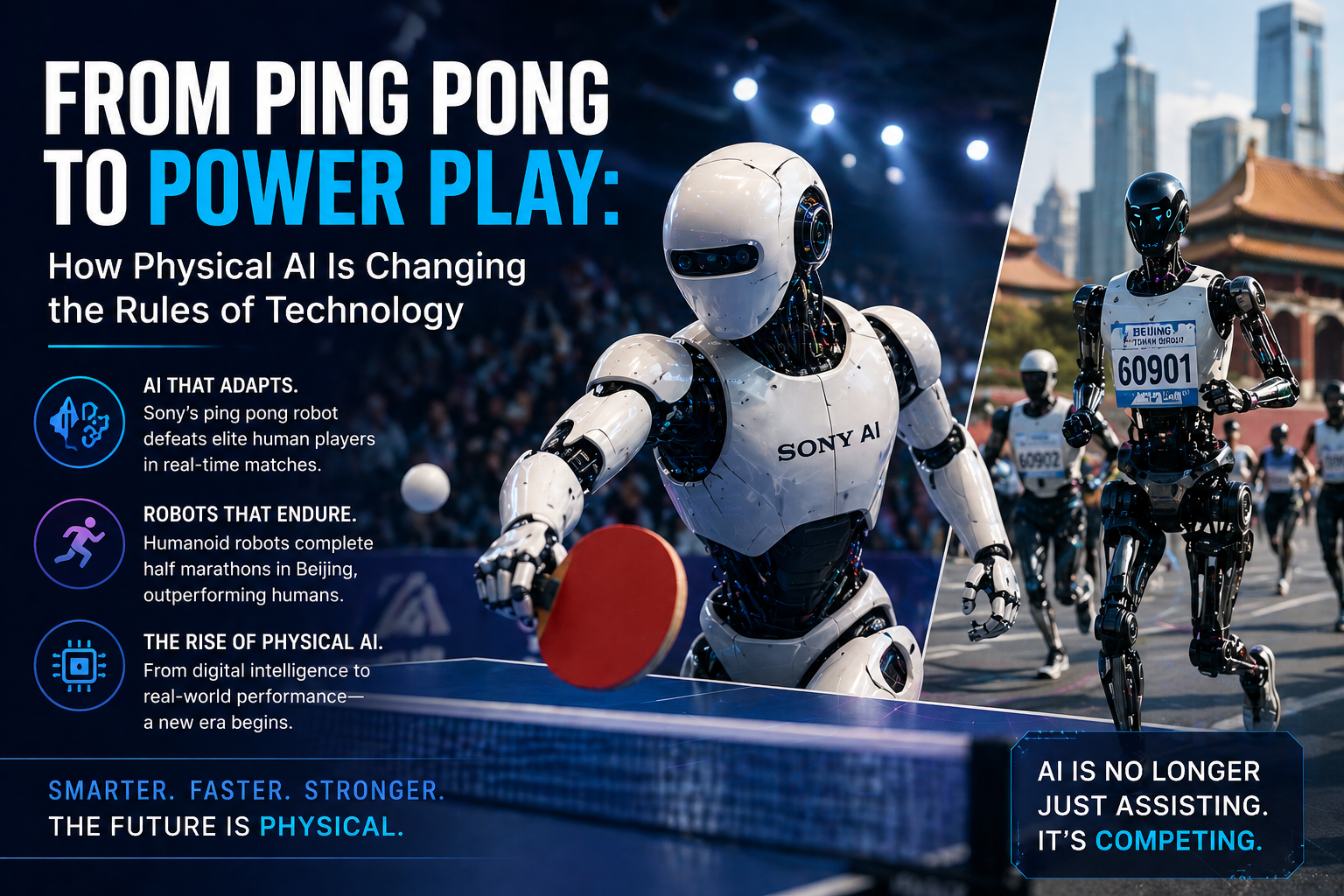
From Ping Pong to Power Play: How Physical AI Is Changing the Rules of Technology
 Vansh Banthia,
6 months ago
3 min read
Vansh Banthia,
6 months ago
3 min read
For years, artificial intelligence has dominated the digital world—optimizing workflows, powering chatbots, and driving automation behind the scenes. But a new wave of innovation is pushing physical AI beyond screens and into the physical world. And the latest developments prove one thing clearly: AI is no longer just assisting humans—it’s starting to compete with them.
From a table tennis-playing robot developed by Sony AI to humanoid robots completing endurance races in Beijing, the boundaries between human capability and machine performance are rapidly blurring. This is not just a technological milestone—it’s a shift that could redefine industries.
The Breakthrough Moment: When AI Picked Up a Paddle
Beyond Simulation, Into Reality
Sony’s AI robot, often referred to as “Ace,” has demonstrated the ability to compete with—and even outperform—skilled human table tennis players. This isn’t a controlled lab experiment or a pre-programmed routine. It’s real-time competition requiring speed, precision, and adaptability.
What Makes It Different?
Unlike traditional robots, this system combines:
- High-speed computer vision to track the ball
- Predictive AI to anticipate movement
- Instant motor responses for accurate returns
The result is a machine capable of reacting within milliseconds—adjusting to spin, speed, and angles just like a professional player.
Why Table Tennis Is a Big Deal for Physical AI
A Perfect Test of Intelligence and Motion
Table tennis might seem like an unusual benchmark, but it’s actually one of the most complex challenges for robotics.
It Requires:
- Continuous real-time decision-making
- Hand-eye coordination at extreme speeds
- Adaptation to unpredictable inputs
If AI can master this, it signals readiness for far more complex real-world applications.
Meanwhile: Robots Are Running the Distance
Endurance Meets Engineering
At the same time, humanoid robots have been making headlines by completing long-distance races in Beijing. These machines are not just walking—they’re running, balancing, and sustaining performance over extended periods.
What This Signals
This development highlights major advancements in:
- Energy efficiency
- Mechanical durability
- Autonomous navigation
It’s a strong indication that robots are becoming more capable of operating in dynamic, real-world environments—not just controlled settings.
The Rise of Physical AI
From Code to Capability
What we’re witnessing is the emergence of physical AI—systems that don’t just process data but interact with the world around them.
Key Characteristics
- Real-time perception and response
- Continuous learning from interaction
- Integration of software intelligence with hardware precision
This shift marks a transition from passive automation to active, embodied intelligence.
What This Means for IT and Business
A New Layer of Transformation
For the IT ecosystem, this evolution opens up entirely new possibilities.
Emerging Use Cases
- Smart manufacturing with adaptive robots
- Advanced logistics and warehouse automation
- AI-powered healthcare robotics
- Autonomous systems in unpredictable environments
Strategic Implications
Organizations will need to rethink how they integrate AI—not just in software, but in operations, infrastructure, and physical processes.
Are Humans Still Ahead?
Despite these breakthroughs, humans still maintain an edge in areas like creativity, intuition, and emotional intelligence. But in tasks that demand precision, consistency, and endurance, machines are quickly catching up—and in some cases, pulling ahead.
The real question isn’t whether physical AI will match human capability, but how industries will adapt when it does.
The Bigger Picture: A Turning Point
This moment represents more than a technological achievement. It’s a signal that AI is entering a new phase—one where digital intelligence meets physical execution.
As AI continues to evolve, the distinction between “tool” and “competitor” will become increasingly blurred. And for businesses, this shift could redefine productivity, efficiency, and innovation.
Final Thoughts
From a ping pong table to a marathon track, AI is proving it can operate—and excel—in the real world. These advancements are not isolated events; they are early indicators of a much larger transformation.
The organizations that recognize and adapt to this shift early will be the ones that lead the next era of technological innovation.