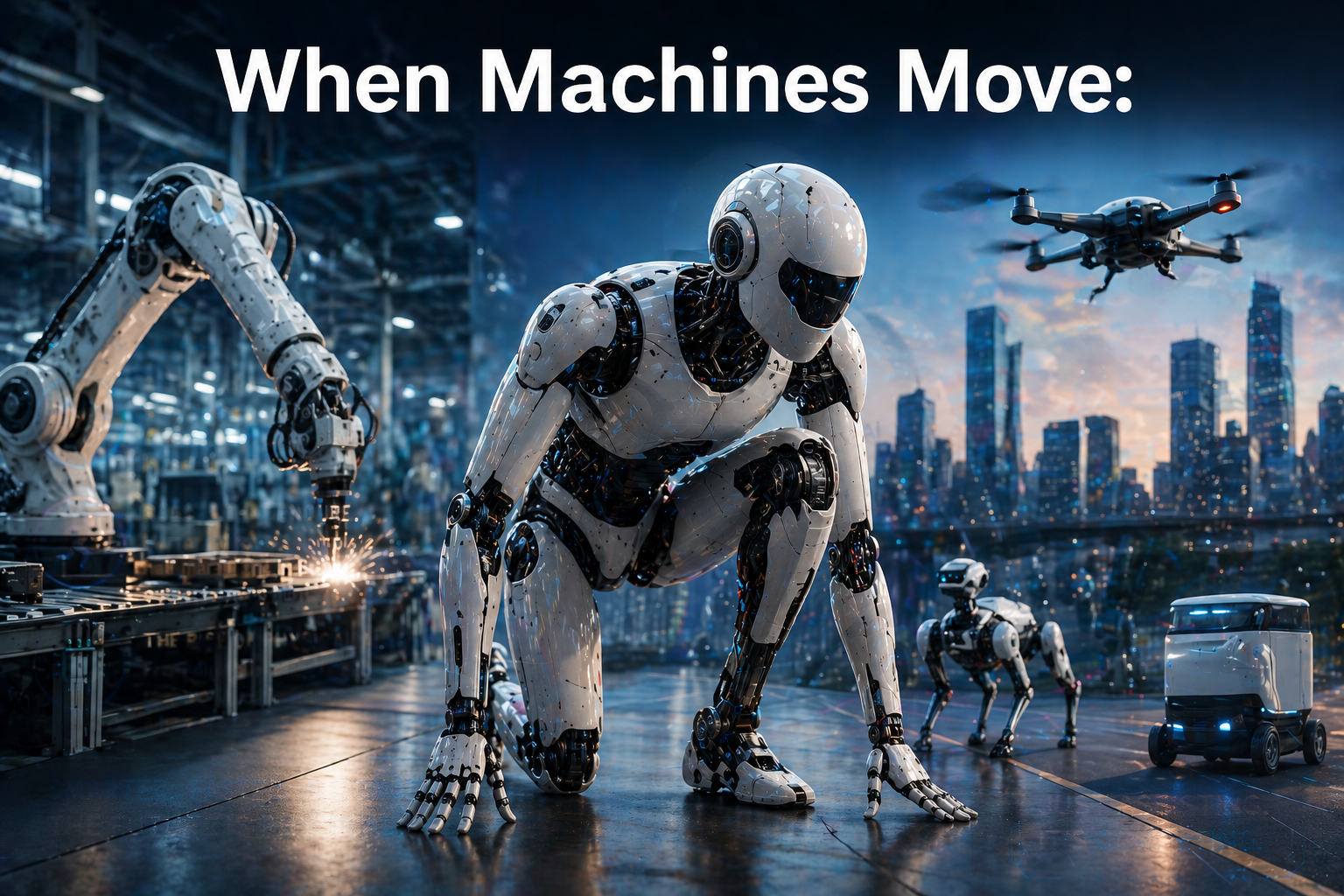
When Machines Move: The Rise of Physical AI Beyond the Screen
 Vansh Banthia,
6 months ago
4 min read
Vansh Banthia,
6 months ago
4 min read
For decades, artificial intelligence has lived comfortably inside software—analyzing data, automating workflows, and quietly improving efficiency across industries. But a new phase of innovation is emerging, one that pushes AI beyond code and into motion. Today, machines are no longer confined to digital environments—they are learning to interact with the physical world in ways that are increasingly intelligent, adaptive, and, in some cases, competitive. This evolution is often referred to as physical AI. Physical AI represents a groundbreaking shift in technology.
Recent developments—from advanced robotics in sports to autonomous systems operating in unpredictable environments—signal a clear shift. AI is evolving from a passive assistant into an active participant. And this transformation is set to redefine how businesses think about technology.
As we embrace this transformation, understanding the implications of physical AI becomes crucial for future innovations.
From Intelligence to Action: AI Steps Into the Real World
Beyond Algorithms and Automation
Traditional AI systems excel at processing information, but physical AI introduces an entirely new layer—execution. It combines perception, decision-making, and movement into a single, unified system, showcasing the power of physical AI.
What Makes Physical AI Different?
- It processes real-time sensory data
- It reacts instantly to dynamic environments
- It continuously learns from interaction
This isn’t just smarter software—it’s intelligence that can act.
The New Benchmark: Precision, Speed, and Adaptability
Real-Time Decision Making at Scale
One of the most significant breakthroughs in physical AI is its ability to operate in high-speed, unpredictable scenarios. Whether it’s tracking fast-moving objects or navigating complex terrains, these systems are designed to perform under pressure.
Why This Matters
Industries have long relied on controlled environments for automation. Physical AI removes that limitation, enabling machines to function effectively in real-world conditions where variables are constantly changing.
The Expanding Role of Robotics
From Repetition to Intelligence
Robotics has traditionally focused on repetitive, pre-programmed tasks. But with AI integration, robots are becoming far more versatile.
Key Advancements
- Enhanced computer vision for spatial awareness
- Improved motor control for precise movements
- Adaptive learning for better performance over time
These capabilities are transforming robots from tools into intelligent systems capable of independent operation.
Industry Implications: A New Operational Paradigm
Manufacturing and Logistics
In industrial settings, physical AI is enabling smarter automation—robots that can adjust to variations in materials, processes, and environments without constant human intervention.
Healthcare and Services
From robotic assistants in hospitals to automated systems in service industries, the ability to operate in dynamic conditions opens up new possibilities for efficiency and scalability.
Infrastructure and Mobility
Autonomous vehicles and drones are perhaps the most visible examples of physical AI in action—navigating complex environments while making real-time decisions.
The Shift Businesses Can’t Ignore
From Digital Transformation to Physical Transformation
For years, organizations have focused on digitizing processes. Now, the next wave is about bringing intelligence into the physical layer of operations.
Strategic Considerations
- How can AI enhance physical workflows?
- Where can automation move beyond software?
- What infrastructure is needed to support this shift?
Businesses that start exploring these questions early will be better positioned to adapt and lead.
Human vs Machine: Collaboration, Not Replacement
While headlines often highlight competition between humans and machines, the reality is more nuanced. Physical AI is not about replacing human capability—it’s about augmenting it.
Humans bring creativity, judgment, and emotional intelligence. Machines bring precision, consistency, and endurance. Together, they create a more powerful, balanced system.
The Road Ahead: Smarter, Faster, More Capable
The rise of physical AI marks the beginning of a new era—one where technology doesn’t just think, but acts. As systems become more capable, the line between digital intelligence and physical execution will continue to blur.
This evolution will not happen overnight, but the direction is clear. AI is moving into the real world, and its impact will extend far beyond isolated use cases.
Final Thoughts
We are witnessing a fundamental shift in how technology is designed and deployed. Physical AI represents a convergence of software, hardware, and real-world interaction—unlocking possibilities that were once considered futuristic.
For businesses, the opportunity lies in understanding this shift early and identifying where it can create value.