ChatGPT vs Claude in 2026: Which AI Assistant Fits Your Workflow Better?
 Vansh Banthia,
6 months ago
5 min read
Vansh Banthia,
6 months ago
5 min read
Artificial intelligence has become part of everyday work faster than most people expected. What started as curiosity-driven experimentation has now turned into something much more practical. Teams use AI to write content, summarize research, brainstorm campaigns, automate repetitive tasks, support coding workflows, and even make faster business decisions.
At the center of this shift are two names that continue dominating conversations across the AI space: ChatGPT and Claude.
Both are incredibly capable. Both are improving rapidly. And both are changing how businesses and individuals interact with technology.
But what makes this comparison interesting is that it no longer feels like a battle where one tool completely replaces the other. In fact, many professionals now use both depending on the type of work they are doing. The discussion has evolved from “Which AI is better?” to “Which AI fits this task better?”
That is a much smarter way to look at it.
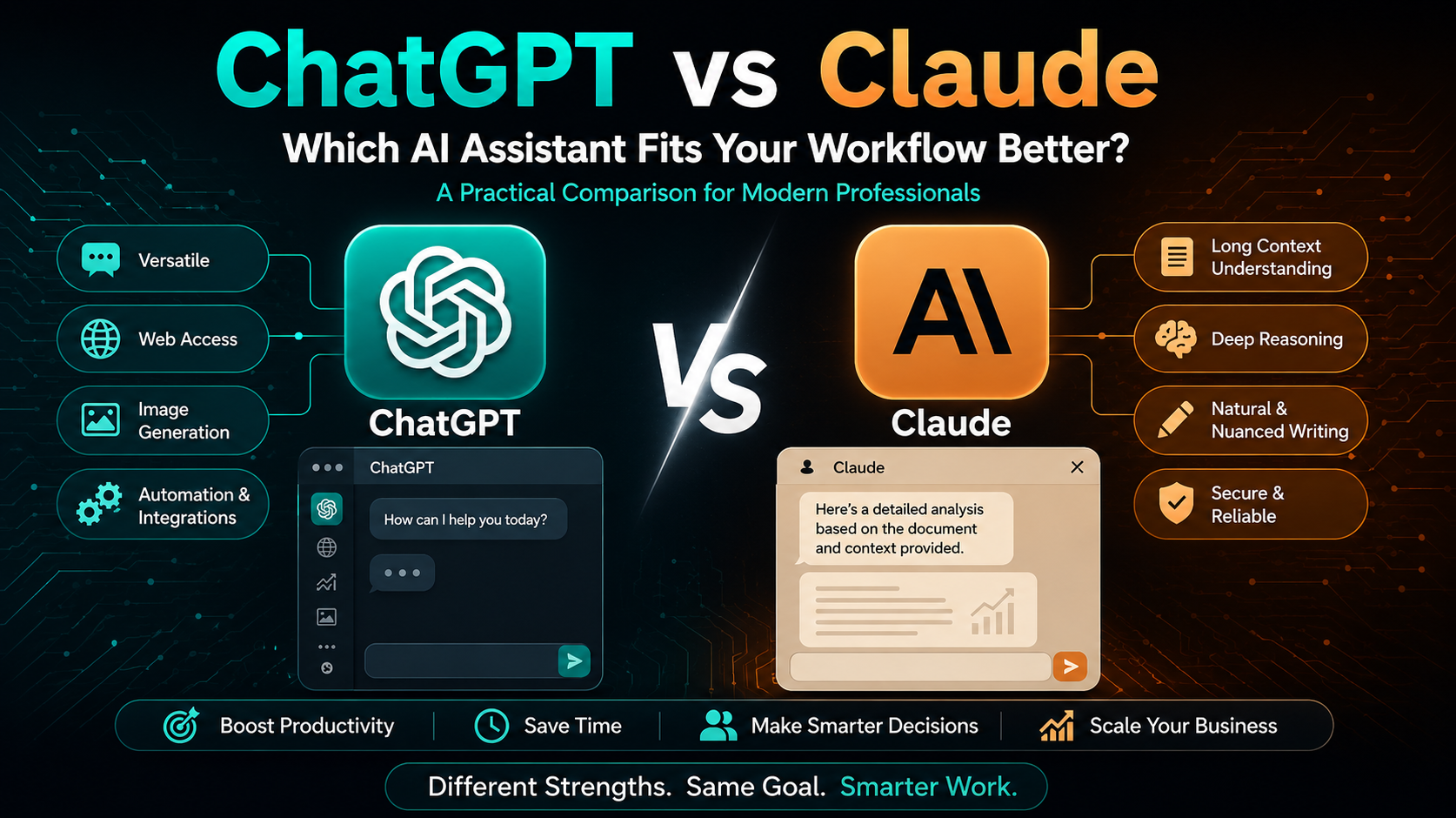
ChatGPT Feels Like an AI Workspace
One of the biggest reasons ChatGPT has become so widely adopted is because it feels flexible. It adapts well to different kinds of work without making the experience feel complicated.
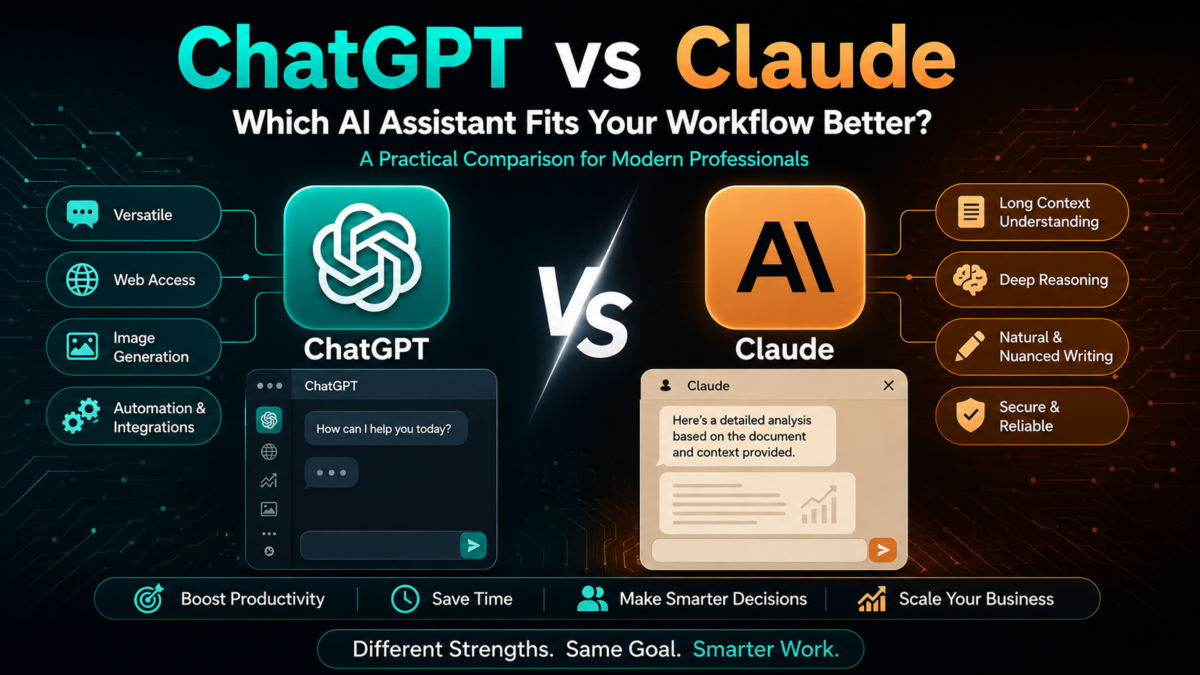
Whether someone wants help writing a blog, generating campaign ideas, analyzing information, creating visuals, organizing thoughts, or automating parts of a workflow, ChatGPT handles those tasks smoothly. It feels less like a single-purpose chatbot and more like an AI workspace that can support multiple types of productivity at once.
That versatility matters in real business environments.
Marketing teams use it to speed up ideation. Agencies use it to structure campaigns faster. Entrepreneurs use it to simplify planning and research. Developers use it to debug and prototype. Even customer-facing teams increasingly rely on AI-assisted workflows to improve response times and operational efficiency.
Another major reason behind ChatGPT’s popularity is how quickly OpenAI has expanded the platform’s ecosystem. Voice interaction, image generation, browsing, file analysis, and integrations have all pushed the product beyond basic conversational AI.
For many users, ChatGPT feels energetic, fast-moving, and highly adaptable. It is especially effective for people who work across multiple disciplines and want one AI system that can support a wide range of tasks.
Claude Has Earned a Reputation for Depth
Claude approaches AI assistance differently.
Where ChatGPT often feels dynamic and broad, Claude tends to feel calmer, more deliberate, and highly structured. That difference has helped it build a strong reputation among users who spend more time working with long documents, technical material, research-heavy tasks, or complex reasoning.
A lot of people who use Claude regularly describe it as thoughtful. Its writing style often feels more natural and less overly polished compared to the sometimes highly optimized tone AI-generated writing can have elsewhere.
That subtle difference matters more than it sounds.
When people are reviewing contracts, analyzing research, working through technical explanations, or handling long-form documentation, clarity and consistency become extremely important. Claude performs especially well in those situations because it maintains context effectively across large amounts of information.
Its large context window has become one of its biggest strengths. Users can feed long reports, detailed codebases, or extensive documentation into Claude while still receiving coherent responses that stay aligned with the original material.
This has made Claude particularly attractive for researchers, developers, analysts, and enterprise teams handling information-heavy workflows.
The Most Interesting Thing? People Are Stopping the Rivalry Narrative
What is happening in 2026 is actually more interesting than a simple competition between platforms.
More professionals are starting to build layered AI workflows instead of depending entirely on one assistant.
Someone might use ChatGPT for brainstorming campaign concepts, generating visuals, or speeding up content workflows, then switch to Claude for reviewing a long strategy document or refining technical explanations.
That combination is becoming surprisingly common.
It also reflects something important about the future of AI adoption. Different AI systems are developing different strengths. Rather than one platform dominating every workflow perfectly, users are learning how to combine tools intelligently depending on the outcome they want.
In many ways, this feels similar to how businesses use software generally. Companies do not expect one tool to handle every single operational task perfectly. Instead, they build ecosystems where different platforms solve different problems well.
AI is beginning to move in the same direction.
Choosing the Right AI Depends on How You Work
The right choice often comes down to working style.
People who prioritize speed, versatility, creativity, and broad workflow support usually lean toward ChatGPT. It works extremely well for dynamic tasks that involve ideation, collaboration, content, and multitasking across different areas.
On the other hand, users who spend more time working through dense information, structured writing, research, or technical analysis often appreciate Claude’s calmer and more context-aware approach.
Neither preference is wrong.
They simply reflect different types of work.
That is why the conversation around AI assistants has become more nuanced over time. Early discussions focused heavily on benchmarks and comparisons. But real-world adoption has shown that usability, workflow fit, and consistency often matter more than isolated performance tests.
AI Is Becoming Part of Everyday Business Infrastructure
The rise of ChatGPT and Claude also signals a much larger shift happening across industries.
AI is no longer being treated as a separate experimental category. It is becoming embedded into daily operations, creative workflows, customer experiences, and strategic planning.
Businesses are redesigning how work gets done around AI-assisted systems. Teams are moving faster, producing more, and making decisions differently because AI is now integrated into the process itself rather than sitting outside it.
That is why staying updated on AI trends, tools, and workflow shifts matters more than ever.
Platforms like iTMunch are helping professionals, marketers, and businesses keep track of this rapidly changing landscape by covering the latest developments in AI, digital transformation, automation, and modern business technology.
Because in 2026, the real advantage is not simply using AI.
It is understanding how to use the right AI tools together in smarter ways.