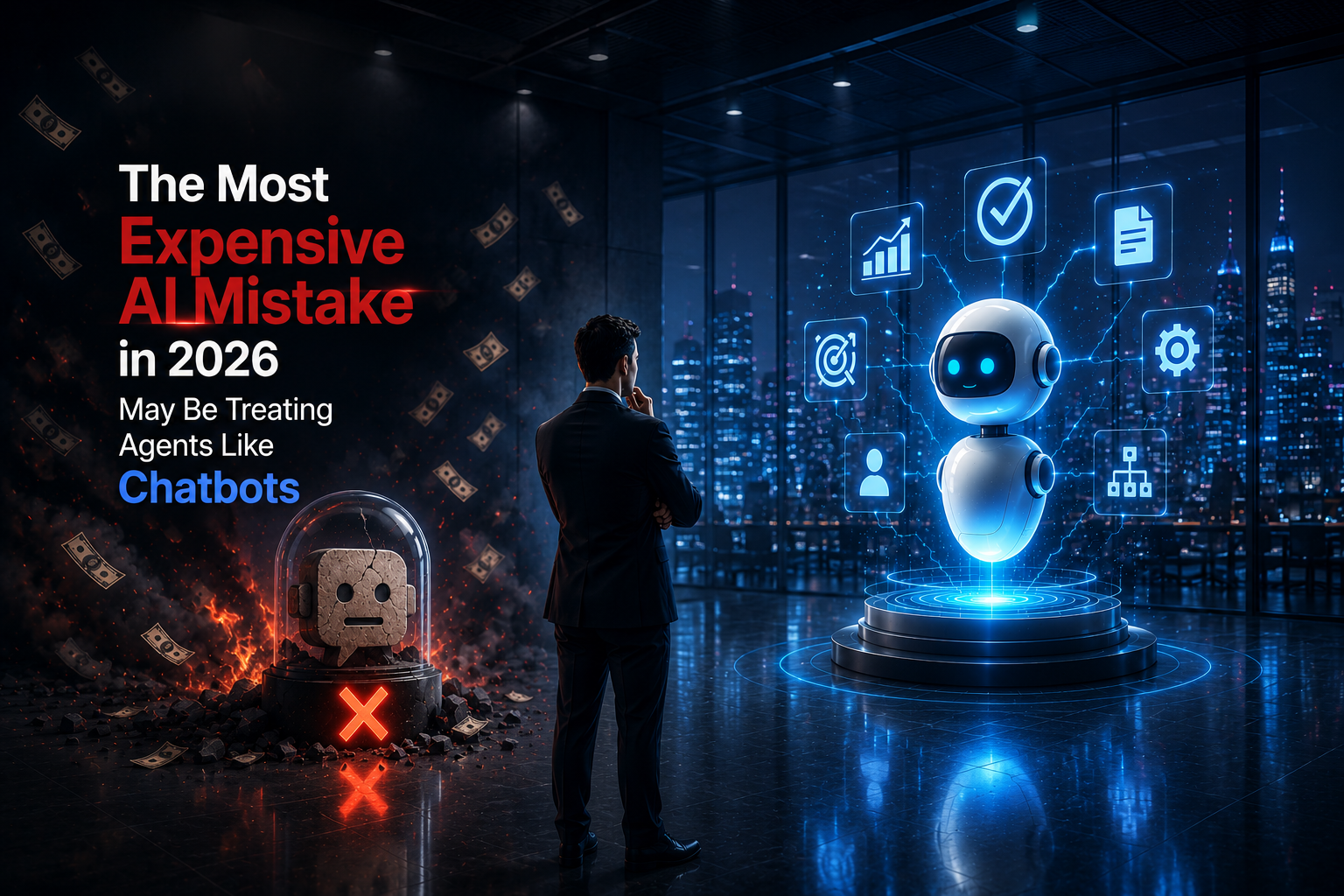
The Most Expensive AI Mistake in 2026 May Be Treating Agents Like Chatbots
 Purva Wankhade,
3 months ago
4 min read
Purva Wankhade,
3 months ago
4 min read
For years, businesses have viewed conversational AI through the lens of chatbots. A customer asks a question, an AI system provides an answer, and the interaction ends. This model helped organizations automate basic support tasks and improve response times.
But 2026 is introducing a very different AI landscape.
The rise of the AI Agent is changing how enterprises think about automation, decision-making, and digital operations. Unlike traditional chatbots that mainly respond to prompts, AI agents are designed to understand goals, plan actions, use tools, analyze information, and complete multi-step workflows with limited human intervention.
The biggest mistake businesses can make today is deploying AI agents with the same expectations and frameworks used for chatbots.
The difference is not just technical. It is strategic.
AI Agents Are Moving From Conversations to Business Execution
The first wave of enterprise AI focused heavily on content generation and conversational experiences. Organizations experimented with AI tools and AI assistants to summarize documents, answer employee questions, and support customer interactions.
However, the next phase is focused on autonomous execution.
An AI Agent is becoming less like a digital receptionist and more like an operational teammate. It can analyze customer behavior, coordinate workflows across multiple systems, identify issues, and recommend or execute actions based on defined objectives.
This shift is already visible across industries. Enterprises are exploring agent-based systems for sales operations, customer experience, software development, cybersecurity monitoring, finance processes, and internal knowledge management.
The growth of agentic AI has also become a major focus among technology companies. Platforms from leading cloud and enterprise technology providers are increasingly introducing AI agent frameworks that allow organizations to build systems capable of reasoning, accessing business data, and interacting with existing software ecosystems.
The opportunity is significant, but so is the complexity.
A chatbot usually operates within a limited conversation window. An AI agent operates within a business environment where decisions can influence revenue, customer relationships, compliance, and operational efficiency.
That requires a completely different approach.
Why Treating AI Agents Like Chatbots Creates Business Risks
Many organizations approach AI adoption by asking, “How can we add an AI chatbot to our workflow?”
In 2026, a more important question is becoming, “What business processes should an AI agent be trusted to manage?”
This distinction matters because AI agents are not simply communication tools. They are systems that can take actions.
For example, an AI customer service chatbot may provide a customer with information about an order. An AI agent could analyze the customer history, identify the issue, check inventory systems, recommend a resolution, and initiate the next steps based on company policies.
The second scenario creates far more value, but it also introduces new considerations around governance, accuracy, permissions, and accountability.
Organizations that fail to recognize this difference may create inefficient AI deployments where advanced technology is limited to basic interactions. They may invest heavily in agent capabilities but use them only as improved chat interfaces.
The real value of AI agents comes from connecting intelligence with action.
This is why enterprise leaders are increasingly focusing on AI governance, data quality, workflow redesign, and human oversight. The success of AI adoption will depend less on simply having advanced models and more on creating the right operating environment around them.
The Future Belongs to Companies That Redesign Work Around AI Agents
The companies gaining the most from AI in 2026 will likely not be those that add the most AI tools. They will be the ones that rethink how work gets done.
AI agents are pushing businesses toward a new model where employees focus more on strategy, creativity, and complex decision-making while intelligent systems handle repetitive operational processes.
However, successful adoption requires more than technology implementation. Businesses need clear objectives, reliable data infrastructure, strong security practices, and a thoughtful approach to where autonomous decision-making makes sense.
The conversation around AI is also shifting from productivity gains to business transformation. Instead of asking how much time an AI tool can save, leaders are beginning to explore how AI agents can create entirely new ways of operating.
This evolution mirrors previous technology shifts. Cloud computing was not valuable simply because companies moved servers online; it became transformative because it changed how businesses built and scaled operations. Similarly, AI agents will create value when organizations redesign processes around their capabilities.
The expensive mistake in 2026 will not be failing to adopt AI.
It will be adopting AI agents while still thinking of them as chatbots.
Businesses that understand this distinction will be better positioned to build intelligent, adaptive, and resilient operations in the years ahead. The future of AI is not just about having conversations with machines. It is about creating systems that can understand goals, take meaningful actions, and become a connected part of how organizations operate.