The 2026 Cyberattack Surge: What Recent Hacks Reveal About the Future of IT Security
 Vansh Banthia,
6 months ago
4 min read
Vansh Banthia,
6 months ago
4 min read
Introduction
Cybersecurity in 2026 is no longer just an IT concern. It is a business-critical priority.
Over the past few months, a wave of high-profile cyberattacks has exposed vulnerabilities across industries. From SaaS platforms to enterprise systems, organizations are facing increasingly sophisticated threats that are faster, smarter, and harder to detect.
These incidents are not isolated. They represent a broader shift in how cyber threats are evolving—and why traditional security models are struggling to keep up.
A Surge in High-Impact Breaches
Recent incidents have highlighted how widespread and disruptive cyberattacks have become.
Several organizations have reported data breaches involving sensitive customer information, internal systems, and even developer environments. In many cases, attackers have not just accessed data but have also leaked it publicly, increasing both financial and reputational damage.
What makes these attacks particularly concerning is their diversity. Some are driven by ransomware, others by data theft, and many by long-term infiltration strategies. The variety of attack methods makes it harder for organizations to predict and defend against threats.
The message is clear—no company is too large, too small, or too secure to be targeted.
The Rise of Supply Chain Vulnerabilities
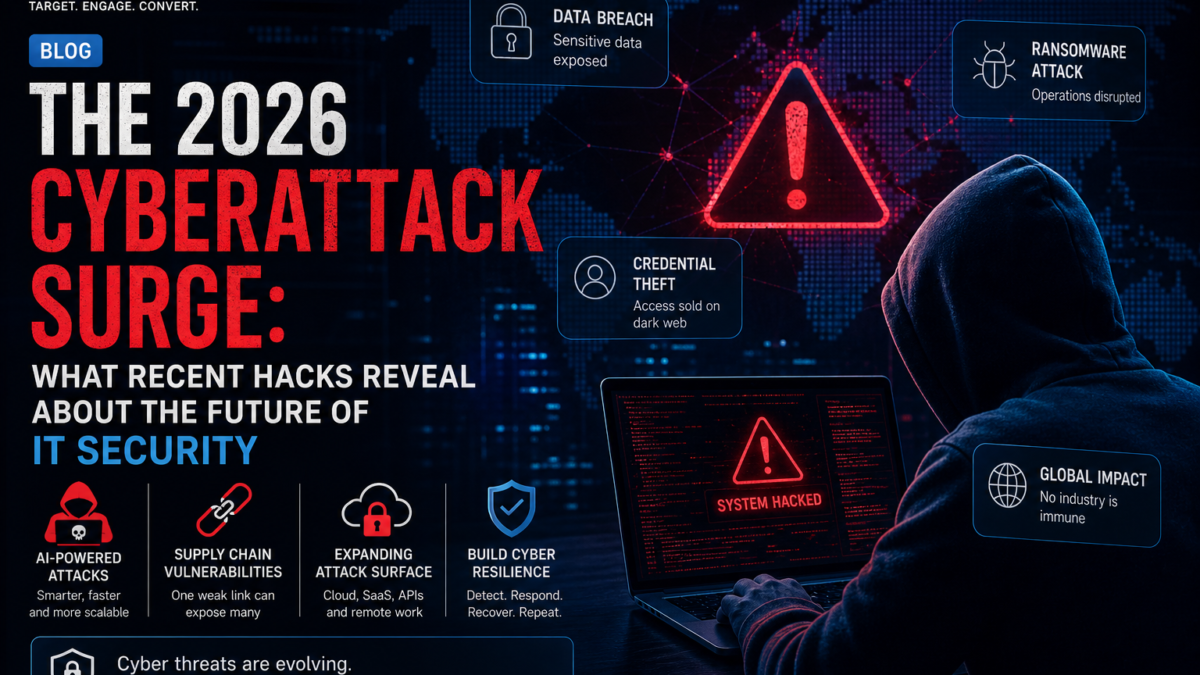
One of the most critical trends emerging in 2026 is the increase in supply chain attacks.
Instead of attacking a company directly, hackers are targeting third-party tools, vendors, and integrations. This allows them to gain access to multiple organizations through a single vulnerability.
Modern IT ecosystems are highly interconnected. Companies rely on dozens, sometimes hundreds, of external tools and services. Each connection introduces a potential point of failure.
When one link in the chain is compromised, the impact can spread quickly across multiple systems.
This makes supply chain security one of the biggest challenges for IT teams today.
AI is Accelerating Cyber Threats
Artificial intelligence is reshaping cybersecurity—and not just for defenders.
Attackers are now using AI to automate and scale their operations. Tasks that once required specialized expertise can now be executed with minimal effort. This lowers the barrier to entry and increases the volume of attacks.
AI-driven phishing campaigns, for example, are becoming more convincing and personalized. Messages are crafted based on user behavior, making them harder to detect.
Another major concern is speed. Vulnerabilities are now exploited within hours of being discovered. This leaves organizations with very little time to respond.
Cybersecurity is no longer a slow-moving battle. It is a real-time race.
An Expanding Attack Surface
The modern IT environment is more complex than ever.
Cloud computing, remote work, SaaS platforms, and APIs have created a highly distributed infrastructure. While this enables flexibility and scalability, it also increases risk.
Each endpoint, integration, and user interaction becomes a potential entry point for attackers.
A single misconfiguration or overlooked vulnerability can expose massive amounts of data. In recent cases, millions of records have been compromised due to simple configuration errors.
This growing complexity makes it harder to maintain visibility and control.
Why Traditional Security Models Are Failing
Many organizations still rely on outdated security approaches.
Perimeter-based defenses assume that threats come from outside the network. However, modern attacks often bypass these defenses entirely, entering through trusted systems or compromised credentials.
Reactive strategies are also proving insufficient. By the time an attack is detected, the damage is often already done.
In 2026, security needs to be proactive, continuous, and adaptive.
Organizations must move beyond prevention and focus on detection, response, and resilience.
What IT Teams Need to Do Differently
To keep up with evolving threats, IT teams need to rethink their approach.
Continuous monitoring is essential. Instead of periodic checks, systems must be observed in real time to detect anomalies and suspicious behavior.
Faster patching cycles are also critical. Vulnerabilities must be addressed quickly to reduce the window of opportunity for attackers.
Third-party risk management should become a priority. Organizations need better visibility into the security practices of their vendors and partners.
Employee awareness remains a key factor. Even the most advanced systems can be compromised through human error, making training and education essential.
The iTMunch Perspective: Intelligence Over Reaction
The evolution of cybersecurity reflects a broader shift toward intelligence-driven systems.
Just as marketing platforms like iTMunch focus on intent, context, and timely engagement, cybersecurity must adopt a similar approach.
It is no longer enough to react to threats. Organizations need to anticipate them.
This means leveraging data, behavioral insights, and automation to identify risks before they escalate. It requires a mindset shift—from defense to prediction.
The same principles that drive effective engagement in marketing are now becoming essential in security.
Conclusion
The surge in cyberattacks in 2026 is a clear signal that the threat landscape is changing.
Attackers are becoming faster, smarter, and more strategic. At the same time, IT environments are becoming more complex and interconnected.
To stay secure, organizations must evolve. They need to adopt proactive strategies, invest in intelligent systems, and build resilience into every layer of their operations.
Because in today’s digital world, cybersecurity is not just about protection. It is about staying ahead.