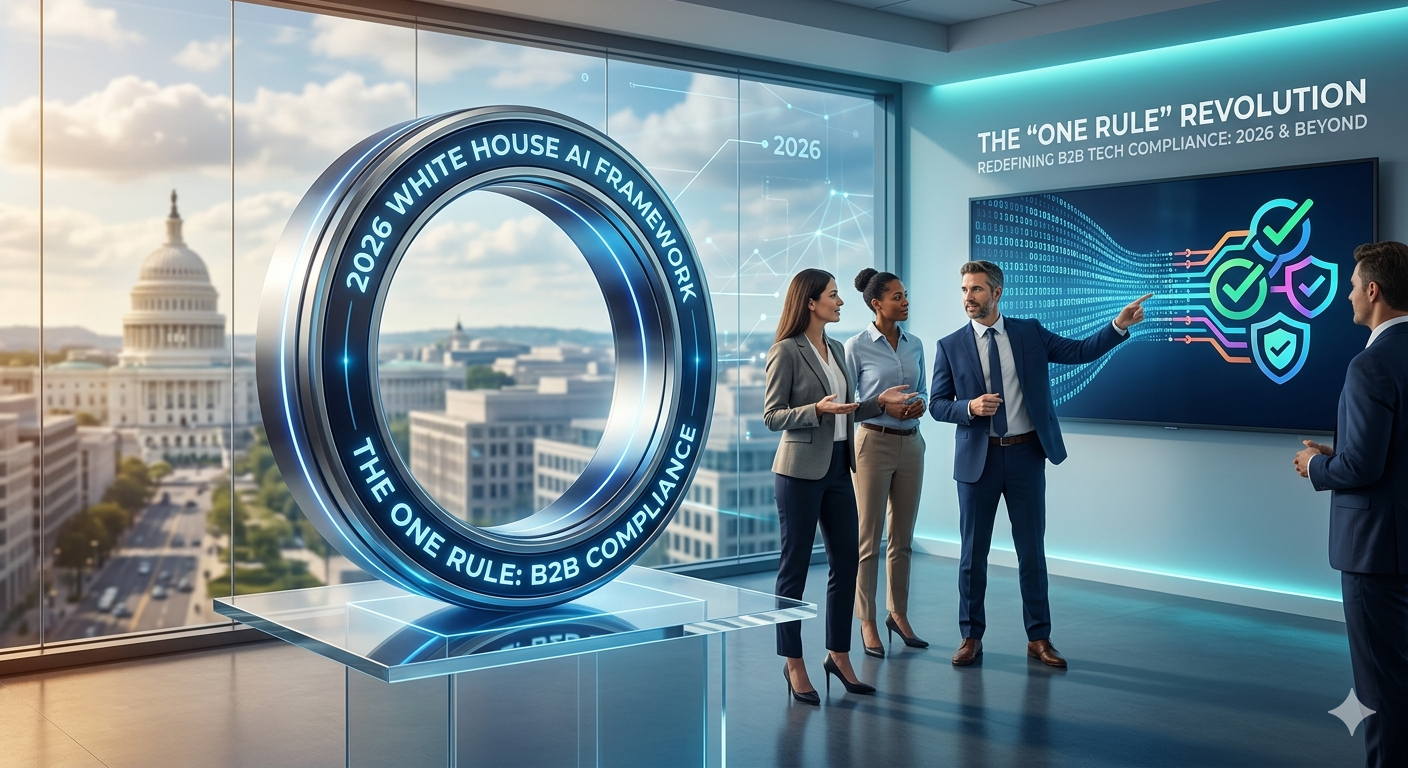
The “One Rule” Revolution: How the 2026 White House AI Framework is Redefining B2B Tech Compliance
 Vansh Banthia,
6 months ago
4 min read
Vansh Banthia,
6 months ago
4 min read
If you’ve been struggling to keep up with the dizzying “patchwork” of state-level AI regulations—from California’s stringent safety audits to New York’s hiring transparency laws—you can finally breathe a sigh of relief. Or at least, a sigh of unified concern. The era of fragmented compliance is effectively ending as the federal government moves to establish “one rule” that promises to streamline the B2B tech landscape once and for all.
Just four days ago, on March 20, 2026, the White House released the National Policy Framework for Artificial Intelligence. This isn’t just another set of “voluntary guidelines.” It is the architectural blueprint for what the administration is calling the “One Rule” era—a massive federal push to preempt conflicting state laws and create a single, predictable standard for AI development and deployment in the United States, marking the beginning of the “One Rule” approach to regulation.
For B2B tech leaders and marketers, this is the most significant regulatory shift since the early days of GDPR. Here’s what you need to know about the new “One Rule” world, which will redefine the AI landscape.
The Death of the Regulatory Patchwork
For the last three years, B2B companies have been forced to play a game of “compliance whack-a-mole.” If you launched a generative AI feature in a B2B SaaS product, you had to ensure it met different transparency requirements for users in Austin versus users in Palo Alto.
The new Framework aims to kill that complexity. By instructing federal agencies (like the FTC, FCC, and SEC) to establish a Unified Federal Standard, the government is signaling that “tech sovereignty” resides at the national level.
Why this matters for your 2026 strategy: * Faster Product Cycles: You no longer need 50 different legal opinions to roll out an AI feature nationwide.
- Preemption Power: The Framework specifically supports federal laws that stop states from “unduly burdening” AI development, especially regarding model training and third-party liability.
Key Pillars of the 2026 Framework
The Framework focuses on seven legislative priorities, but three are particularly critical for the IT and B2B sectors:
| Feature | The Old “Patchwork” Era (Pre-2026) | The “One Rule” Framework (2026+) |
| Compliance Complexity | High (50+ differing state laws). | Low (Single Federal Standard). |
| Developer Liability | Uncertain (Varies by state). | Protected (Limited liability for 3rd-party misuse). |
| Digital Replicas | Wild West (Few protections). | Strict (Federal protection of voice/likeness). |
| Regulatory Oversight | New “AI Commissions” in many states. | Handled by existing agencies (FTC, SEC, etc.). |
Protecting the “Human Identity” in B2B Marketing
One of the most striking parts of the March 20th announcement is the federal regime designed to protect against unauthorized digital replicas. In a world where B2B brands are using “Synthetic Influencers” and AI-cloned voices for webinars, the government has set a hard line.
Under the new Framework, using an individual’s voice or likeness for commercial purposes without explicit, verified consent is now a federal offense. This puts an immediate end to the “cloned CEO” trend we saw peaking in late 2025. For B2B marketers, this means your Digital Provenance (proving your content is human-verified) just became your most important asset.
The “Incentive Over Enforcement” Model
Unlike the EU’s AI Act, which focuses heavily on fines and restrictions, the U.S. Framework utilizes discretionary funding as a carrot. The “One Rule” Executive Order directs the Department of Justice and other agencies to prioritize federal funding for states and companies that adopt the national standard.
In short: If you want those massive federal infrastructure contracts or AI research grants, you must follow the One Rule.
3 Steps for B2B Leaders to Pivot This Week
- Audit Your “Likeness” Library: Ensure every AI-generated voice or avatar in your marketing stack has a clear, federally compliant paper trail of consent.
- Lobby for Preemption: If your company operates in states with “unduly burdensome” AI laws, your legal teams should be preparing to cite the new White House Framework to challenge those barriers.
- Invest in “Intent-Driven” Development: The Framework favors “intent-driven” AI—software that acts on user intent rather than just passive automation. Align your product roadmap with these federally favored “low-risk” categories.
The Bottom Line: Innovation Over Fragmentation
The 2026 National Policy Framework is a clear signal that the U.S. wants to win the AI arms race by removing friction. While privacy advocates are already raising concerns about “preempting” state-level protections, the B2B tech industry is likely to view this as the “Great Unclogging.”
By moving from 50 rules to One Rule, the federal government is attempting to turn the “Regulatory Red Tape” into a “Predictable Guardrail.”
As federal standards tighten, the margin for error in AI-driven outreach is disappearing. Staying ahead of the National Policy Framework requires more than just legal awareness; it requires a technology partner that prioritizes data integrity at the source. At iTMunch, our B2B Lead Generation Services are already evolving to meet these 2026 standards. By utilizing proprietary, compliance-first AI algorithms and high-authority content syndication, we help you capture high-intent leads that respect the new federal “human identity” protections, ensuring your pipeline grows without the risk of regulatory friction.