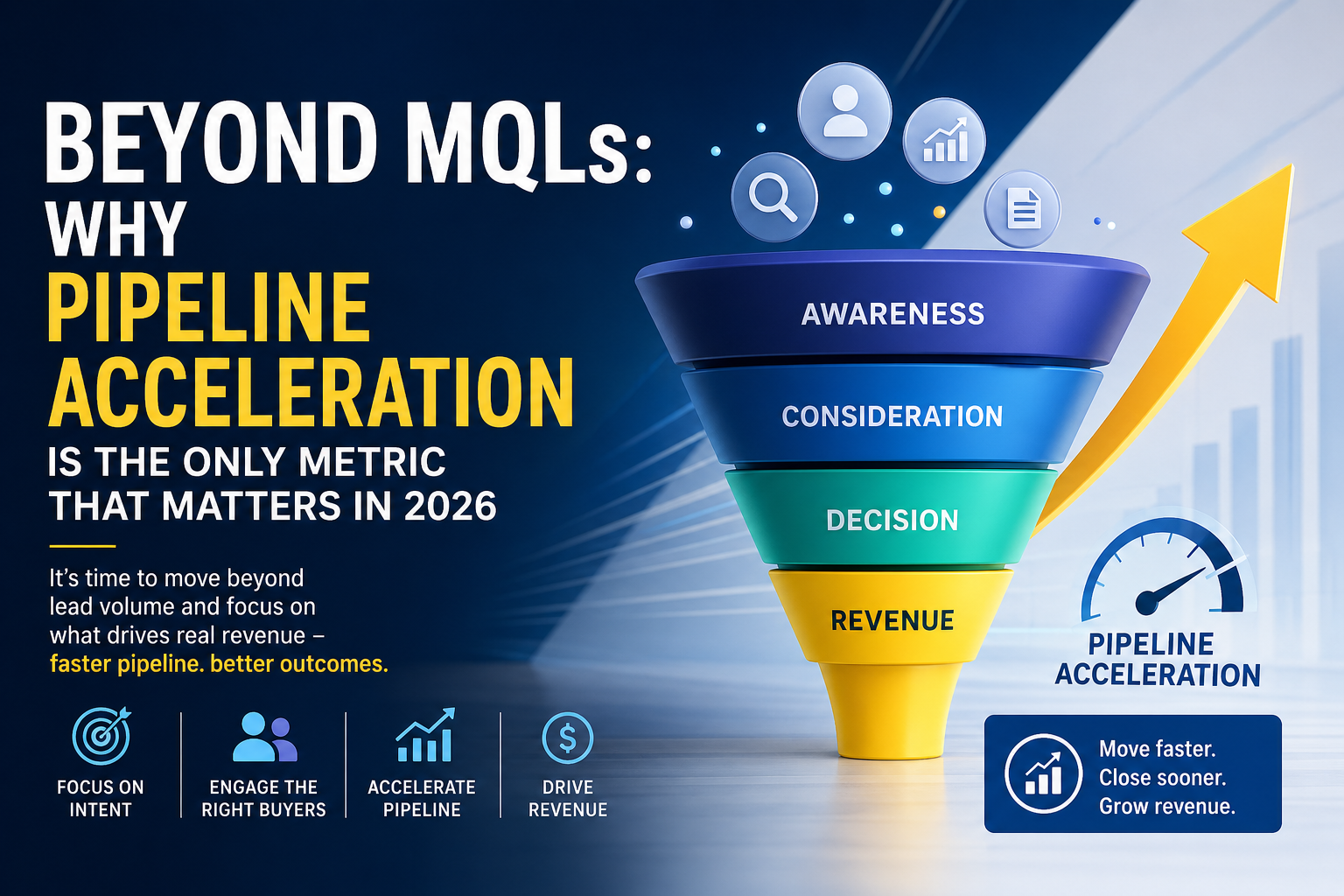
Beyond MQLs: Why Pipeline Acceleration is the Only Metric That Matters in 2026
 Simon Powell,
6 months ago
6 min read
Simon Powell,
6 months ago
6 min read
Introduction
For years, B2B marketing teams operated with a clear, measurable goal—generate more Marketing Qualified Leads (MQL). Dashboards were built around MQL targets, campaigns were optimized to increase MQL volume, and success was often defined by how full the top of the funnel looked.
But in 2026, that model is starting to break down.
Organizations today are not struggling with a lack of leads. In fact, most teams are generating more leads than ever before. The real challenge lies in converting those leads into meaningful business outcomes. Pipelines are crowded, sales cycles are unpredictable, and conversion rates are under pressure. The issue is no longer about creating demand. It is about translating that demand into revenue efficiently.
This shift in reality has given rise to a new focus—pipeline acceleration.
This shift in focus towards MQL has changed the way organizations approach their sales and marketing strategies.
From Lead Generation to Revenue Movement
The traditional funnel was built on a simple assumption: if you feed enough leads into the system, a percentage of them will convert into customers. While this approach worked in more predictable buying environments, it no longer reflects how modern B2B buyers behave.
Today’s buyers are informed, independent, and selective. They conduct their own research, compare solutions before engaging with vendors, and often enter the funnel when they are already close to making a decision. This means that by the time a lead is captured, much of the buying journey has already taken place.
In this context, generating more leads does not necessarily improve outcomes. What matters is identifying where real buying intent exists and ensuring that those opportunities move quickly through the pipeline.
Pipeline acceleration shifts the focus from filling the funnel to moving opportunities forward. It emphasizes speed, precision, and timing over volume.
Understanding MQL allows organizations to tailor their outreach efforts more effectively.
Marketing teams focus on increasing MQL numbers, often at the expense of genuine engagement.
Why MQL-Centric Strategies Are Falling Short
The concept of MQL was originally designed to create alignment between marketing and sales by defining a threshold for lead readiness. Over time, however, it evolved into a performance metric that marketing teams were incentivized to maximize.
Focusing on MQL metrics can sometimes mislead teams into prioritizing quantity over quality.
Emphasizing MQL helps bridge the gap between marketing and sales teams.
This created unintended consequences.
Campaigns began to prioritize scale over relevance. Leads were often qualified based on surface-level engagement rather than genuine intent. As a result, sales teams found themselves spending time on prospects who were not ready to buy, while truly interested buyers were not always identified or prioritized effectively.
Understanding the difference between MQL and SQL (Sales Qualified Leads) is crucial for effective strategy.
The disconnect between marketing and sales widened. Marketing reported success through rising MQL numbers, while sales struggled to convert those leads into pipeline and revenue.
Pipeline acceleration addresses this gap by redefining success. Instead of measuring how many leads enter the funnel, it focuses on how efficiently those leads progress and convert.
Understanding What Drives Acceleration
At its core, pipeline acceleration is about removing friction from the buyer journey.
One of the most important factors in this process is intent. Not all prospects are equal, and treating them as such leads to inefficiency. By identifying signals that indicate active interest—such as content consumption patterns, repeated engagement, or category-level research—marketers can focus their efforts on accounts that are more likely to convert.
Equally important is the nature of engagement. Modern buyers rarely make decisions based on a single interaction. They move across channels, revisit information, and validate their choices over time. Consistent, well-timed engagement ensures that your brand remains part of that decision-making process.
Content also plays a critical role. While awareness-driven assets help introduce a brand, it is the deeper, more practical content that drives movement. Case studies, comparison guides, and solution-focused narratives help buyers overcome hesitation and move closer to a decision.
When these elements come together, the result is a smoother, faster path from interest to conversion.
Successful organizations leverage MQL data to optimize their sales processes.
iTMunch aids in maximizing MQL effectiveness, ensuring that leads generated are of high quality.
Where Many Organizations Still Struggle
Despite the growing awareness around pipeline acceleration, many organizations remain anchored in outdated practices. They continue to chase lead volume, apply uniform follow-up strategies, and rely on delayed or incomplete data.
With MQL data, sales teams can focus their efforts on leads that are more likely to convert.
This often leads to missed opportunities. High-intent prospects are not always engaged at the right time, while lower-quality leads consume valuable sales bandwidth. The overall effect is a slower, less efficient pipeline.
As the metrics around MQL evolve, so too must the strategies employed by organizations.
Another common challenge is the lack of alignment between teams. Without shared goals and clear visibility into what drives conversions, marketing and sales operate in silos, limiting their collective impact.
In 2026, leveraging MQL effectively will be essential for driving revenue growth.
Ultimately, the future of B2B marketing lies in the effective management and analysis of MQL.
Addressing these gaps requires a shift not just in tactics, but in mindset.
How iTMunch Supports Pipeline Acceleration
Platforms like iTMunch are designed to support this evolving approach to B2B marketing. Rather than focusing solely on lead generation, iTMunch emphasizes connecting brands with audiences that demonstrate real intent and engagement potential.
Through targeted content distribution and a strategic approach to audience targeting, iTMunch enables marketers to reach decision-makers at more relevant stages of their journey. This ensures that interactions are not only timely but also meaningful.
By aligning outreach with actual buyer behavior, iTMunch helps reduce inefficiencies in the funnel. Leads generated through such an approach are more likely to convert, and sales teams are better equipped to engage them effectively.
The result is a pipeline that moves with greater speed and clarity, ultimately contributing to stronger revenue outcomes.
Conclusion
The landscape of B2B marketing is evolving, and with it, the metrics that define success.
Pipeline acceleration represents a shift toward a more outcome-driven approach—one that values quality over quantity, timing over scale, and alignment over isolated performance. It acknowledges that in a complex buying environment, speed and relevance are critical differentiators.
As organizations continue to adapt to changing buyer behavior, the ability to move opportunities efficiently through the funnel will become a defining factor of success.
In 2026, the question is no longer how many leads you can generate. It is how effectively you can turn those leads into revenue.