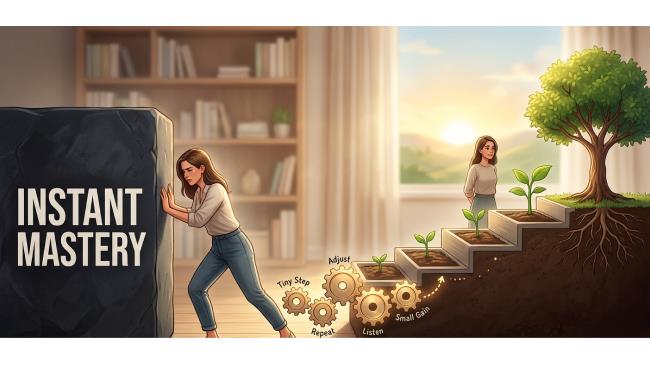
The Problem With Wanting Immediate Mastery
Most people approach personal change like flipping a switch. We decide we want a new habit, a new mindset, or a new life direction, and we expect the results to show up quickly. When they do not, frustration arrives almost immediately. The assumption behind this frustration is simple: if we truly want something badly enough, we should be able to take control right away.
Yet the reality of change is much less dramatic and much more subtle. Real transformation rarely appears in bold moments of control. Instead, it shows up quietly through repeated adjustments that accumulate over time. The shift from instant control to gradual change is not just a motivational idea. It is a structural reality of how people actually evolve.
Learning From Systems That Change Slowly
Consider how complex systems operate. Ecosystems, economies, and even our own brains adapt gradually because they are made of interconnected parts. Attempting to force immediate control often disrupts those systems rather than improving them.
Financial habits offer a good example. Someone facing overwhelming debt might wish for a sudden solution that erases the problem overnight. In reality, progress often comes through structured approaches such as budgeting, repayment strategies, or services like debt consolidation, which work by organizing change step by step rather than delivering instant relief.
The same pattern shows up in personal development. Instead of flipping a mental switch, people rewire patterns through repetition, reflection, and small improvements.
Why Gradual Change Feels So Uncomfortable
Expecting slow progress sounds reasonable on paper, but emotionally it can feel disappointing. Instant control gives us a sense of power. Gradual change requires patience, and patience often feels like passivity.
This discomfort happens because our brains are wired to look for quick feedback. We want confirmation that our efforts are working. When change unfolds slowly, the feedback becomes subtle and harder to notice.
Psychological research on habit formation shows that lasting behavioral shifts emerge through consistent repetition and environmental adjustments rather than sudden bursts of motivation. Studies on the psychology of behavior change from the American Psychological Association highlight how habits become stable when small actions are repeated in predictable contexts over time. You can explore more about this process through the psychology of behavior change.
Understanding this helps us reinterpret slow progress. What feels like stagnation may actually be the early stage of a system reorganizing itself.
Progress Often Happens Before We Notice It
Another overlooked aspect of gradual change is that the most important shifts often happen beneath the surface.
Think about learning a new skill. During the early phase, improvement may feel invisible. But internally, the brain is forming new neural pathways, experimenting with strategies, and adjusting responses. Eventually the visible results appear, sometimes suddenly, but they are the outcome of many quiet attempts.
Health researchers describe a similar pattern in habit development. Sustainable routines grow through small adjustments that accumulate over time. The Harvard Health guide to building healthy habits explains that consistency and environmental cues play a larger role than bursts of motivation.
This perspective changes how we interpret effort. The goal is not immediate control. The goal is creating conditions where improvement becomes almost inevitable.
Shifting From Control to Direction
A useful way to think about personal growth is to replace the idea of control with the idea of direction.
Control suggests we can command outcomes instantly. Direction suggests we can guide processes that unfold gradually.
When people focus on direction, their decisions begin to look different. Instead of asking, “How do I fix this right now?” they start asking, “What small adjustment moves me closer to where I want to go?”
This shift reduces pressure while increasing effectiveness. It turns progress into a sequence of manageable steps rather than a single overwhelming leap.
For example, someone trying to improve their financial situation might begin by tracking expenses for a month, then adjusting spending categories, and later exploring structured repayment strategies. Each step may seem modest, yet together they reshape the entire system.
The Hidden Advantage of Slower Change
Ironically, gradual change often produces stronger results than instant control ever could.
Rapid transformations can collapse just as quickly because they rely heavily on temporary motivation. Gradual shifts, on the other hand, reshape routines, environments, and expectations simultaneously. By the time the results become visible, the underlying structure supporting them is already in place.
This is why sustainable growth often looks uneventful from the outside. It lacks dramatic turning points. Instead, it consists of many quiet decisions that slowly compound.
Over time those small decisions redefine identity. Someone who repeatedly practices healthy habits begins to see themselves as a healthy person. Someone who consistently manages finances begins to see themselves as financially responsible.
The change becomes part of who they are rather than something they are forcing themselves to do.
Learning to Measure the Right Signals
If gradual change is the true path to lasting transformation, then the way we measure progress must also change.
Many people track outcomes such as weight loss, income growth, or debt reduction. While those metrics matter, they often lag behind the behaviors that create them.
A more useful approach is to measure consistency. Did you perform the action today? Did you move slightly closer to your intended direction?
This shift turns progress into something visible even when outcomes take time. Each small action becomes evidence that the system is evolving.
Over weeks and months, these actions accumulate until the results that once seemed distant begin to appear naturally.
Patience as a Practical Skill
Patience is often described as a personality trait, but it is more accurately a practical skill. It involves recognizing that meaningful change follows a timeline that cannot always be rushed.
People who embrace gradual change tend to experience less frustration because their expectations match reality. Instead of waiting for a dramatic breakthrough, they look for small signals of progress.
That mindset creates resilience. When setbacks occur, they are interpreted as part of the process rather than proof of failure.
In many ways, the real transformation is not the external result but the internal shift in how we relate to progress itself.
A Different Way to Think About Control
The paradox of personal growth is that giving up the need for instant control often leads to greater influence over our lives.
When we accept that change unfolds gradually, we start designing systems that support improvement rather than trying to force outcomes. We pay attention to habits, environments, and small decisions that accumulate quietly.
Over time, these adjustments reshape our circumstances in ways that dramatic efforts rarely achieve.
What once felt slow begins to reveal itself as steady. What once felt uncertain begins to look inevitable. And what once seemed like a lack of control turns out to be a deeper form of it, one built through patience, consistency, and the quiet power of gradual change.
To learn more about the practical application of these principles across finance, psychology, and health, please refer to the following resources: