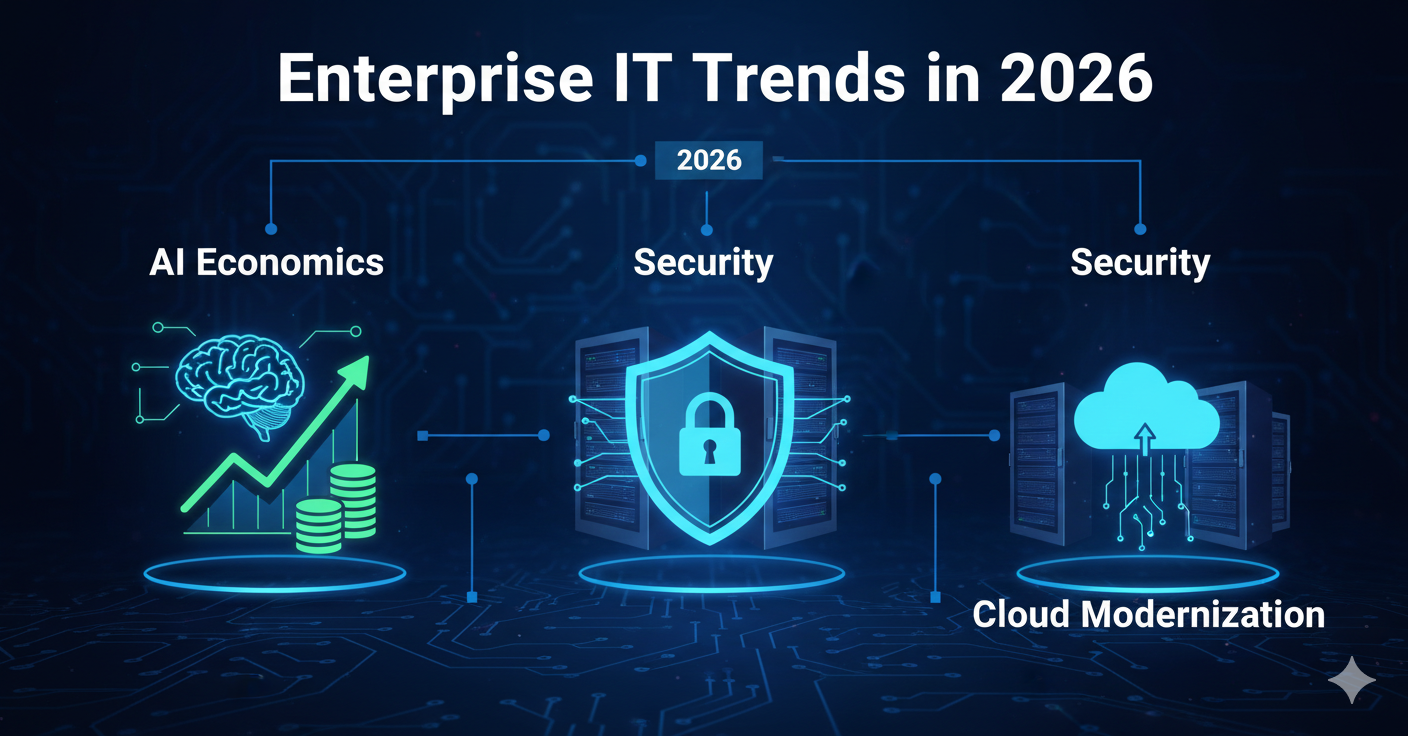
Enterprise IT Trends in 2026: From AI Economics to Security and Cloud Modernization
 Vansh Banthia,
2 months ago
4 min read
Vansh Banthia,
2 months ago
4 min read
How the B2B tech landscape is reshaping priorities, investment, and competitive advantage
The pace of technological change in the B2B IT market is accelerating faster than most firms anticipated. In 2026, leaders are looking beyond proof-of-concept pilots and toward real deployments, cost governance, security, and enterprise readiness. What was next year is now this year.
Here’s a snapshot of the biggest IT trends driving B2B transformation right now—and what they mean for modern enterprises.
1. B2B Spending on AI Is Exploding—but Requires Financial Discipline
A recent survey found that 90% of enterprises plan to increase AI investment in 2026, with dedicated AI budgets becoming the norm rather than the exception. Even organizations that have long piloted generative AI and advanced analytics are now putting money behind operational use cases instead of experiments.
But there’s a catch: as AI becomes more integral to business operations, so do the costs—especially at scale. Rather than paying perpetual software license fees, enterprises increasingly think of AI consumption in terms of tokens and usage governance, driving a nascent discipline sometimes referred to as AI FinOps.
This shift means B2B IT leaders must balance innovation with visibility over costs—a strategic necessity for maintaining competitiveness.
2. AI Security Is an Enterprise Priority—Urgently
AI isn’t just creating productivity opportunities—it’s exposing new threats.
Recent industry testing revealed that 90% of enterprise AI systems could be compromised within 90 minutes under adversarial conditions.
Critical implications for B2B IT teams include:
- AI risk profiling and governance
- Adoption of Zero Trust architectures
- Integration of context-aware security tooling
- Better visibility over embedded models
The lesson is clear: AI adoption without robust security architecture is no longer acceptable.
3. Legacy IT Modernization Is Getting Strategic Investment
Cloud adoption used to be about cost and scalability. In 2026, it’s about agility, compliance, regional sovereignty, and industry-specific solutions.
One major initiative illustrating this evolution is a multi-year partnership between AWS and NTT Data to modernize legacy systems in Europe, focusing on AI-based cloud transformation and local, secure solutions.
For B2B organizations, particularly those operating across borders or under strict regulations, this means:
- Cloud isn’t optional—it’s foundational
- Sovereign cloud options are becoming strategic
- AI and data innovation require secure, compliant environments
4. Enterprise AI Is Becoming Contextual and Operational, Not Experimental
While most earlier AI deployments centered on chatbots and narrow tasks, 2026 is the year of context-aware, operational AI—systems that understand domain-specific business logic and act with purpose.
Instead of generic language models, enterprises are adopting:
- Specialist models for key business processes
- Context protocols for secure and relevant data access
- Open standards (like MCP) that bridge models to operations
This puts AI in the heart of B2B workflows—not as an extra tool but as an integrated decision engine.
5. IT Market Size and B2B Business Shift Are Still Growing Strong
The sheer scale of the IT B2B market continues to expand. Projections suggest the sector will be worth over $6.7 trillion in 2025, with AI and IoT outpacing overall growth.
B2B companies now must think like technology firms, adopting enterprise solutions not just to compete, but to survive and innovate.
6. Digital Infrastructure Evolves: Multi-Cloud, Distributed Fabric, and Edge Reality
Established cloud adoption is being superseded by distributed cloud fabric—a unified operating model across public clouds, private clouds, and edge infrastructure.
This has major implications:
- Dynamic workload orchestration
- Cost-and-risk optimized IT environments
- Unified compliance and observability
- Resilience against vendor lock-in
Edge computing and advanced wireless technologies (like Wi-Fi 7) are also enabling enterprises to push compute closer to data sources and workflows, benefiting manufacturing, logistics, and hybrid workforces.
7. AI Agents and Copilots Are Becoming Enterprise Norms
As general-purpose AI evolves into agentic platforms—systems that execute multi-step tasks autonomously—B2B firms are exploring how this changes operations, customer engagement, and internal productivity.
Examples include:
- AI copilots embedded across enterprise apps
- Agentic assistants for automated workflows
- Domain-specific cloud platforms tailored to industries
- Zero-trust edge security enhancements
By combining agentic AI with secure infrastructures, enterprises can automate not just tasks, but decision pathways.
What B2B IT Leaders Should Do Now?
In 2026’s rapidly evolving landscape, IT leaders can thrive by focusing on:
- Cost-aware AI Governance
Treat AI as an economic system, not a set of experiments. - Security-First AI Architectures
Embed Zero Trust and context-aware protections from the start. - Cloud Modernization and Sovereignty
Strategic partnerships and secure frameworks accelerate transformations. - Operational AI Integration
Shift AI from augmentation to direct workflow orchestration. - Distributed Infrastructure Strategies
Leverage multi-cloud fabrics and edge computing for resilience and performance.
Final Thoughts
Enterprise IT in 2026 is defined by pragmatism, governance, and scalability. The age of pilots is over; responsible operationalization is the new standard.
For B2B companies, success won’t come from chasing the latest buzzword—it will come from embracing strategic implementation of AI, cloud, security, and infrastructure that aligns with business outcomes.
Stay informed, stay agile, and prepare your IT stack not just for performance—but for the unpredictable trajectory of innovation that lies ahead.
🔗 Related to trends shaping the broader B2B market:
- Gartner and other analysts emphasize operational AI adoption and enterprise grade technologies.