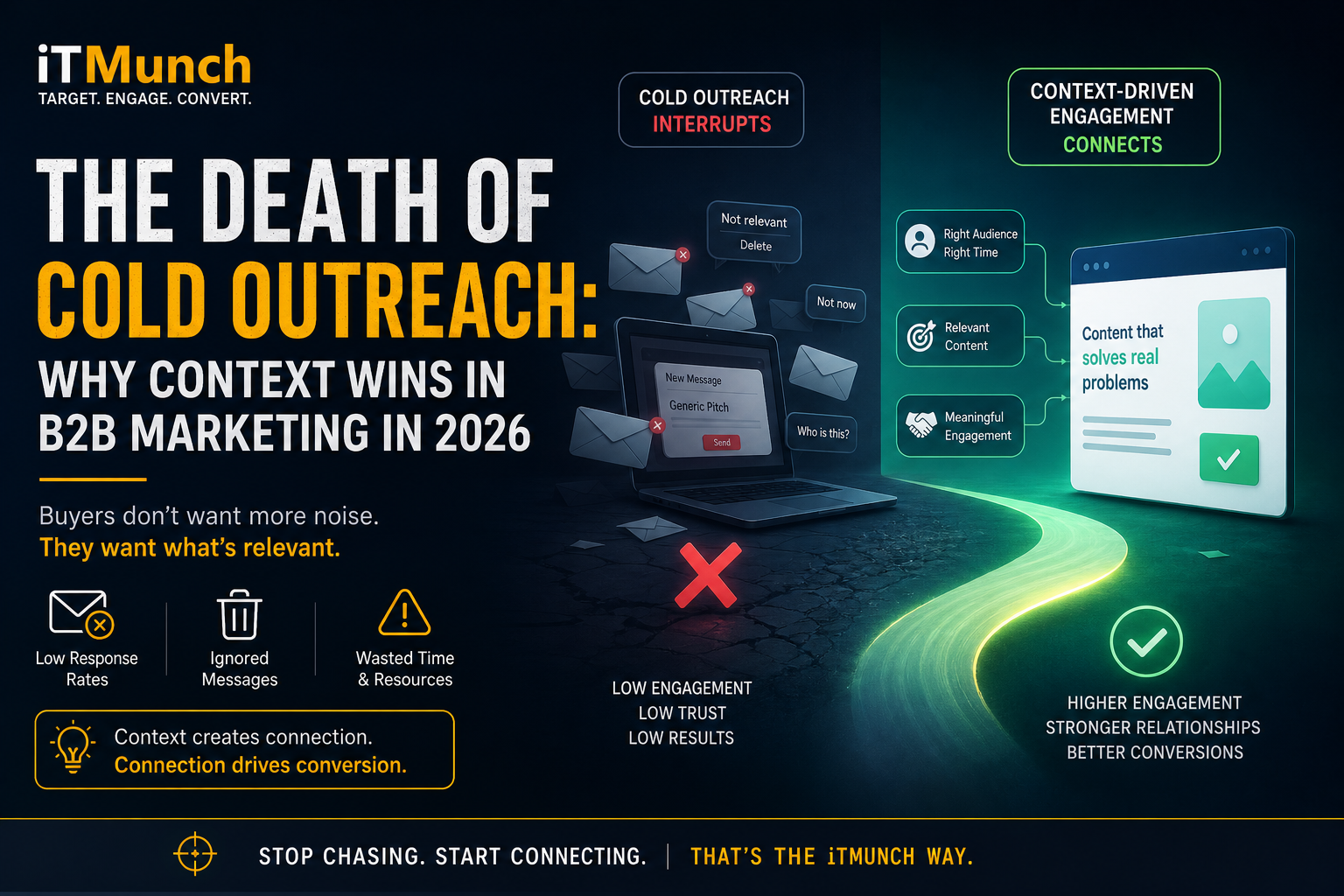
The Death of Cold Outreach: Why Context Wins in B2B Marketing in 2026
 Vansh Banthia,
6 months ago
4 min read
Vansh Banthia,
6 months ago
4 min read
Introduction
Cold outreach once defined B2B growth.
Sales teams built pipelines through cold emails, cold calls, and outbound campaigns. It was a numbers game—reach more people, send more messages, and eventually, conversions would follow.
But in 2026, that model is breaking down.
Buyers are more informed, more selective, and more resistant to unsolicited communication. Inboxes are crowded, attention spans are limited, and generic messaging is easier than ever to ignore.
The result is a clear shift: cold outreach is losing effectiveness, and context-driven engagement is taking its place.
Why Cold Outreach is Failing
The decline of cold outreach is not sudden. It is the result of gradual changes in buyer behavior.
Today’s B2B buyers have access to more information than ever before. They conduct research independently, compare solutions, and form opinions long before engaging with vendors. By the time they receive a cold email, they are often already aware of their options.
At the same time, the volume of outreach has increased dramatically. Automation tools have made it easy to scale campaigns, but this has also led to saturation. Buyers receive dozens of similar messages every day, making it harder for any single message to stand out.
Trust is another factor. Unsolicited outreach often lacks context, making it feel irrelevant or intrusive. Without a clear connection to the buyer’s needs, these messages are quickly dismissed.
The Rise of Context-Driven Marketing
As cold outreach declines, a new approach is emerging—context-driven marketing.
Context goes beyond personalization. It is not just about using a name or referencing a company. It is about understanding the buyer’s situation, intent, and stage in the journey.
Context-driven marketing answers key questions:
- Why is this message relevant right now?
- What problem is the buyer trying to solve?
- How can this interaction add immediate value?
When these elements align, engagement becomes more natural and effective.
From Interruption to Relevance
Traditional outreach interrupts the buyer.
Context-driven engagement, on the other hand, integrates into the buyer’s journey. Instead of pushing messages, it provides value where and when it is needed.
This shift changes the role of marketing.
Rather than trying to capture attention through volume, marketers focus on earning attention through relevance. This requires a deeper understanding of audience behavior and more strategic use of data.
It also requires patience. Context-driven strategies may not deliver instant results, but they build stronger, more sustainable relationships.
Content as the Bridge
Content plays a central role in contextual marketing.
High-quality content allows brands to engage buyers without direct outreach. It provides information, answers questions, and supports decision-making at different stages of the journey.
However, content alone is not enough. Distribution is equally important.
Content must reach the right audience in the right context. This means going beyond owned channels and leveraging platforms where buyers are already active.
When content is aligned with both audience intent and distribution strategy, it becomes a powerful tool for engagement.
Where Most Teams Go Wrong
Despite the shift toward context, many organizations continue to rely on outdated outreach methods.
They personalize messages superficially without understanding deeper intent. They prioritize volume over relevance. They measure success based on activity rather than outcomes.
This creates a disconnect between effort and impact.
To succeed in 2026, teams need to rethink not just their tactics, but their mindset. Engagement should be driven by insight, not assumption.
How iTMunch Enables Context-Driven Engagement
This is where iTMunch becomes highly relevant.
iTMunch focuses on delivering content to audiences based on context, intent, and relevance. Instead of relying on cold outreach, it enables brands to engage buyers through meaningful interactions.
By placing content within targeted ecosystems and aligning it with audience behavior, iTMunch helps ensure that messages are not just seen, but also valued.
This approach reduces friction in the buyer journey and increases the likelihood of conversion.
Rather than interrupting buyers, iTMunch allows brands to become part of their decision-making process.
The Future of B2B Engagement
The decline of cold outreach does not mean the end of outbound strategies. It means the evolution of how they are executed.
Future engagement will be defined by:
- Better use of data and intent signals
- More relevant and timely messaging
- Stronger alignment between marketing and sales
- A focus on long-term relationships rather than short-term gains
In this environment, context is not an advantage. It is a requirement.
Conclusion
Cold outreach is not completely dead, but it is no longer enough.
In 2026, B2B marketing success depends on understanding the buyer, delivering value, and engaging with purpose. Context-driven strategies offer a more effective and sustainable way to achieve these goals.
As the landscape continues to evolve, the brands that win will not be the loudest. They will be the most relevant.
And in a world where attention is scarce, relevance is everything.