The Rise of the Digital Buying Committee: Why B2B Decisions Are Harder to Win in 2026
 Vansh Banthia,
6 months ago
5 min read
Vansh Banthia,
6 months ago
5 min read
Introduction: The Deal That Stalled for No Clear Reason
In today’s complex landscape, understanding the dynamics of the buying committee is crucial.
The product was a strong fit.
The demo went well. The initial conversations were promising. Everyone involved seemed aligned.
And then, suddenly, progress slowed down.
Engaging with each member of the buying committee can make or break a deal.
This highlights the importance of effectively navigating the buying committee.
Follow-ups became less frequent. Decisions were delayed. New questions started coming in—often from people who weren’t part of the earlier discussions.
Eventually, the deal didn’t move forward. Not because it was rejected, but because it never reached a clear conclusion.
This is becoming increasingly common in B2B sales. And the reason is simple: you’re no longer selling to one decision-maker. You’re selling to a buying committee.
From Single Decision-Makers to Group Decisions
In the past, B2B deals often revolved around one or two key stakeholders. If you convinced them, the deal moved forward.
Today, the process is far more complex.
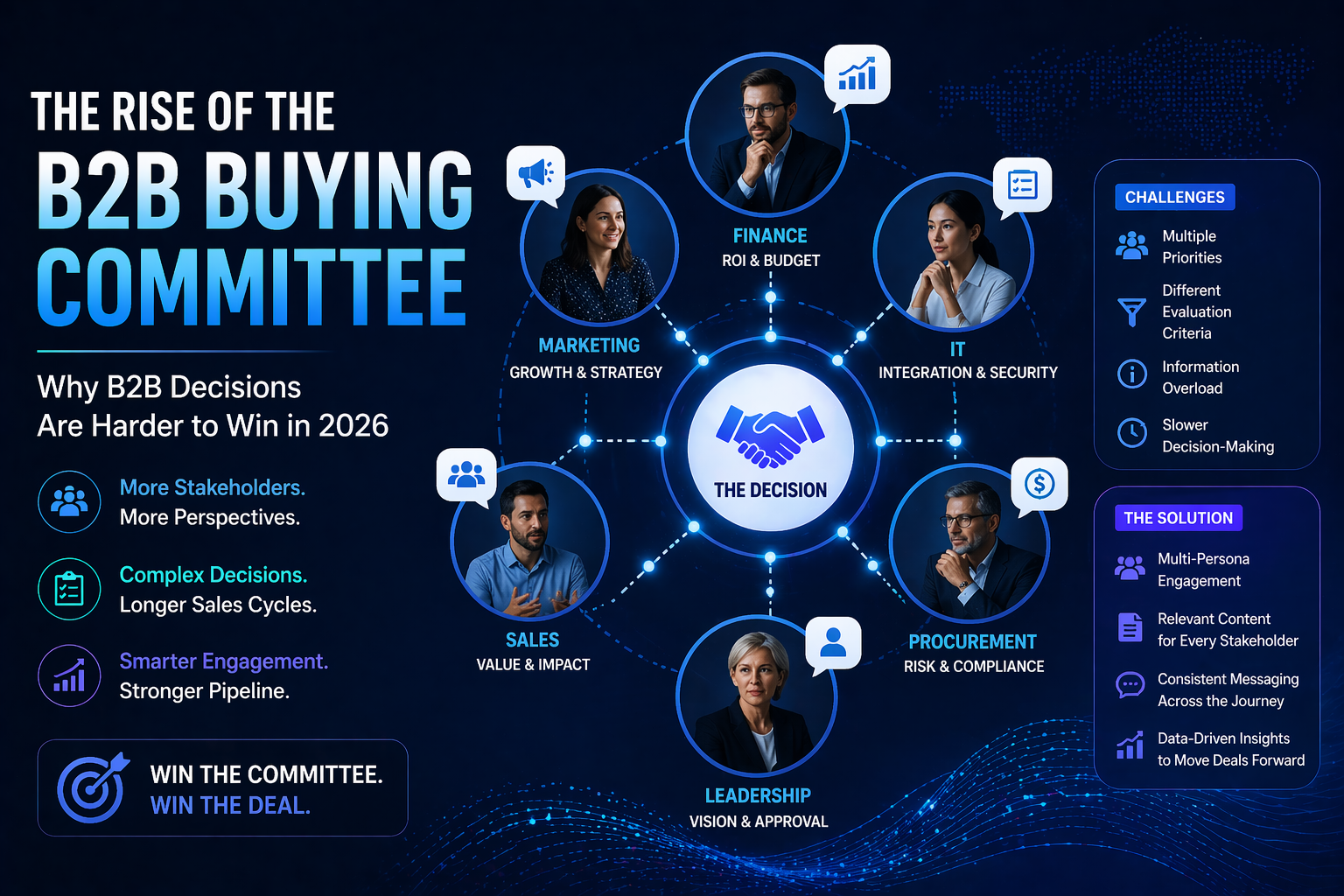
A typical B2B purchase now involves multiple stakeholders across different functions—marketing, sales, finance, IT, procurement, and leadership. Each of them brings their own priorities, concerns, and expectations.
This shift has transformed decision-making from a straightforward process into a collaborative—and often complicated—one.
Why Buying Committees Are Growing
There are several reasons behind this change.
First, the cost and impact of B2B solutions have increased. Decisions carry more risk, so organizations involve more people to ensure they’re making the right choice.
Second, technology has become deeply integrated into business operations. This means decisions are no longer isolated to one department—they affect multiple teams.
Third, access to information has empowered stakeholders at all levels. More people feel equipped to evaluate options and contribute to the decision.
The result is a more inclusive but slower and more fragmented buying process.
The Challenge: Multiple Perspectives, One Decision
Each member of a buying committee evaluates your solution through a different lens.
A marketing leader might focus on growth and performance.
An IT stakeholder may prioritize integration and security.
A finance executive will look at cost and ROI.
Even if your solution is strong overall, failing to address one perspective can create hesitation.
This is why deals often stall. It’s not that your solution isn’t good enough—it’s that it hasn’t been validated across all stakeholders.
Why Traditional Sales and Marketing Struggle Here
Most B2B strategies are still built around engaging a primary contact or persona.
Marketing campaigns target a specific role. Sales conversations focus on a single champion. Content is often designed with one audience in mind.
But in a committee-driven environment, this approach falls short.
You’re not just convincing one person—you’re influencing a group. And each member may enter the conversation at different stages with different levels of context.
Without a broader strategy, it becomes difficult to maintain alignment and momentum.
The Shift Toward Multi-Persona Engagement
To address this challenge, B2B teams are starting to rethink how they engage buyers.
Instead of focusing on individual leads, they’re focusing on accounts and the various stakeholders within them.
This means creating content and messaging that speaks to different roles. It means ensuring that when a new stakeholder enters the conversation, they can quickly understand the value proposition.
It also means maintaining consistency across touchpoints so that every interaction reinforces the same narrative.
This approach requires more coordination, but it reflects how decisions are actually made.
The Role of Content in Influencing Committees
Content becomes even more critical in a buying committee environment.
Different stakeholders will engage with different types of content. Some may prefer detailed reports, while others rely on case studies or executive summaries.
The key is not just to create content, but to ensure it is accessible and relevant at each stage of the decision-making process.
When done effectively, content acts as a bridge between stakeholders, helping align perspectives and move the decision forward.
Where Platforms Like iTMunch Add Value
As buying committees become more complex, reaching the right stakeholders at the right time becomes increasingly important.
Platforms like iTMunch support this by enabling targeted content distribution across specific roles and accounts. Instead of relying on a single point of entry, they help brands engage multiple decision-makers within the same organization.
This aligns with how modern B2B buying works—multi-touch, multi-persona, and driven by context rather than linear progression.
The Impact on Sales Cycles
One of the most noticeable effects of buying committee is the lengthening of sales cycles.
With more stakeholders involved, decisions take longer. More discussions, more evaluations, and more internal alignment are required before a deal is finalized.
However, this doesn’t mean deals are harder to close—it means they require a different approach.
Teams that understand the dynamics of buying committees can navigate them more effectively, reducing friction and maintaining momentum.
Conclusion: Winning the Group, Not the Individual
The rise of digital buying committee is reshaping B2B sales and marketing.
Success is no longer about convincing a single decision-maker. It’s about aligning a group of stakeholders with different priorities and perspectives.
This requires a shift in strategy—from individual targeting to account-level engagement, from single-message campaigns to multi-layered communication.
The companies that adapt to this change are better positioned to move deals forward, even in complex environments.
Because in 2026, winning a deal doesn’t mean winning one conversation.
It means winning the room.