The $18 Billion Signal: What Microsoft’s Australia Bet Really Means for the Future of AI and B2B
 Vansh Banthia,
7 months ago
5 min read
Vansh Banthia,
7 months ago
5 min read
Introduction: This Isn’t Just Another Tech Investment
When Microsoft announced it would invest nearly $18 billion in Australia, it wasn’t just a regional expansion. It was a statement.
A statement about where technology is heading.
A statement about how serious the AI race has become.
And more importantly, a statement about what the future of business infrastructure will look like.
On the surface, the move is about expanding cloud capacity and AI capabilities. But underneath, it signals something much bigger—a global shift where AI is no longer an add-on. It’s becoming the foundation.
Breaking Down the Investment
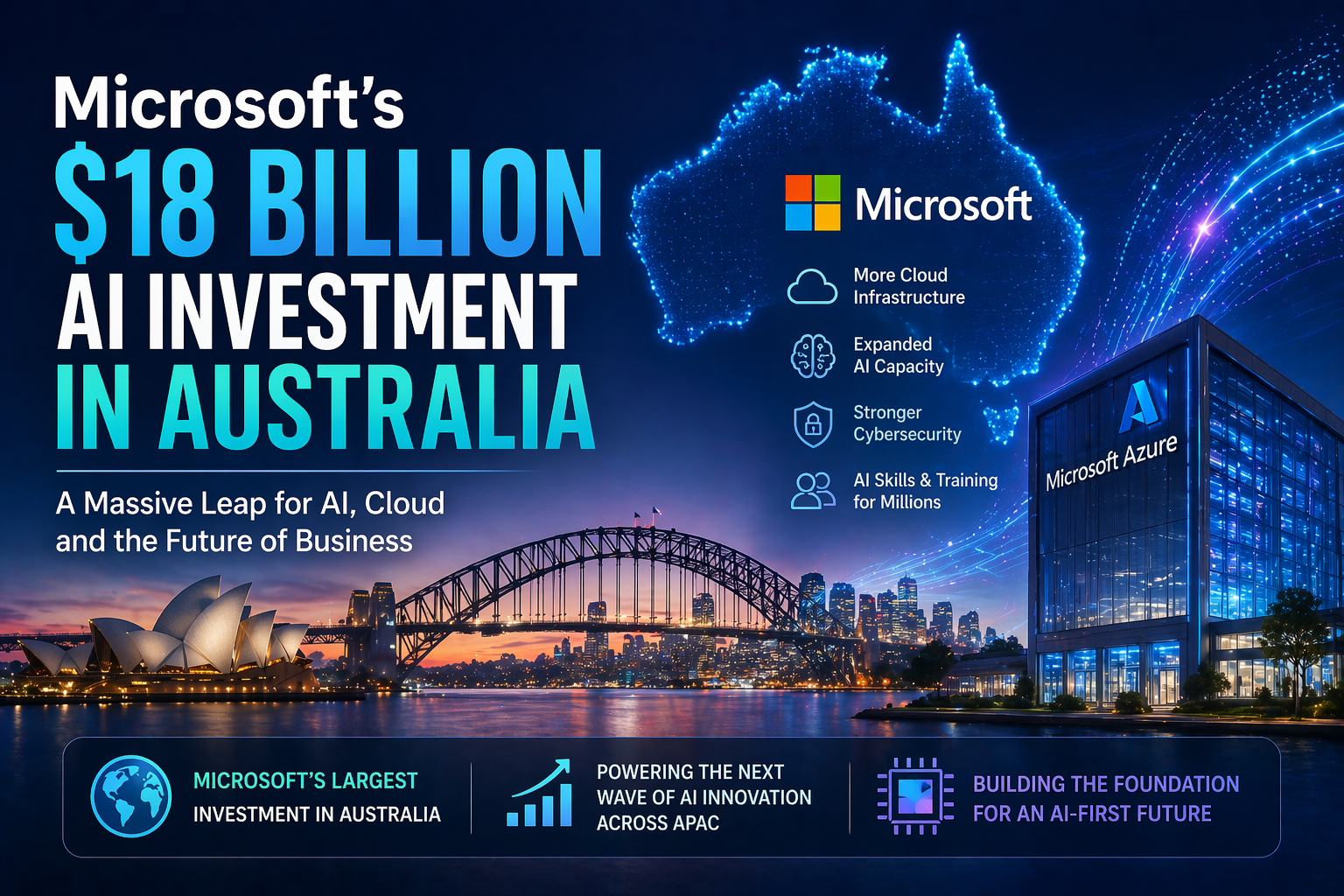
Microsoft plans to invest around a $25 billion (approximately $18 billion) in Australia by 2029 to expand its AI and cloud infrastructure.
This includes:
- Expanding Azure AI supercomputing capacity
- Building more data centers
- Strengthening cybersecurity systems
- Training millions in AI-related skills
The scale alone makes it significant. It’s the company’s largest investment in Australia to date, and part of a much broader global push toward AI dominance.
But the real story isn’t the number—it’s the intent behind it.
Why Australia—and Why Now?
At first glance, Australia might seem like an unusual focal point. It’s not the largest tech market globally.
But that’s exactly why it matters.
Australia represents a growing, stable, and digitally advanced economy—one that can act as a strategic hub for AI expansion in the Asia-Pacific region.
More importantly, it reflects a broader strategy:
Big Tech is no longer focusing only on traditional strongholds like the U.S. or Europe. It’s expanding aggressively into new markets to capture future demand.
And that demand is clear. AI adoption is accelerating globally, and companies are racing to build the infrastructure required to support it.
AI is Becoming Infrastructure, Not Innovation
For years, AI was treated as a layer on top of existing systems. Something you “added” to improve efficiency.
That phase is over.
This investment shows that AI is now being treated like electricity or the internet—core infrastructure that everything else depends on.
When companies invest billions into data centers, supercomputing, and cloud ecosystems, they’re not experimenting. They’re rebuilding the foundation of how businesses operate.
For B2B companies, this changes the conversation entirely.
You’re no longer deciding if you should adopt AI.
You’re deciding how fast you can adapt to an AI-first world.
The Competitive Pressure is Rising
This move is not happening in isolation.
Across the industry, major players are pouring massive capital into AI infrastructure, with total investments expected to reach hundreds of billions globally.
This creates a new kind of competition.
It’s no longer just about better products or better marketing. It’s about who controls the infrastructure that powers those products.
Cloud platforms, AI models, and data ecosystems are becoming the battleground.
And companies that build early advantages in these areas will shape the market for years to come.
What This Means for B2B Companies
For B2B businesses, this shift has direct and immediate implications.
First, expectations are changing.
As AI becomes embedded into platforms, buyers will start expecting smarter, faster, and more personalized experiences by default. What was once a differentiator will quickly become the baseline.
Second, the speed of execution will increase.
With more powerful infrastructure, companies can analyze data faster, automate processes more efficiently, and respond to market signals in real time. This raises the bar for everyone.
Third, the gap between leaders and laggards will widen.
Companies that adopt AI effectively will move faster and operate more efficiently. Those that delay will struggle to keep up—not just in innovation, but in basic competitiveness.
The Talent and Skills Equation
One of the most interesting parts of this investment is the focus on training.
Microsoft plans to train millions of people in AI skills as part of this initiative.
This highlights a critical reality:
Technology alone isn’t enough.
For AI to deliver real value, businesses need people who understand how to use it effectively. Without that, even the most advanced infrastructure remains underutilized.
This is where many organizations will face challenges. The demand for AI-skilled talent is rising rapidly, and supply is still catching up.
The Bigger Picture: A Global AI Race
If you zoom out, this investment is part of a much larger story.
Countries are competing to become AI hubs.
Companies are competing to dominate infrastructure.
And industries are being reshaped in real time.
This is not a slow transition. It’s a rapid shift that is already underway.
The companies that recognize this early—and align their strategies accordingly—will be in a much stronger position moving forward.
Conclusion: A Signal You Can’t Ignore
It’s easy to look at a headline like “$18 billion investment” and see it as just another tech story.
But it’s not.
It’s a signal.
A signal that AI is moving from experimentation to execution.
A signal that infrastructure is becoming the real competitive advantage.
And a signal that the pace of change is accelerating.
For B2B companies, the takeaway is clear.
The question is no longer whether AI will shape your business.
It’s whether you’ll adapt fast enough to keep up with the ones who already are. This is where the gap is widening. While some companies are still operating on volume-driven strategies, others are already adopting intent-led platforms like iTMunch to align with how modern buyers actually behave. And in a market moving this fast, that difference compounds quickly.