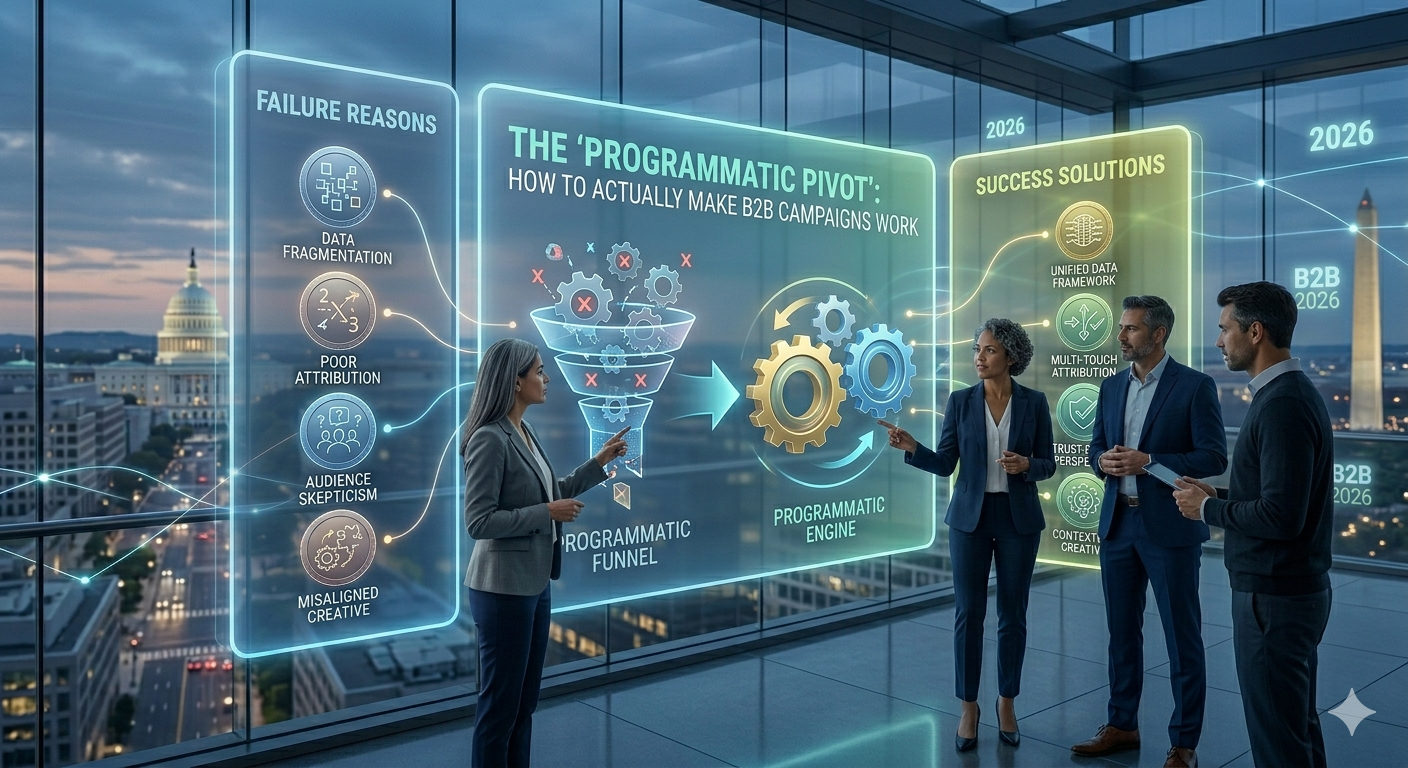
Why Most B2B Programmatic Campaigns Fail (And How to Actually Make Them Work)
 Vansh Banthia,
6 months ago
4 min read
Vansh Banthia,
6 months ago
4 min read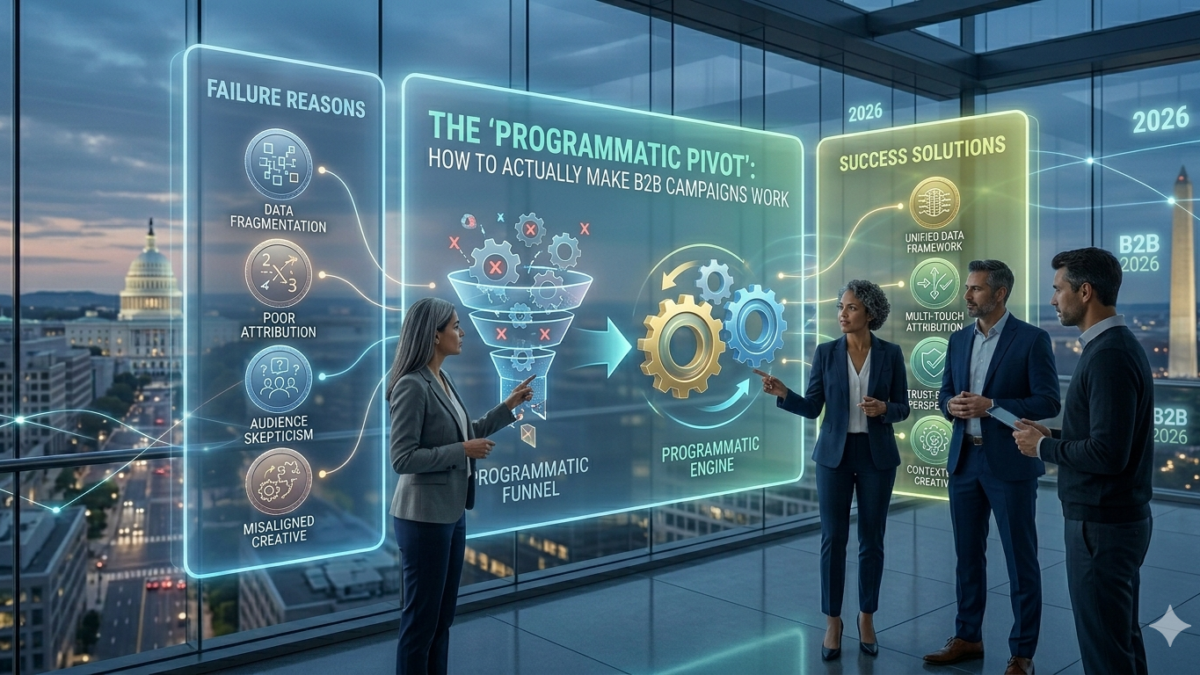
For years, B2B marketers have watched their B2C counterparts reap the rewards of programmatic advertising—efficiency, scale, and laser-targeted precision. We were promised the same revolution. Yet, for many B2B organizations, programmatic has become a frustrating black hole of budget, yielding high impressions but dismayingly low conversion rates.
The harsh reality in 2026 is that the B2B buying journey is too complex, too long, and too committee-driven for a standard B2C programmatic playbook. If you are applying simple retargeting and broad demographic filters, you are not running a programmatic campaign; you are just efficiently wasting your ad spend.
The B2B Programmatic Failure Points
Most B2B programmatic campaigns fail not because the technology is flawed, but because the strategy ignores the fundamental realities of B2B purchasing. Here are the three most common failure points:
1. Identity Crisis: Account-Based Inaccuracy
B2B does not sell to individuals; it sells to accounts. The biggest failure point is trying to target “VPs of Manufacturing” without defining which manufacturing companies. Broad job-title targeting on open exchanges leads to massive waste, reaching people at companies that are too small, in the wrong sector, or have zero intent to buy.
2. Signal Noise: Ignoring Real Intent
A click is not an intent signal. A standard programmatic setup might retarget anyone who visited your home page. But in B2B, a home page visit could be a job seeker, a competitor, or a student. Without layering on deeper intent data (e.g., specific product page views, white paper downloads, or third-party research behavior), you are retargeting noise.
3. Contextual Irrelevance: Right Person, Wrong Place
Just because you found your ideal prospect doesn’t mean they are in a buying mindset. Reaching a CISO while they are reading a sports blog is far less effective than reaching them while they are researching “2026 data compliance regulations” on a trade publication. Many programmatic campaigns prioritize cheap inventory over contextual relevance, sacrificing engagement for efficiency.
How to Actually Make B2B Programmatic Work
The solution is not to abandon programmatic, but to deploy it as a surgical tool within a broader Account-Based Marketing (ABM) framework. Here is how to build a high-performing B2B programmatic engine in 2026:
Phase 1: The Account Intelligence Layer
Before you ever bid on an impression, you must define your Ideal Customer Profile (ICP) with absolute precision. Use a data-driven approach to build your target account list (TAL), incorporating firmographics (industry, size, revenue), technographics (current tech stack), and—most importantly—situational intent.
Your AI model should be constantly scoring accounts based on real-time signals: Are they expanding into a new region? Did they just hire a new VP of Operations? Are they searching for your competitors on third-party review sites?
This intelligence layer ensures that your programmatic spend is restricted ONLY to accounts that are actively in a window of opportunity.
Phase 2: Orchestrated Omni-Channel Personalization
The B2B buying committee has 6-10 stakeholders. Programmatic allows you to reach all of them, but you must reach them with the right message, in the right context.
[Image illustrating the different stages of the B2B buying journey (Awareness, Consideration, Decision), with corresponding personalized ad content being triggered at each stage (e.g., high-level thought leadership for Awareness, technical white papers for Consideration, ROI calculators for Decision).]
Instead of one generic “Check out our solution” ad, your AI should dynamically serve tailored creative based on the account’s stage in the journey:
- Awareness: Serve high-level thought leadership (e.g., a white paper on future industry trends) on premium business-news sites like Forbes or the Wall Street Journal.
- Consideration: Trigger product-specific ads (e.g., a “how we compare” sheet) on niche industry publications and review sites like G2 or Capterra.
- Decision: Deliver bottom-of-the-funnel offers (e.g., a personalized ROI consultation) when intent signals peak.
Phase 3: Measuring Value, Not Volume
Stop measuring “Cost Per Thousand” (CPM) and “Click-Through Rate” (CTR). These are vanity metrics that don’t correlate to revenue. Instead, measure:
- Account Lift: Are targeted accounts engaging with your brand more than non-targeted accounts?
- Pipeline Velocity: Is your targeted outreach accelerating the speed at which accounts move through the funnel?
- Win Rate: Are your ABM-supported deals converting at a higher percentage?
The Bottom Line: Intelligence Over Automation
Programmatic technology provides the efficiency of automation, but strategy provides the intelligence. When you flip the script—starting with the account, layering on intent, and prioritizing context over cost—programmatic moves from being a budgetary drain to being the scalable engine of your B2B demand generation strategy.
Stop wasting budget on broad clicks and start driving revenue with iTMunch’s B2B Programmatic Advertising Services, where we combine surgical account-based targeting with real-time intent data to reach your high-value decision-makers exactly when they are ready to buy.