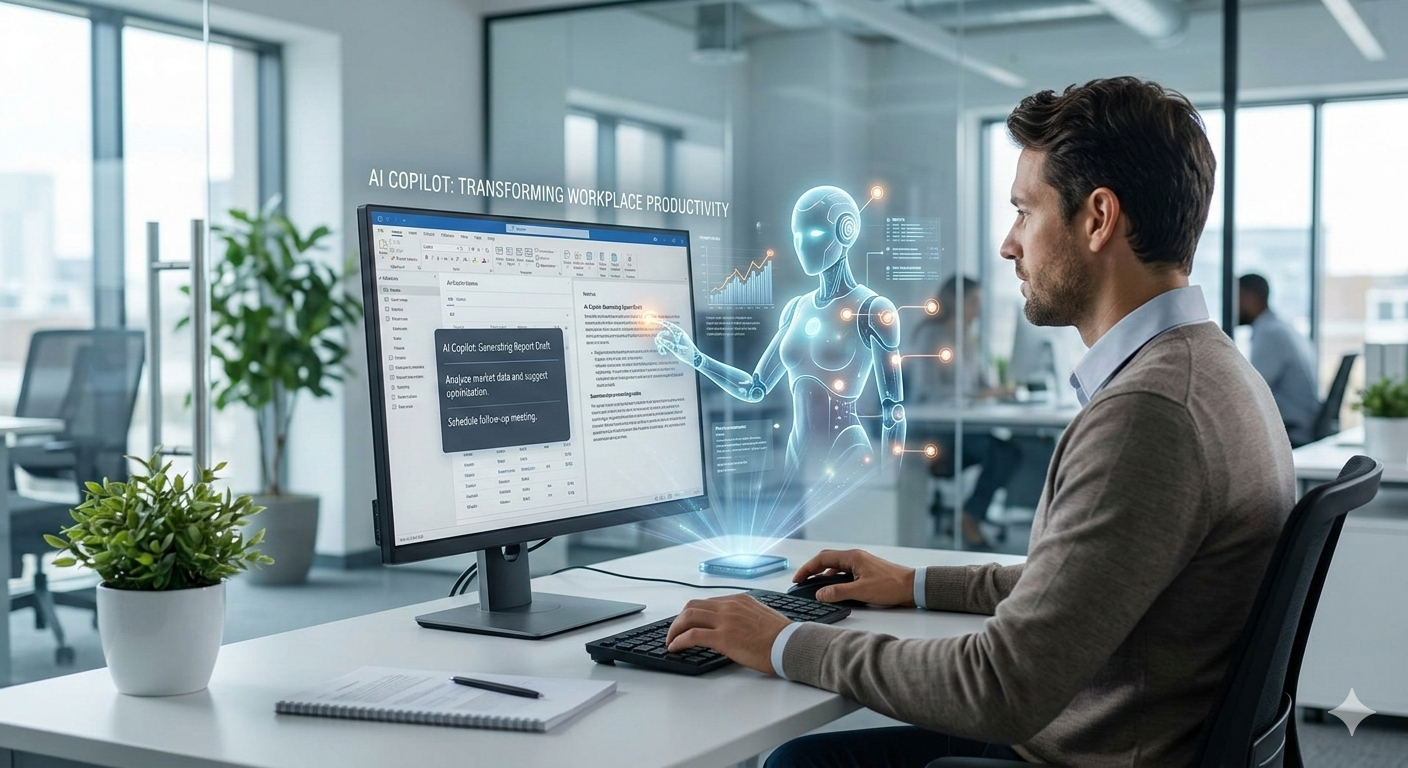
AI Copilots: How Intelligent Assistants Are Transforming Workplace Productivity
 Simon Powell,
6 months ago
4 min read
Simon Powell,
6 months ago
4 min read
As the role of technology expands, AI Copilots are becoming central to enhancing workplace productivity.
Artificial intelligence is rapidly reshaping the modern workplace. While early AI tools focused primarily on automation and chat-based assistance, the latest generation of AI systems is evolving into AI copilots—intelligent assistants designed to work alongside humans and enhance productivity.
These AI Copilots provide real-time support that streamlines workflows and reduces manual effort.
Integrating AI Copilots into daily operations not only saves time but also enhances overall efficiency.
The emergence of AI Copilots represents a significant leap in how technology assists in business tasks.
AI systems are integrated into software platforms and applications, helping users complete tasks more efficiently by providing suggestions, automating repetitive work, and generating insights in real time.
Understanding the function of AI Copilots is essential for leveraging their full potential in the workplace.
Many professionals find that AI Copilots improve their workflow and assist in complex problem-solving.
From writing reports and analyzing data to generating code and managing workflows, these systems are becoming an essential part of digital work environments.
Utilizing AI Copilots can drastically change the efficiency of task management in various sectors.
As businesses adopt AI-driven tools to remain competitive, copilots are emerging as one of the most impactful innovations in workplace technology.
What Are AI Copilots?
In the world of software development, AI Copilots are becoming indispensable tools for engineers.
AI copilots are advanced AI-powered assistants designed to support users while they perform tasks within digital tools and applications.
Unlike standalone AI chatbots, copilots are embedded directly into productivity platforms, enabling them to assist users within their existing workflows.
These AI systems can analyze context, understand user intent, and provide relevant recommendations that help accelerate task completion.
For example, an intelligent assistant in a document editor might help draft content, summarize information, or suggest improvements to writing.
Similarly, a coding assistant can assist developers by generating code snippets and identifying errors.
Key Capabilities of AI Copilots
These systems offer several powerful capabilities that enhance workplace efficiency.
Real-Time Task Assistance
They provide suggestions and insights while users are actively working. This real-time assistance helps professionals complete tasks more quickly and accurately.
Workflow Automation
Many repetitive tasks—such as data entry, report generation, or document formatting—can be automated using these systems.
This allows employees to focus on more strategic activities.
Contextual Understanding
They analyze the context of documents, projects, or datasets to deliver more relevant and useful suggestions.
This contextual awareness significantly improves productivity.
Applications of AI Copilots Across Industries
These systems are being adopted across multiple industries to support different professional workflows.
Software Development
Developers use intelligent assistants to generate code, identify bugs, and understand complex programming concepts.
These tools accelerate development cycles and improve code quality.
With the integration of AI Copilots, businesses can expect a transformation in operational effectiveness.
Marketing and Content Creation
Marketing teams use these systems to generate campaign ideas, write content, and analyze audience engagement.
This helps organizations scale content production efficiently.
Data Analysis
Analysts can use intelligent assistants to process large datasets, generate insights, and create visual reports.
This significantly reduces the time required for data interpretation.
Business Operations
These systems can assist with tasks such as scheduling meetings, drafting emails, and summarizing documents.
These capabilities help streamline daily operations.
Benefits of AI Copilots for Organizations
Adopting these systems can provide several advantages for businesses.
One of the most important benefits is increased productivity. Employees can complete tasks faster with AI-generated suggestions and automation.
Another advantage is improved decision-making. These systems can analyze large amounts of data and present insights that help leaders make informed choices.
Additionally, they can enhance collaboration by helping teams share knowledge and streamline communication.
The ongoing development of AI Copilots is poised to redefine the future of workplace technology.
Challenges and Considerations
Despite their benefits, organizations must carefully manage the implementation of these systems.
One challenge involves ensuring that generated suggestions are accurate and reliable.
Businesses must also address concerns related to data privacy and security when integrating AI systems into internal workflows.
Training employees to effectively use these systems is another important step in maximizing their value.
The Future of AI Copilots
As artificial intelligence technology continues to evolve, these systems are expected to become even more capable.
Future systems may offer deeper integrations with enterprise tools, improved reasoning capabilities, and more advanced automation features.
They could eventually function as intelligent collaborators that help manage complex projects, coordinate workflows, and support strategic decision-making.
Why AI Copilots Matter
These systems represent a shift toward more collaborative relationships between humans and machines.
Rather than replacing workers, these intelligent assistants are designed to enhance human productivity by handling repetitive tasks and providing valuable insights.
For businesses navigating an increasingly digital and data-driven world, these systems offer a powerful way to improve efficiency and unlock new levels of innovation.
As the technology matures, these systems will likely become a standard feature in modern workplace software and productivity platforms.