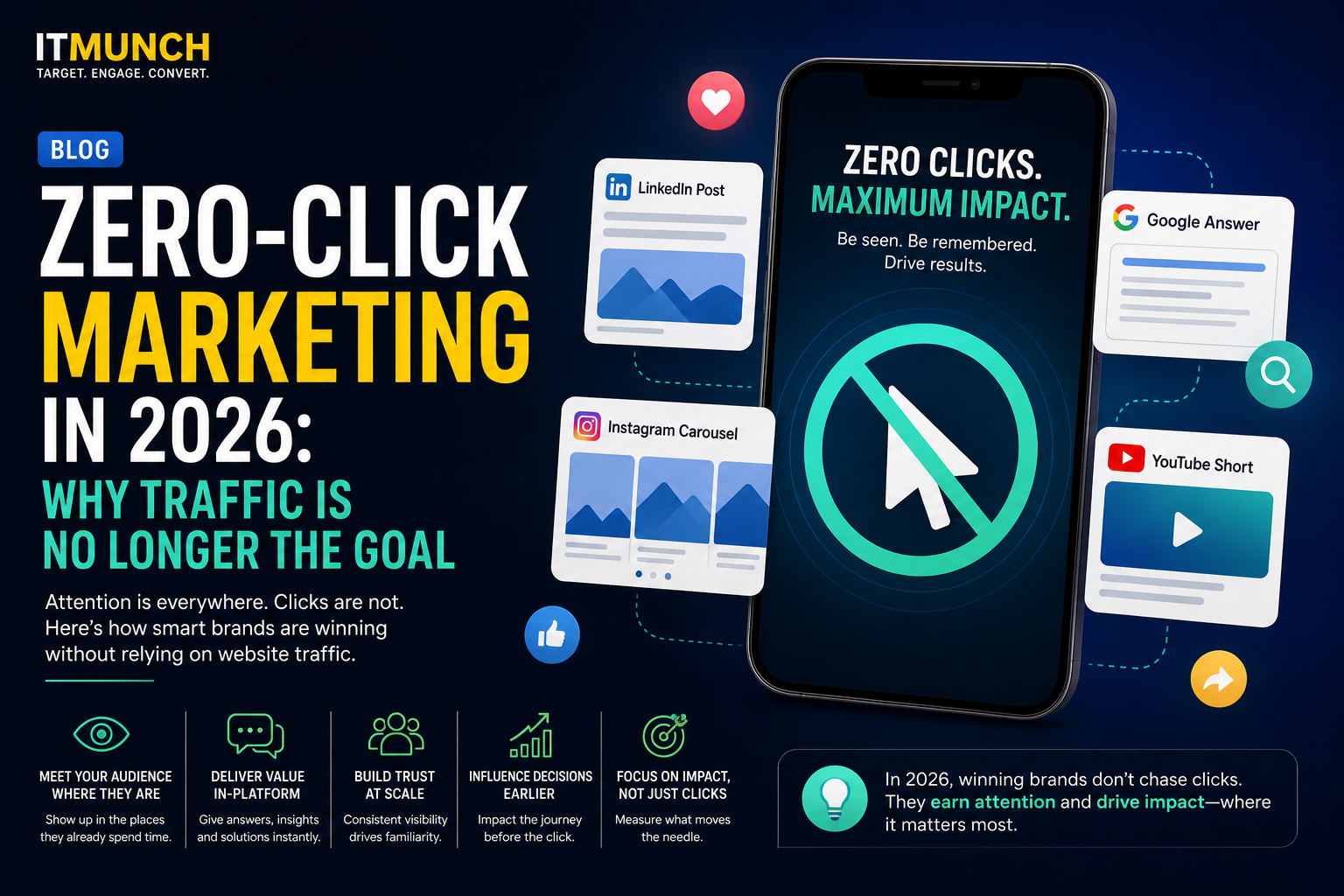
Zero-Click Marketing in 2026: Why Traffic Is No Longer the Goal
 Vansh Banthia,
6 months ago
4 min read
Vansh Banthia,
6 months ago
4 min read
Introduction
For years, digital marketing has been built around a single objective—driving traffic and embracing strategies like Zero-Click marketing.
Marketers optimized headlines for clicks, designed campaigns to pull users onto websites, and measured success through visits, sessions, and bounce rates. The assumption was simple: more traffic meant more opportunities to convert.
In 2026, that assumption is no longer entirely true.
A growing share of user engagement now happens without clicks. Content is consumed directly on platforms, questions are answered within feeds, and decisions are influenced long before a user ever visits a website. This shift has given rise to what is now known as Zero-Click marketing.
What is Zero-Click Marketing?
Zero-click marketing refers to delivering value directly within the platform where the audience already exists, without requiring them to click through to another destination.
This includes:
- Informative LinkedIn posts that provide complete insights
- Social media carousels that educate users end-to-end
- Search results that answer queries instantly
- Video content that delivers standalone value
The goal is not to force a click, but to earn attention and influence decisions in place.
Why Traffic is Becoming Less Reliable
The decline of click-driven strategies is closely tied to platform evolution.
Social media platforms are designed to keep users within their ecosystems. Algorithms prioritize content that retains attention rather than content that redirects users elsewhere. As a result, posts with external links often receive lower reach compared to native content.
Search behavior is also changing. With the rise of AI-generated summaries and instant answers, users can find what they need without visiting multiple websites.
This creates a new reality: visibility does not guarantee traffic, and traffic does not guarantee impact.
The Shift from Clicks to Influence
In a zero-click world, the role of content changes fundamentally.
Instead of acting as a gateway to deeper resources, content becomes the experience itself. It must deliver value immediately, without relying on additional steps.
This requires a different approach to storytelling.
Content must be concise yet meaningful, engaging yet informative. It should address real problems, offer clear insights, and leave a lasting impression. The focus shifts from attracting users to earning their attention and trust.
What Winning Brands Are Doing Differently
Brands that succeed in zero-click marketing understand that distribution is as important as creation.
They design content specifically for each platform, adapting format, tone, and structure to match audience behavior. Instead of repurposing blog links, they create native content experiences that feel natural within each environment.
They also prioritize consistency. Visibility is built over time through repeated exposure. A single post may not drive immediate results, but consistent presence strengthens brand recall and credibility.
Most importantly, they measure success differently. Instead of focusing only on clicks, they track engagement, reach, and influence on pipeline outcomes.
Challenges of the Zero-Click Approach
While zero-click marketing offers new opportunities, it also comes with challenges.
One of the biggest concerns is attribution. Without direct traffic, it becomes harder to track the exact path from content to conversion. Marketers must rely on broader indicators and qualitative insights to understand impact.
Another challenge is control. Platforms own the audience, which means changes in algorithms can significantly affect visibility. This requires continuous adaptation and experimentation.
Despite these challenges, the benefits of zero-click marketing often outweigh the limitations, especially in a landscape where attention is increasingly fragmented.
How iTMunch Fits into the Zero-Click Era
This is where iTMunch becomes highly relevant.
ITMunch enables brands to distribute content across targeted platforms and ecosystems where their audience is already active. Instead of depending solely on website visits, it ensures that content reaches users in environments where they are most likely to engage.
By aligning content with audience intent and delivering it in native formats, ITMunch helps brands maximize visibility without relying entirely on clicks.
This approach bridges the gap between awareness and action, allowing marketers to influence decisions even when the buyer journey remains partially invisible.
Conclusion
Zero-click marketing is not a passing trend. It is a reflection of how digital behavior is evolving.
In 2026, success in B2B marketing is less about driving traffic and more about delivering value wherever the audience is. Brands that adapt to this shift will be better positioned to capture attention, build trust, and influence decisions.
The future belongs to marketers who understand that sometimes, the most impactful interaction is the one that happens without a click.