Imagine this.
Your marketing team launches a campaign at 9:00 AM. By 9:01 AM, thousands of advertising decisions have already been made—who sees your ad, on which platform, at what cost, and at what exact moment.
No manual bidding. No endless spreadsheets. No waiting for campaign reports.
This is programmatic advertising.
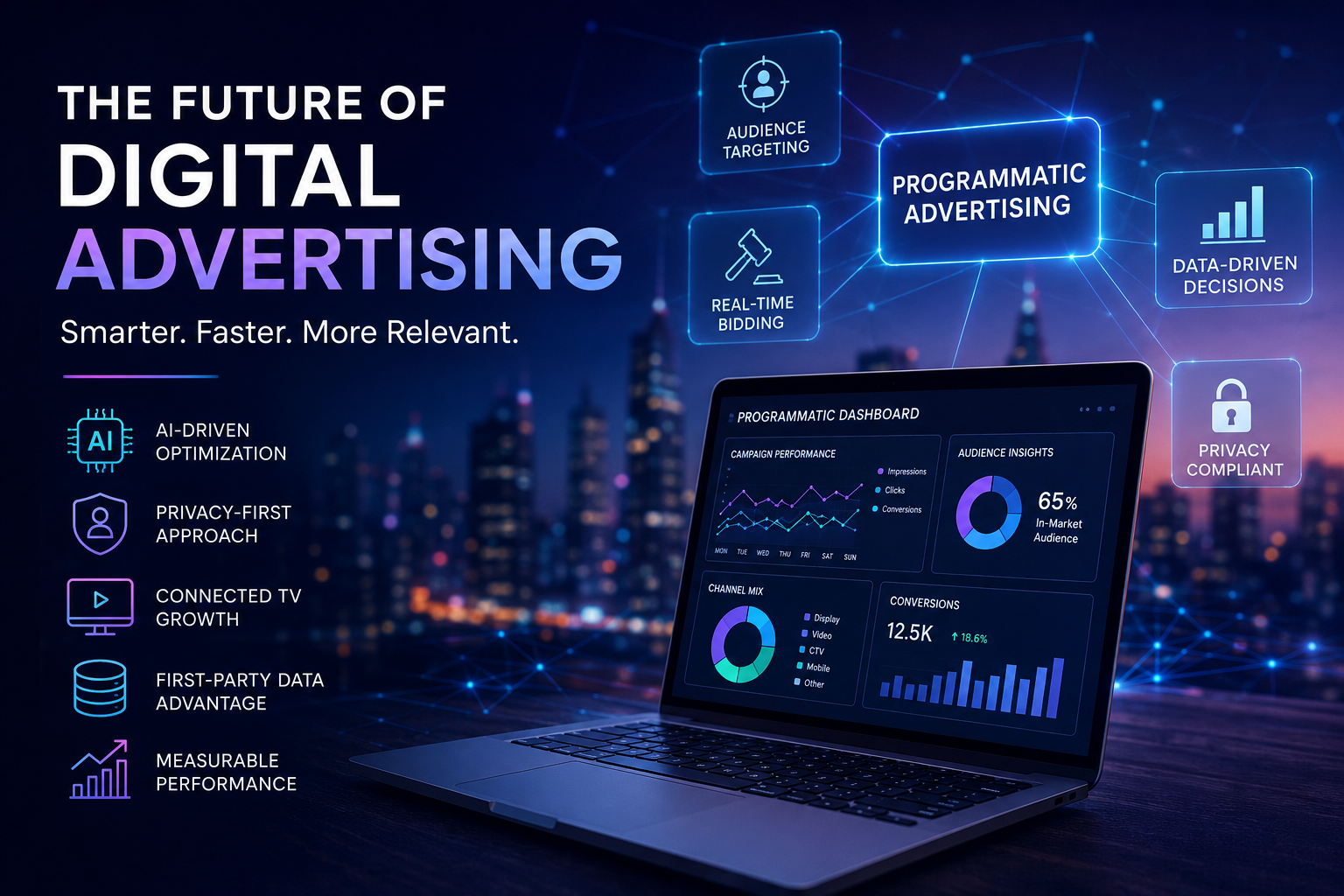
And while the term has been around for years, 2026 is proving to be a turning point. The combination of AI-driven optimization, privacy regulations, retail media growth, and Connected TV (CTV) is reshaping how businesses reach buyers.
For decision-makers, the question is no longer whether programmatic advertising works. The question is whether your organization is prepared for where it is headed next.
Programmatic Advertising Is Now the Default, Not the Alternative
Programmatic advertising has quietly become the dominant method of buying digital media.
According to recent industry estimates, more than 90% of digital display advertising in mature markets is now purchased programmatically. Global programmatic ad spending is expected to exceed $700 billion by 2027, reflecting how deeply automation has become embedded in modern marketing strategies.
The reason is simple.
Traditional media buying cannot match the speed and precision required in today’s fragmented digital landscape. Consumers move between websites, mobile apps, streaming platforms, social media channels, and online marketplaces within minutes. Programmatic platforms enable advertisers to reach these audiences in real time while optimizing performance continuously.
For business leaders, this means advertising is increasingly becoming a technology function as much as a marketing function.
AI Is Changing the Rules of Campaign Optimization
Artificial intelligence has become the biggest force shaping programmatic advertising.
Historically, marketers used audience segments, demographic assumptions, and manual optimizations to improve campaign performance. Today’s platforms can analyze thousands of signals simultaneously, including browsing behavior, contextual relevance, engagement patterns, device usage, and purchasing intent.
Consider a B2B software company targeting CIOs.
Rather than relying solely on job titles or company size, AI-powered systems can identify users actively researching cloud migration, cybersecurity investments, or enterprise software modernization. Campaign budgets can then shift automatically toward higher-performing audiences and placements.
This capability is particularly valuable as customer journeys become increasingly unpredictable.
According to industry research, organizations leveraging AI-driven advertising optimization have reported significant improvements in conversion rates while reducing wasted ad spend.
The result is not just better targeting, fit is more efficient decision-making at scale.
The Death of Third-Party Cookies Is Creating New Winners
For years, digital advertising relied heavily on third-party cookies to track users across the internet.
That era is ending.
Major browsers have already limited tracking capabilities, while privacy regulations continue to expand globally. As a result, advertisers are being forced to rethink audience targeting strategies.
Interestingly, this shift is not necessarily bad news.
Companies with strong first-party data strategies are gaining a competitive advantage.
Retailers, publishers, streaming platforms, and businesses with direct customer relationships now possess valuable audience insights that competitors cannot easily replicate.
A practical example is the rise of retail media networks.
Companies such as Amazon, Walmart, and other major commerce platforms have transformed their customer data into advertising ecosystems. Because these businesses understand actual purchase behavior, advertisers can target consumers with a level of precision that traditional cookie-based advertising often struggled to achieve.
For executives, first-party data is increasingly becoming a business asset, not just a marketing resource.
Connected TV Is Becoming a Serious Business Channel
Television advertising was once accessible only to brands with massive budgets.
Programmatic technology has changed that equation.
Connected TV (CTV), which includes streaming platforms and smart TV environments, is one of the fastest-growing segments within digital advertising.
Consumers are spending more time streaming content and less time watching traditional linear television. This shift has created new opportunities for advertisers to combine television’s storytelling power with digital targeting capabilities.
A cybersecurity vendor, for example, can now deliver video ads specifically to business decision-makers consuming industry content through streaming platforms.
This level of audience precision was almost impossible in traditional television advertising.
Industry analysts expect CTV spending to continue growing rapidly throughout 2026 and beyond, making it an increasingly important channel for both B2B and B2C organizations.
Transparency Is Becoming a Boardroom Issue
As programmatic spending grows, so does scrutiny.
Businesses are asking tougher questions:
- Where exactly are ads appearing?
- How much of the budget reaches publishers?
- Are impressions being served to real people?
- Is the campaign delivering measurable business outcomes?
These concerns are driving increased demand for transparency, supply path optimization (SPO), and stricter verification standards.
Several industry studies have highlighted inefficiencies in complex advertising supply chains, prompting advertisers to simplify partnerships and focus on higher-quality inventory sources.
For business leaders managing significant marketing budgets, transparency is no longer a technical detail—it is a governance issue.
The Next Phase of Programmatic Advertising
The future of programmatic advertising is not simply more automation.
It is smarter automation.
The industry is moving toward a model where AI, first-party data, contextual intelligence, and privacy-first targeting work together to deliver more relevant advertising experiences.
Success will depend less on buying the most impressions and more on understanding audiences, data quality, and business outcomes.
For organizations navigating increasingly complex digital markets, programmatic advertising has evolved from a tactical marketing channel into a strategic growth capability.
And as technology continues to reshape how buyers discover, evaluate, and purchase solutions, the businesses that adapt fastest will likely gain the greatest advantage, not because they advertise more, but because they advertise smarter.