Could Jenga Help Robots Learn Dexterous Tasks? Encord’s EMG-1 Dataset, Explained
 Nadin Lasko,
1 hour ago
3 min read
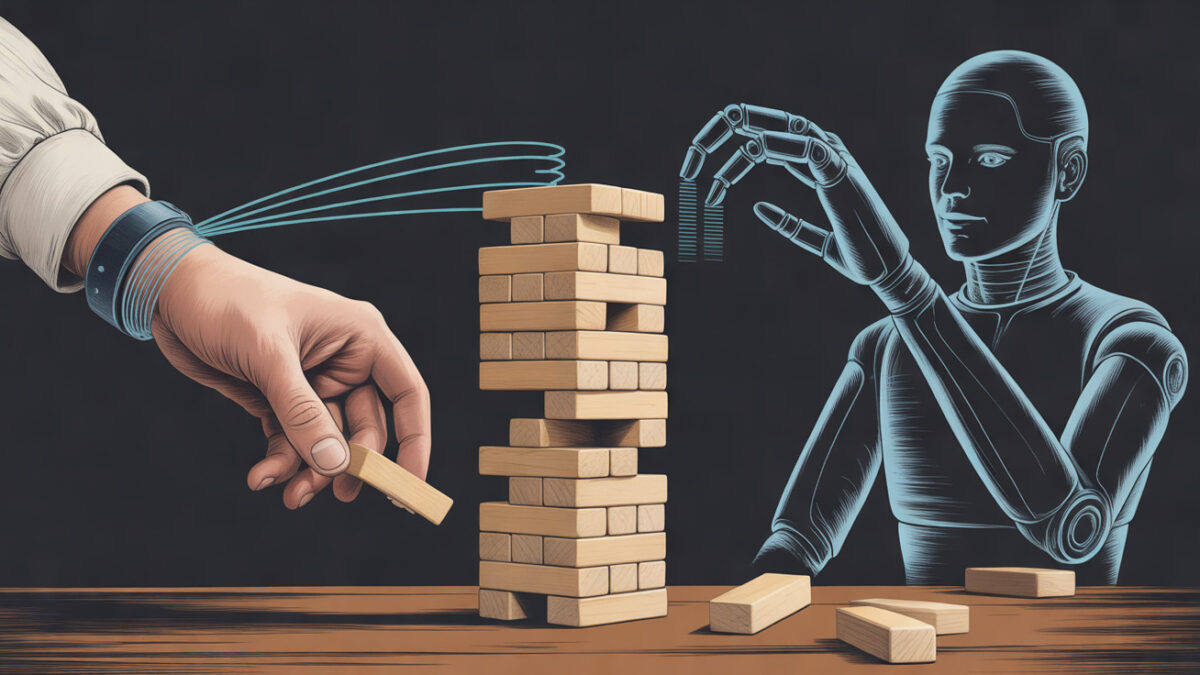
Quick answer: Encord’s EMG-1 is a dataset that pairs wrist muscle signals with first-person video to help researchers study hand movement for robotics. Encord calls it the largest open dataset of its kind. A person playing Jenga is a vivid example of the precise manipulation it can capture. The dataset is research material—not proof that a robot can already play Jenga.
Encord announced EMG-1 on October 20, describing it in its technical release as wrist electromyography (EMG) synchronized with egocentric, or first-person, video. Reuters featured the project on October 23, and USA Today reported on the Jenga demonstration.
What is Encord’s EMG-1 dataset?
EMG-1 has two distinct collections. The field dataset contains 307 hours of real-world recordings, pairing three-channel EMG from both wrists with head- and wrist-mounted video, depth and inertial measurements. It spans 3,804 clips gathered across seven collection stations. Encord says these recordings capture natural work with objects, where fingers can disappear behind what a person is handling.
A separate 10.4-hour laboratory collection uses eight-channel EMG and optical motion capture. The motion-capture system provides independently measured finger positions for evaluating models. Unlike the field recordings, the lab set uses free hand movement without objects. Encord developed the dataset with wearable-sensing company Wearable Devices.
Why use Jenga to study robot hand skills?
Jenga makes the problem easy to picture: a player must select a block, grip it gently and move it without destabilizing the tower. USA Today reported that Encord used the game to demonstrate a head-mounted camera and wristband sensors recording human movement. The example is one way to show the data-collection method; the broader field dataset covers real-world object manipulation, not only Jenga.
EMG measures electrical activity associated with muscles in the forearm. Encord’s technical explanation says those signals can continue during a grasp even when a camera cannot see the fingers. But EMG is not a direct reading of finger-joint position, object contact or grip force. A model has to infer movement from the signals and other measurements.
What did Encord’s early test find?
In Encord’s laboratory evaluation, a model combining camera input and EMG achieved a median fingertip-position error of 15.3 millimeters, compared with 20.3 millimeters for a camera-and-held-pose reference—about 25% lower, according to the company. The test also examined how the combined model behaved when camera tracking lost the fingers.
The result is promising but narrow. Encord says the evaluation was an offline annotation experiment, used half a second of future EMG, and included its own camera branch. It therefore does not isolate how much improvement came from EMG alone, establish real-time performance or show a robot completing Jenga. The finding is a company-reported lab benchmark, not a demonstration of a finished robotic capability.
Can researchers access EMG-1?
Encord’s EMG-1 page offers a form to request access to the 300-plus-hour dataset and an eight-channel sample. The company says raw sensor streams, camera-derived annotations, quality metadata and laboratory motion-capture ground truth are part of the release. Derived pose estimates and object-contact or force labels are planned for later releases.
The next question is whether models trained with these signals generalize across different people, sessions, electrode placements and objects. Encord itself says those areas still need investigation. EMG-1 is best understood as research infrastructure that may help improve how robots learn dexterous hand movements—not as a robot that has already learned to play a block-stacking game.
Sources: Encord’s technical announcement · Encord Data Labs · Reuters video report · USA Today report.
Could Jenga Help Robots Learn Dexterous Tasks? Encord’s EMG-1 Dataset, Explained