Why B2B Lead Generation Is Becoming a Sales Intelligence Function
 Purva Wankhade,
3 months ago
5 min read
Purva Wankhade,
3 months ago
5 min read
There was a time when B2B lead generation was largely a numbers game. Marketing teams measured success by the volume of contacts captured through forms, gated content, webinars, or outbound campaigns. Sales teams, in turn, worked through those lists in the hope that a percentage would eventually convert into customers.
That approach is becoming increasingly ineffective.
Today’s enterprise buying environment is more complex than ever. Decision-making involves multiple stakeholders, longer evaluation cycles, AI-assisted research, and buyers who often prefer to educate themselves before speaking with a sales representative. According to recent industry research, many B2B buyers complete a significant portion of their purchasing journey independently before engaging with vendors, making traditional lead collection an incomplete measure of marketing success.
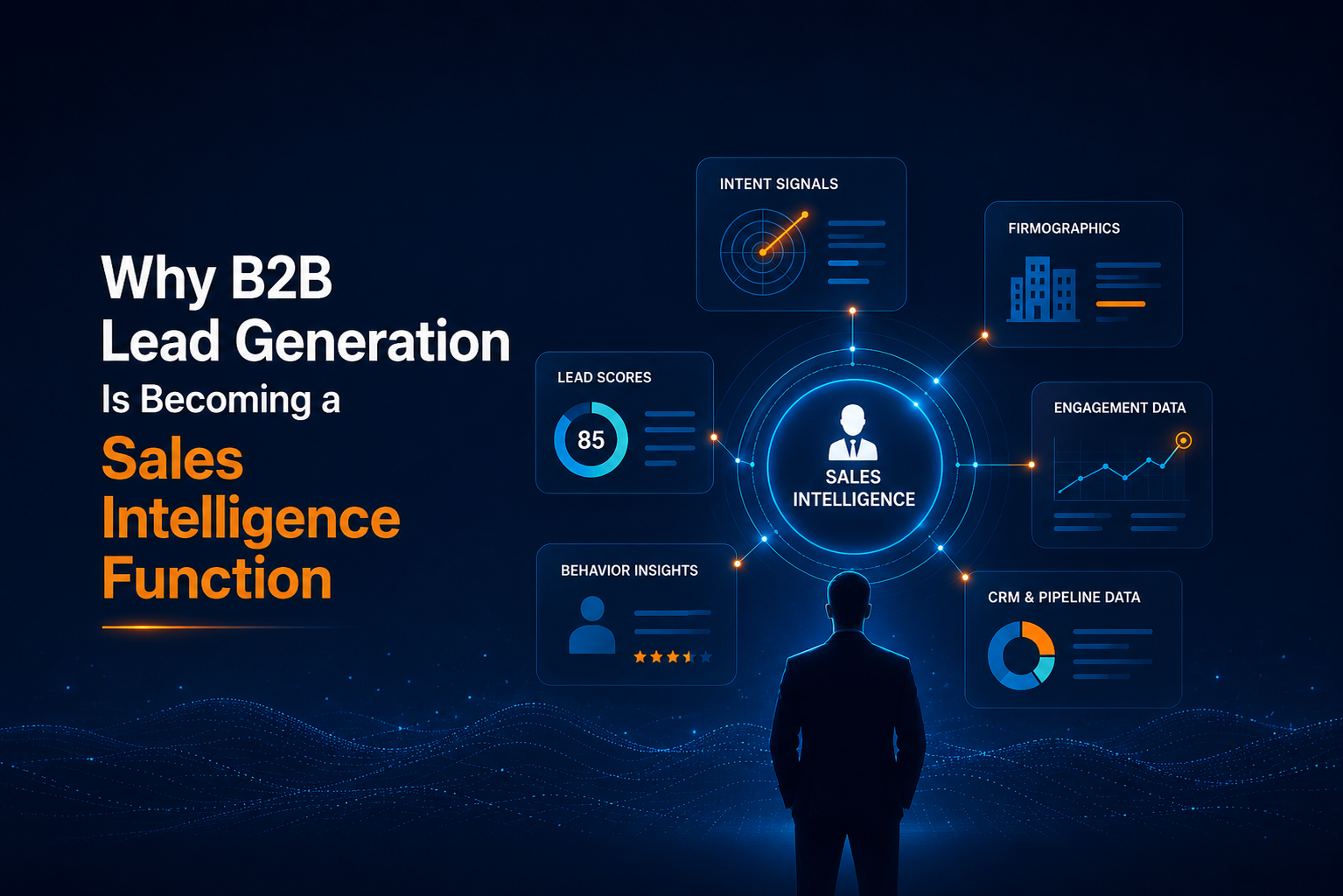
This evolution is fundamentally changing the purpose of B2B lead generation. Rather than simply filling the sales pipeline with names and contact details, leading organizations are transforming lead generation into a sales intelligence function, one that helps sales teams understand who is buying, why they are buying, when they are most likely to engage, and what challenges they are trying to solve.
For enterprise leaders, this shift represents more than a change in tactics. It reflects a broader transformation in how revenue teams use data, artificial intelligence, and customer insights to create meaningful buying experiences.
Lead Generation Is Shifting From Volume to Buyer Intelligence
The traditional lead generation model rewarded quantity.
More leads often meant more opportunities, even if many prospects were not ready to purchase. Marketing automation systems helped scale this approach, but they also created an environment where sales teams spent valuable time qualifying contacts that lacked genuine buying intent.
Today, that equation is changing.
Modern B2B lead generation increasingly focuses on understanding buyer behavior rather than simply collecting buyer information.
Artificial intelligence, intent data platforms, lead management platforms, CRM systems, website analytics, and first-party customer signals now provide organizations with a far richer picture of potential customers. Instead of asking whether someone downloaded a whitepaper, enterprises can evaluate broader behavioral patterns that indicate purchasing readiness.
Has the prospect visited pricing pages multiple times?
Have they researched specific business challenges?
Are multiple stakeholders from the same company engaging with content?
Is the organization actively exploring solutions within a relevant technology category?
These insights create context that is far more valuable than a standalone email address.
Recent advances in AI-powered revenue platforms are accelerating this transformation. Predictive analytics can identify high-intent accounts, recommend optimal engagement timing, prioritize sales opportunities, and surface hidden buying signals that previously required significant manual analysis.
As a result, lead generation is becoming less about capturing interest and more about interpreting intent.
The organizations gaining a competitive advantage are those that treat every interaction as a source of intelligence rather than simply another marketing metric.
Sales and Marketing Are Finally Working From the Same Intelligence
For years, one of the biggest challenges in enterprise organizations has been the disconnect between marketing and sales.
Marketing focused on generating leads.
Sales focused on closing opportunities.
While both teams shared revenue goals, they often relied on different definitions of success, different datasets, and different customer perspectives.
That separation is beginning to disappear.
Modern B2B lead generation is increasingly creating a shared intelligence layer that benefits both functions.
Marketing teams now analyze search behavior, content engagement, account activity, firmographic data, buying committee participation, and customer intent to develop a deeper understanding of each opportunity. Sales teams use those insights to personalize outreach, prioritize conversations, and tailor messaging to specific business challenges.
Instead of passing leads between departments, organizations are sharing knowledge throughout the buying journey.
Artificial intelligence is making this collaboration even more effective.
AI can consolidate signals from multiple channels, identify patterns across thousands of accounts, summarize prospect activity, recommend next-best actions, and continuously refine lead scoring models based on actual sales outcomes.
This enables revenue teams to spend less time managing data and more time building meaningful customer relationships.
For B2B decision-makers, the implications are significant.
Rather than asking whether marketing generated enough leads this quarter, executives are increasingly evaluating whether revenue teams have sufficient intelligence to engage the right accounts at the right moment with the right message.
That represents a far more strategic approach to growth.
The Future of B2B Lead Generation Is Predictive, Not Reactive
Perhaps the most important change happening today is the shift from reacting to buyer activity toward anticipating it.
Historically, organizations responded after prospects completed a form, requested a demonstration, or contacted the sales team.
The next generation of B2B lead generation seeks to recognize buying intent before those actions occur.
AI models can analyze historical customer data, identify common purchasing patterns, detect changes in digital behavior, and estimate which organizations are entering active buying cycles.
Combined with first-party data and privacy-conscious measurement strategies, these capabilities allow enterprises to engage buyers earlier and more thoughtfully.
This does not mean replacing human judgment with algorithms.
On the contrary, it elevates the role of sales professionals.
AI can identify opportunities, but experienced sales teams provide the context, empathy, strategic thinking, and relationship-building that enterprise purchasing decisions still require. Technology becomes an intelligence partner rather than a replacement for meaningful human interaction.
The growing emphasis on account-based marketing, buying committee analysis, revenue intelligence platforms, and AI-assisted sales workflows reinforces this direction. Across industries, enterprises are recognizing that successful lead generation depends less on collecting contacts and more on understanding complex customer journeys.
For B2B leaders, this requires a change in mindset.
The most valuable lead is no longer simply the first person who raises their hand. It is the organization whose needs, timing, decision-makers, and priorities are understood well enough to support a relevant and productive conversation.
In the years ahead, the distinction between lead generation and sales intelligence will continue to fade. Organizations that combine AI-driven insights with human expertise will be better positioned to identify opportunities, shorten sales cycles, and build stronger customer relationships.
The future of B2B lead generation is not defined by larger databases or higher lead volumes. It is defined by deeper intelligence, sharper decision-making, and a clearer understanding of the people behind every opportunity.
In an era where buyers expect relevance from the very first interaction, the businesses that succeed will be those that treat lead generation not as the beginning of the sales process, but as the foundation of a smarter, more informed revenue strategy.