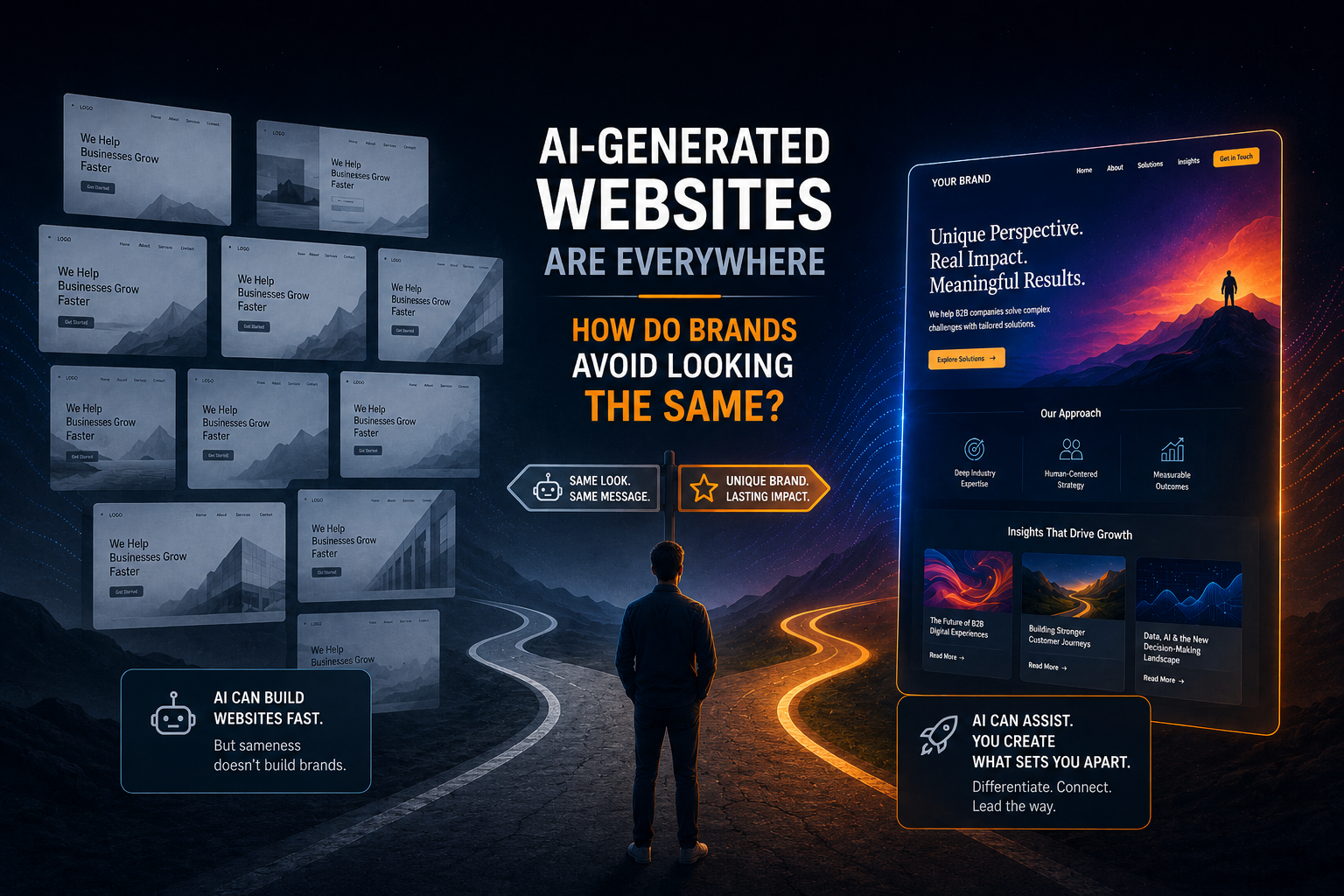
AI-Generated Websites Are Everywhere – How Do Brands Avoid Looking the Same?
 Purva Wankhade,
3 months ago
5 min read
Purva Wankhade,
3 months ago
5 min read
Artificial intelligence has fundamentally changed how organizations approach Website development. What once required weeks of planning, design, coding, and testing can now be accomplished in hours using AI-powered website builders, automated design assistants, and generative coding tools. For B2B organizations, this acceleration offers clear advantages. Faster launches, lower development costs, and streamlined workflows have made AI an attractive option for businesses of every size.
However, a new challenge is emerging. As more companies rely on the same AI models, templates, and design recommendations, websites are beginning to look remarkably similar. Layouts, messaging, imagery, navigation, and even calls-to-action often follow identical patterns. Instead of helping brands stand out, AI-generated experiences risk blending them into an increasingly crowded digital landscape.
For B2B decision-makers, this creates an important strategic question. If every competitor has access to the same technology, what makes one website memorable while another becomes forgettable? The future of Website development is no longer about building faster. It is about building experiences that reflect a company’s unique expertise, credibility, and competitive advantage.
AI Is Standardizing the Web Faster Than Ever
The rapid adoption of generative AI has transformed digital production across industries. AI-powered development platforms can now generate complete landing pages, recommend layouts, write marketing copy, create visuals, optimize code, and even improve search engine performance. Major technology companies continue expanding AI capabilities within their productivity and development ecosystems, making automated website creation more accessible than ever before.
While these innovations improve efficiency, they also introduce an unintended consequence. AI systems are trained on enormous volumes of existing web content. As a result, many generated websites naturally follow familiar structures, predictable messaging patterns, and widely accepted design conventions.
Across B2B industries, organizations increasingly publish websites featuring nearly identical hero sections, repetitive value propositions, stock-inspired visuals, and generic customer journeys. At the same time, many are adopting similar AI search optimization strategies, making it even harder to stand out in AI-powered search experiences. The result is a growing sea of digital sameness where businesses struggle to communicate what truly differentiates them.
This shift is forcing organizations to rethink the purpose of Website development. Instead of asking how quickly a website can be built, leading companies are asking how effectively it represents their expertise and market position.
Brand Identity Must Guide Every AI Decision
AI should accelerate creativity rather than replace it. Successful organizations are discovering that the strongest websites begin with a clearly defined brand strategy before AI generates a single design or sentence.
A distinctive B2B website reflects more than attractive visuals. It communicates industry knowledge, customer understanding, organizational values, and business credibility through every interaction. These elements cannot simply be generated from a prompt.
Companies investing in modern Website development increasingly combine AI efficiency with human expertise. Brand positioning, customer research, messaging frameworks, visual identity, and strategic storytelling remain human-led decisions that AI can help execute more efficiently.
This approach has become even more important as AI-powered search experiences continue evolving. Search platforms increasingly evaluate expertise, authority, structured information, and content quality rather than simply rewarding keyword optimization. Websites that demonstrate genuine thought leadership, original insights, and clear business value are more likely to earn visibility across both traditional search engines and emerging AI search experiences.
Rather than publishing generic pages filled with predictable marketing language, organizations are focusing on publishing proprietary research, industry perspectives, customer success stories, executive insights, and interactive experiences that AI cannot easily replicate.
The Future of Website Development Belongs to Original Experiences
As AI continues reshaping digital experiences, differentiation will become one of the most valuable competitive advantages. The companies that succeed will not necessarily be those using the most AI. They will be the organizations using AI most strategically.
Modern Website development is evolving beyond attractive interfaces into intelligent digital ecosystems. Websites increasingly integrate personalization engines, first-party customer data, behavioral analytics, conversational AI, predictive recommendations, and dynamic content experiences tailored to different buying stages.
Enterprise buyers now expect websites to recognize intent, simplify complex purchasing decisions, and deliver highly relevant information without unnecessary friction. Static pages are gradually giving way to adaptive experiences that respond to visitor behavior in real time.
Originality will also become increasingly measurable. AI systems powering search and recommendation engines are becoming better at identifying authentic expertise, unique information, and high-value content. Organizations that rely entirely on AI-generated text and generic templates may struggle to earn long-term visibility as search ecosystems continue prioritizing helpful, trustworthy, and experience-driven content.
The most effective digital experiences will combine AI automation with strategic creativity. Businesses that invest in distinctive messaging, meaningful customer experiences, and continuous optimization will create websites that remain memorable long after visitors leave.
The rise of generative AI does not signal the end of creativity in Website development. Instead, it raises the standard. When every organization has access to similar technology, differentiation becomes a strategic responsibility rather than a design preference.
For B2B leaders, the opportunity is clear. AI can accelerate production, simplify workflows, and improve operational efficiency, but lasting competitive advantage will come from originality, expertise, and authentic brand storytelling. The websites that win in the coming years will not be those built fastest—they will be the ones that feel unmistakably human, communicate genuine business value, and deliver experiences competitors simply cannot duplicate.