Why Embedded Finance Is Becoming a Competitive Advantage Beyond Banking
 Purva Wankhade,
4 months ago
5 min read
Purva Wankhade,
4 months ago
5 min read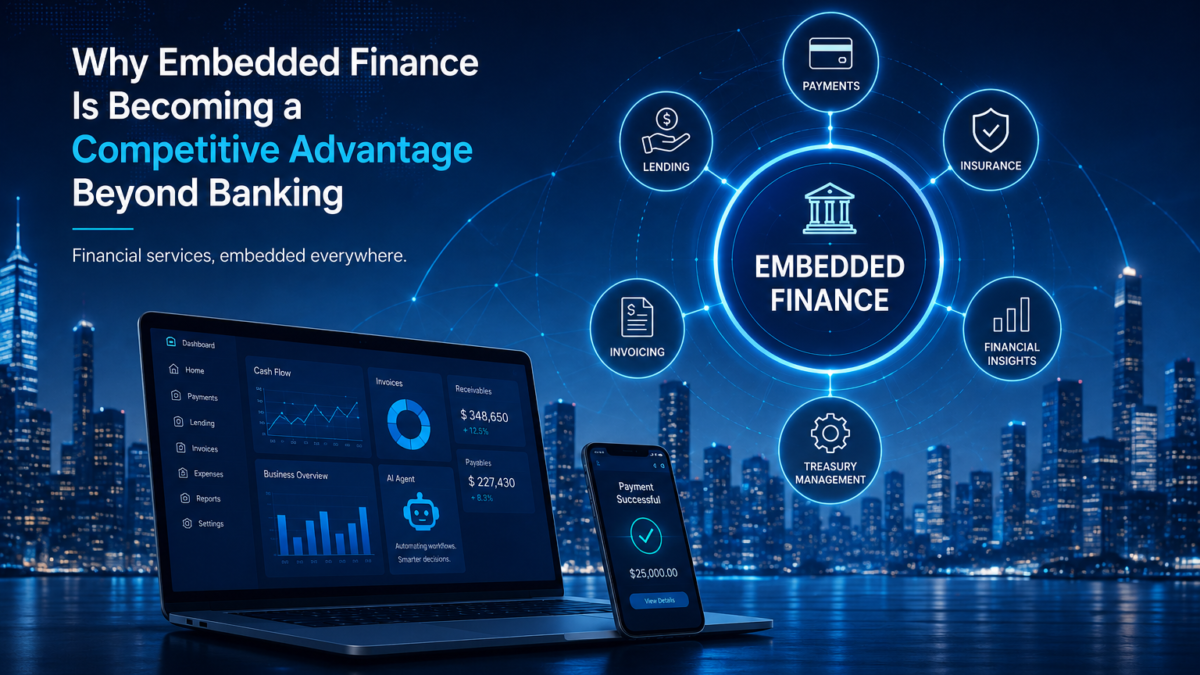
For years, embedded finance was largely associated with consumer experiences like “Buy Now, Pay Later” at online checkouts or digital wallets inside mobile apps. In 2026, however, the conversation has shifted dramatically. Embedded finance is no longer confined to banks or fintech startups. It is becoming a strategic capability across manufacturing, healthcare, logistics, SaaS, retail, and enterprise software.
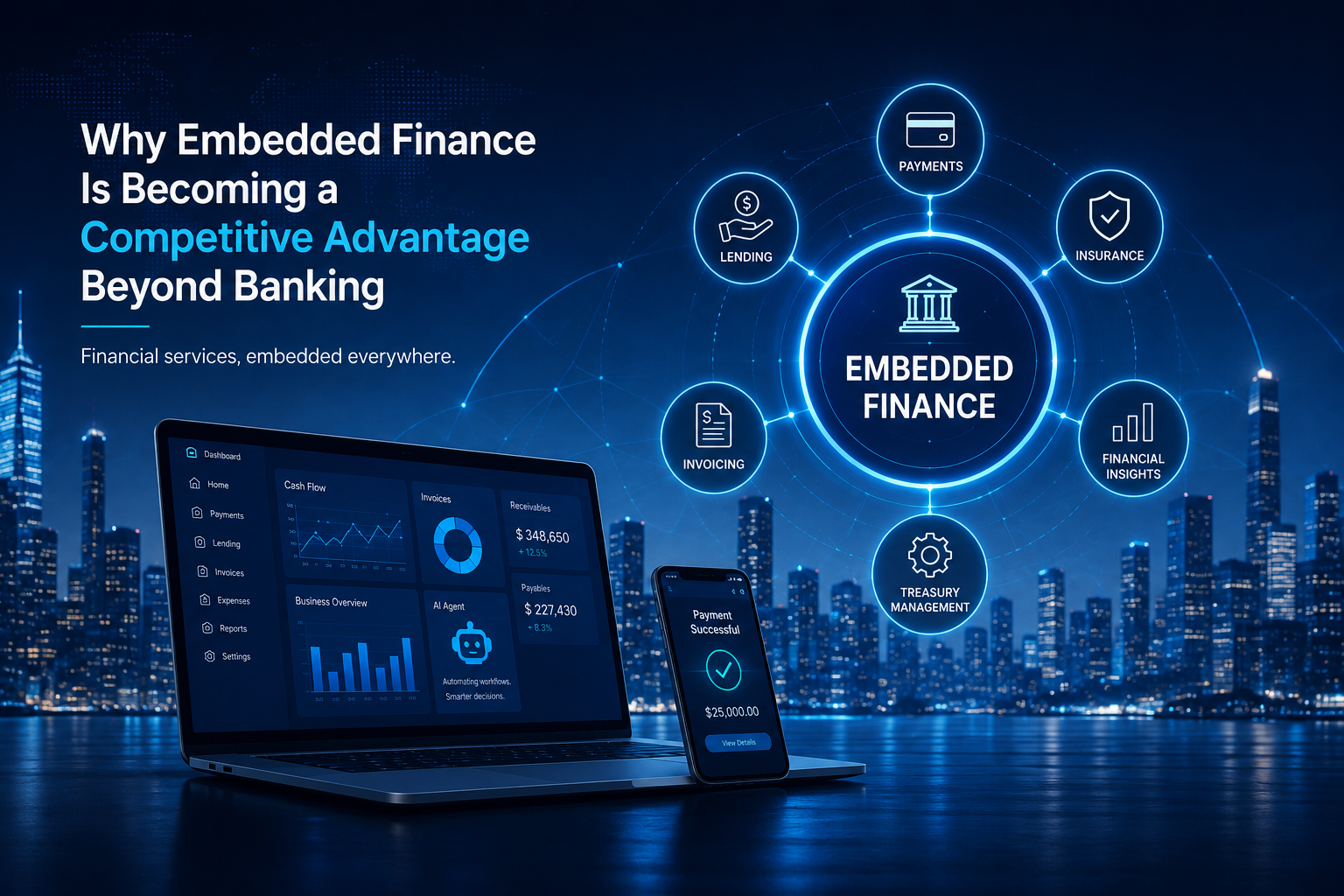
The latest wave of innovation is being driven by advances in AI, open banking frameworks, API-first infrastructure, intelligent automation, and the growing adoption of AI agent capabilities. Organizations are increasingly embedding payment processing, lending, insurance, invoicing, treasury management, and financial insights directly into the platforms customers already use. Rather than redirecting users to external banking portals, businesses are bringing financial services into their own digital ecosystems.
For B2B decision makers, embedded finance is evolving beyond convenience. It is becoming a competitive differentiator that improves customer experience, unlocks new revenue streams, and strengthens long-term business relationships. As enterprises invest in digital transformation, financial capabilities are quietly becoming part of the overall product strategy instead of remaining separate business functions, with every modern AI agent helping automate complex financial workflows behind the scenes.
Embedded Finance Is Becoming Part of Every Digital Experience
Enterprise buyers increasingly expect seamless experiences. Whether they are purchasing industrial equipment, managing supply chains, subscribing to enterprise software, or coordinating procurement, they want transactions to happen without unnecessary friction. Embedded finance addresses this expectation by integrating financial services directly into operational workflows.
Recent developments across enterprise technology highlight this trend. Major cloud providers, ERP vendors, and modern ERP tools continue expanding financial integrations through APIs, allowing organizations to automate payments, financing, expense management, and reconciliation without leaving their primary applications. As businesses prioritize operational efficiency, these integrated ERP tools are making financial interactions nearly invisible to end users while enabling faster, more connected business processes.
Artificial intelligence is accelerating this transformation even further. Modern AI agent technology can analyze transaction history, recommend payment options, detect unusual financial behavior, automate approvals, and assist finance teams with increasingly complex workflows. Instead of acting as simple automation tools, AI-powered financial assistants are becoming intelligent participants in enterprise operations.
This convergence of embedded finance and AI enables organizations to reduce manual effort while improving decision-making speed. Businesses no longer need multiple disconnected systems to complete financial processes because intelligent platforms, powered by an AI agent, can coordinate activities across departments through unified workflows. As AI agent technology continues to evolve, enterprises can orchestrate payment approvals, invoicing, reconciliation, and financial reporting with greater accuracy while freeing teams to focus on strategic initiatives.
Competitive Advantage Comes From Context, Not Just Transactions
The true value of embedded finance extends far beyond processing payments. The greatest advantage lies in delivering financial services exactly when customers need them.
Imagine a B2B procurement platform that automatically offers flexible financing based on purchasing history. Consider a logistics platform that instantly provides shipment insurance during booking or a manufacturing portal that recommends payment schedules aligned with production cycles. These capabilities reduce friction while creating additional value throughout the customer journey.
This contextual approach is becoming increasingly important as enterprise purchasing grows more complex. Decision makers expect software platforms to anticipate business needs instead of simply responding to requests.
The availability of real-time data plays a significant role in making this possible. Organizations can combine customer behavior, operational insights, purchasing patterns, and financial information to create highly personalized experiences. An AI agent can continuously analyze these signals to recommend financing options, optimize cash flow decisions, detect financial risks, and improve overall business planning without requiring constant manual intervention.
Businesses adopting embedded finance are also discovering new commercial opportunities. Instead of treating payments as operational necessities, they are transforming financial interactions into strategic touchpoints that strengthen customer retention and generate recurring revenue. Combined with an AI agent, these embedded financial experiences become increasingly proactive, enabling businesses to anticipate customer needs instead of simply reacting to them.
As competition intensifies across nearly every B2B market, differentiation increasingly comes from delivering smoother experiences rather than offering additional features alone. Enterprises that integrate intelligent financial services directly into customer workflows are creating experiences that are faster, more personalized, and significantly more valuable than traditional financial interactions.
AI Is Expanding the Future of Embedded Finance
One of the biggest shifts shaping enterprise finance is the rise of intelligent automation. Financial services are becoming proactive rather than reactive, with AI playing an increasingly central role.
An advanced AI agent can monitor payment behavior, identify invoice risks before they occur, recommend financing alternatives, forecast cash flow, automate compliance checks, and support financial planning simultaneously. Rather than replacing finance professionals, these systems augment decision-making by processing vast amounts of financial data in real time while providing actionable recommendations.
This capability is becoming especially valuable as regulatory requirements continue evolving and businesses expand globally. Organizations require financial platforms that not only execute transactions but also provide visibility, governance, and predictive insights across increasingly complex ecosystems.
Industry analysts continue reporting growing investment in embedded financial infrastructure as enterprises seek integrated platforms that simplify operations while supporting scalable growth. Open banking initiatives, real-time payment networks, API ecosystems, AI agent technology, and AI-powered analytics are collectively accelerating enterprise adoption across industries that historically had limited financial technology capabilities. Major enterprise software providers continue introducing AI-driven financial assistants and intelligent automation capabilities, reinforcing that embedded finance is becoming a core component of digital transformation strategies rather than an optional enhancement.
Looking ahead, embedded finance will become even more deeply integrated with enterprise software. Financial services will appear naturally inside procurement systems, CRM platforms, supply chain applications, customer portals, HR solutions, and digital marketplaces without customers consciously recognizing the underlying complexity.
Organizations that embrace this evolution today will be better positioned to deliver faster experiences, reduce operational friction, and create stronger customer relationships tomorrow.
The future of embedded finance is not about becoming a bank. It is about making financial capabilities available wherever business decisions happen. As digital platforms continue converging with intelligent automation, every AI agent will help optimize financial processes, improve decision-making, and personalize customer experiences at scale. For B2B leaders planning long-term growth, the opportunity lies in building connected ecosystems where finance works quietly in the background while enabling smarter decisions, better customer experiences, and more resilient business operations.